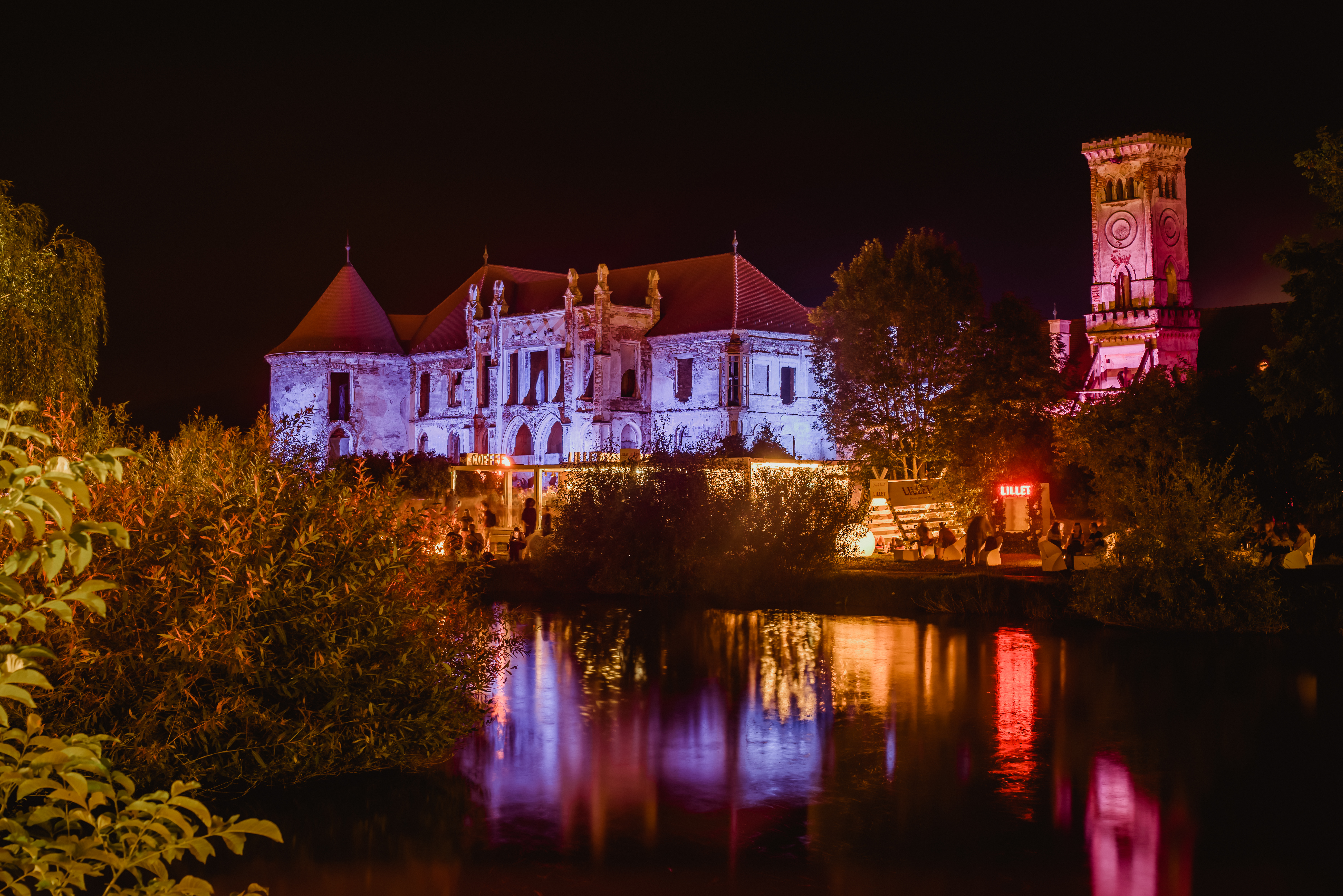
Bontida Banffy Castle
In 1963, a film crew needed a scene with fire. They were shooting Padurea spanzuratilor at Banffy Castle in Bontida, and the scenographers lit one of the buildings for a brief sequence. The flames spread beyond the script. That accidental blaze was only the latest in a long series of destructions visited upon a castle that has been burned, besieged, stripped, repurposed as a driving school, and used as a cooperative farm, yet still refuses to disappear entirely. Banffy Castle has been absorbing punishment since the 17th century, and it has been rebuilding itself for just as long.
A Family's Fortress
The story begins in 1387, when Sigismund of Luxemburg donated the Bontida estate to Denes, son of Tamas Losonci, founding the Banffy family's connection to this land. For two centuries, a manor house occupied the site. Then, after 1640, Denes Banffy II inherited the estate and transformed it into something more formidable. Between 1668 and 1674, he surrounded the manor with curtain walls forming a rectangular enclosure, reinforced at each corner with massive circular towers. A seven-storey gatehouse guarded the eastern approach. Denes was county governor of both Doboka and Kolozs, brother-in-law and counselor to Prince Michael I Apafi, and his castle reflected that political weight. When he died in 1674, his successor Gyorgy Banffy III continued the fortification works, creating a Renaissance ensemble that would soon be tested by real conflict.
Baroque Ambitions
Between 1704 and 1711, Rakoczi's War of Independence swept through the estate, leaving the Renaissance castle in need of serious repair. The reconstruction that followed went far beyond patching walls. Denes Banffy IV had spent time at the Viennese court of Empress Maria Theresa, and when he returned to Bontida in 1747, he brought Austrian Baroque ambitions with him. Over four years, a grand U-shaped cour d'honneur rose on the castle's eastern side, housing a riding school, stables, carriage rooms, and servants' quarters. Along the Somes River, architect Johann Christian Erras designed a 70-hectare park governed by strict geometry, its walkways lined with stone statues carved by sculptor Johann Nachtigall from subjects drawn from the ancient poet Ovid. The castle had become a statement about culture as much as power.
Unraveling
Each generation reshaped the castle according to its own tastes, and each reshaping erased something. In the 1820s, Jozsef Banffy demolished the seven-storey gate tower to unite the Renaissance and Baroque courtyards, using the salvaged stone to build a water mill for Bontida's villagers. In 1850, architect Anton Kagerbauer redesigned the western wing and re-landscaped the park in the English Romantic style. But the 20th century brought destruction on a different scale. Under communism, the castle served as a driving school, a cooperative farm, and a children's hospital. The furniture, library, and gallery of paintings were destroyed. By the time Romania declared Banffy Castle a historic monument in 1990, the building was more ruin than residence.
The Long Rescue
In 1999, the Transylvania Trust placed Banffy Castle on the World Monuments Watch List of 100 Most Endangered Sites. That same year, Romania and Hungary signed a bilateral agreement for restoration. Romanian state funds rebuilt roughly two-thirds of the main building's roof. In 2003, the Transylvania Trust secured a long-term lease, later extended through Katalin Banffy, the castle's current owner, for 49 years. The Built Heritage Conservation Training Centre opened at the castle in 2005, teaching traditional building crafts for the repair of historic structures. In 2008, the program won the Europa Nostra prize for Cultural Heritage education. Charles, Prince of Wales, visited the castle to support the effort, and Princess Margareta of Romania serves as the training centre's patron. Restoration proceeds building by building, craft by craft.
Electricity in the Ruins
Since 2013, each July has brought a transformation that the Banffy family's 17th-century builders could never have predicted. Electric Castle, an annual music festival, fills the grounds with stages, light installations, and tens of thousands of visitors. The contrast is deliberate and striking: electronic music reverberating through half-restored Renaissance walls, laser shows playing across Baroque facades, festival-goers dancing in the shadow of circular defense towers built to repel Ottoman-era raids. The festival has become one of Romania's largest cultural events, and its revenue supports the ongoing restoration. Banffy Castle now earns its survival through the one thing its six centuries of owners could never quite secure: a future that depends not on a single family's fortune but on the public's desire to gather in a place where history is visible in every crumbling wall and every newly laid stone.
From the Air
Located at 46.91N, 23.81E in the village of Bontida, approximately 30 km northeast of Cluj-Napoca. The castle complex is visible from the air as a large rectangular compound with formal gardens near the Somes River. Best viewed below 3,000 feet AGL. Nearest major airport is Cluj-Napoca International (LRCL), about 25 km southwest. The Somes River valley provides a useful visual reference for locating the site.