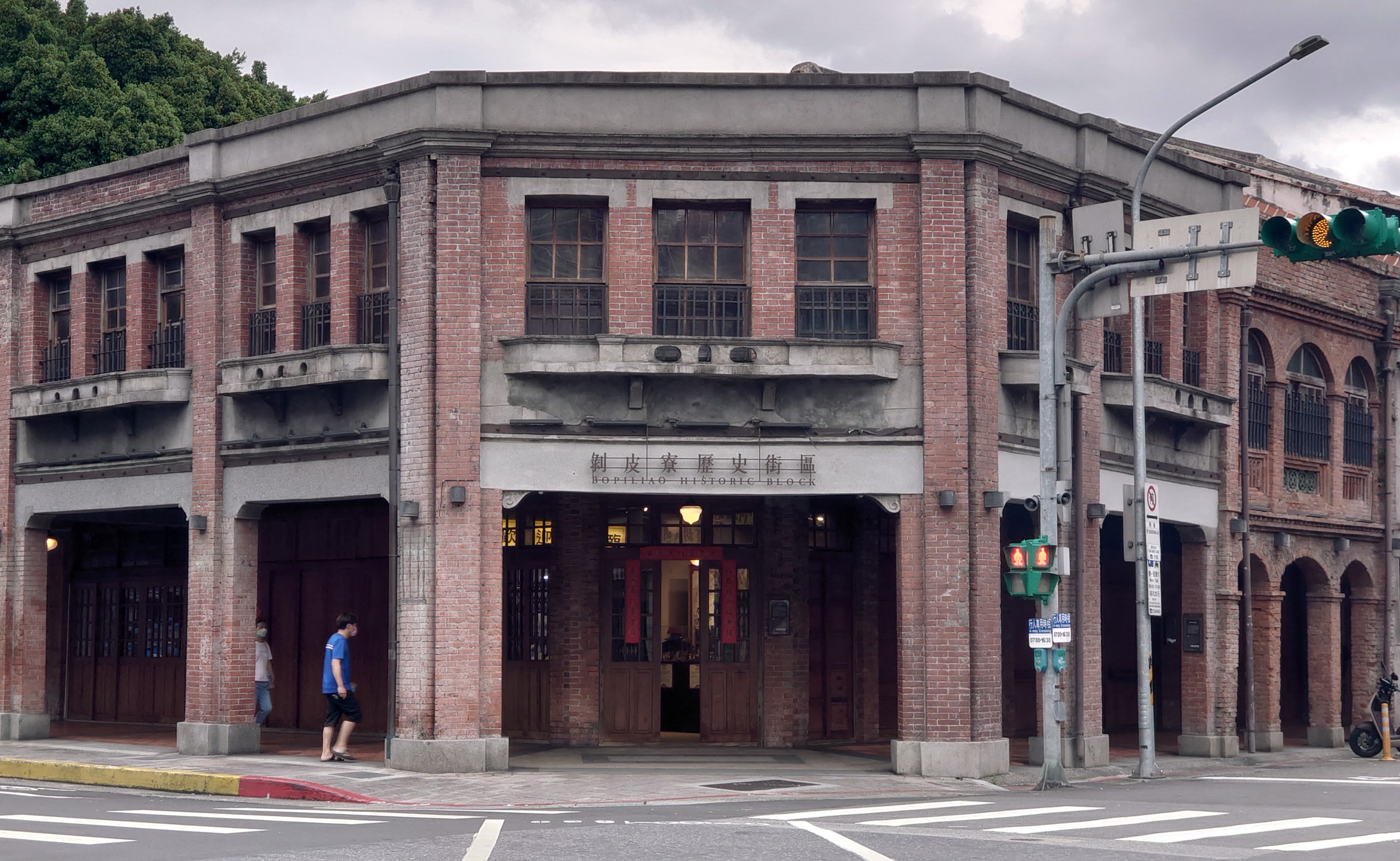
Bopiliao Historic Block
The name tells you everything and nothing. Bopiliao -- literally "stripped skin" in Chinese -- has been explained as a reference to lumber stripping, animal skinning, or tree bark peeling, depending on which historian you ask. What no one disputes is the age of the place. These low brick buildings in Taipei's Wanhua District have stood, in some form, since the early Qing Dynasty, making Bopiliao one of the oldest surviving commercial streets in northern Taiwan. That it survives at all is an accident of bureaucratic neglect and, improbably, a hit movie.
Merchants and Empires
Bopiliao was already a functioning commercial settlement when the Qing Dynasty governed Taiwan. Merchants from the Chinese mainland established shops along what became one of Wanhua's busiest trading corridors. Over the centuries that followed, each successive ruler left marks on the street's architecture. Qing-era red-brick shophouses with narrow frontages and deep interiors stand beside buildings that bear the Western-influenced detailing introduced during Japanese colonial rule. The Japanese also altered the neighborhood's footprint, widening streets and creating a trapezoidal plaza that still exists, along with a fire-fighting reservoir that speaks to the practical concerns of governing a densely packed wooden neighborhood. The architectural result is a compressed timeline of northern Taiwan's colonial history, readable in the brickwork.
The School That Saved a Street
In 1941, the Japanese authorities planned to build Laosong Elementary School in the neighborhood. The decision inadvertently froze the surrounding blocks in place -- construction on adjacent land was restricted, and the buildings that might otherwise have been demolished or modernized simply remained. For decades after the war, the area declined. Shops closed, residents moved out, and the block settled into quiet disrepair. It was precisely this neglect that preserved its architectural diversity. By the time Taipei's city government turned its attention to the area in 1999, the block held an unusually intact collection of buildings spanning the Qing, Japanese, and early Republic of China periods -- a collection that more prosperous neighborhoods had long since demolished in favor of concrete apartments.
Gangsters and Galleries
Restoration work began in 1999 and was completed in 2009, transforming the abandoned block into a cultural hub. But the catalyst that thrust Bopiliao into popular consciousness came from cinema. In 2010, the release of the film Monga -- a gritty drama about gangsters in Wanhua during the 1980s -- drew nationwide attention to the neighborhood and its layered history. Tourists who came for the movie stayed for the architecture. That same year, the Taipei City Government officially designated Bopiliao as a historic site, delineating its boundaries within the Wanhua District. The block was divided into east and west sections, each with a different development strategy: one side focused on cultural heritage education and art exhibitions, the other on commercial revitalization.
Walking Through Centuries
Today Bopiliao hosts rotating art exhibitions, film promotions, and educational programs about Taipei's heritage. The street itself is the primary exhibit -- visitors walk beneath tile roofs and past storefronts that have changed hands dozens of times across three centuries without losing their fundamental character. The one- and two-story brick buildings feel impossibly low against the modern skyline visible above the rooftops, a physical reminder of the scale at which Taipei once operated. The block is accessible from Longshan Temple Station on the Bannan line of the Taipei Metro, placing it within walking distance of another of Wanhua's landmark sites, the Bangka Lungshan Temple. Together they anchor a neighborhood that refuses to let Taipei forget where it started.
From the Air
Coordinates: 25.036N, 121.501E. Located in the Wanhua District of western Taipei, near the Bangka Lungshan Temple area. From altitude, look for the dense, low-rise historic block contrasting with surrounding modern buildings along the Xindian River. Nearby airport: RCSS (Taipei Songshan Airport, ~8 km northeast). Best viewed at 2,000-4,000 feet. The area is near Longshan Temple, another visible landmark.