Borbeck-Mitte
If history had broken slightly differently, Borbeck would be a city. In the years before 1862 it had more than 100,000 inhabitants, the size threshold that German law uses to define a Grossstadt - a major city. Then Prussia carved most of it up. Lipperheide and Lirich went to the new city of Oberhausen. Altendorf, Frohnhausen, and Holsterhausen formed their own administrative district. What was left still had over 70,000 people, which made it the largest administrative district in all of Prussia without town privileges - a strange limbo of being large enough to matter but not officially a town. In 1915 it was incorporated into Essen. Borbeck-Mitte is what remains: the old village center at the heart of the lost city.
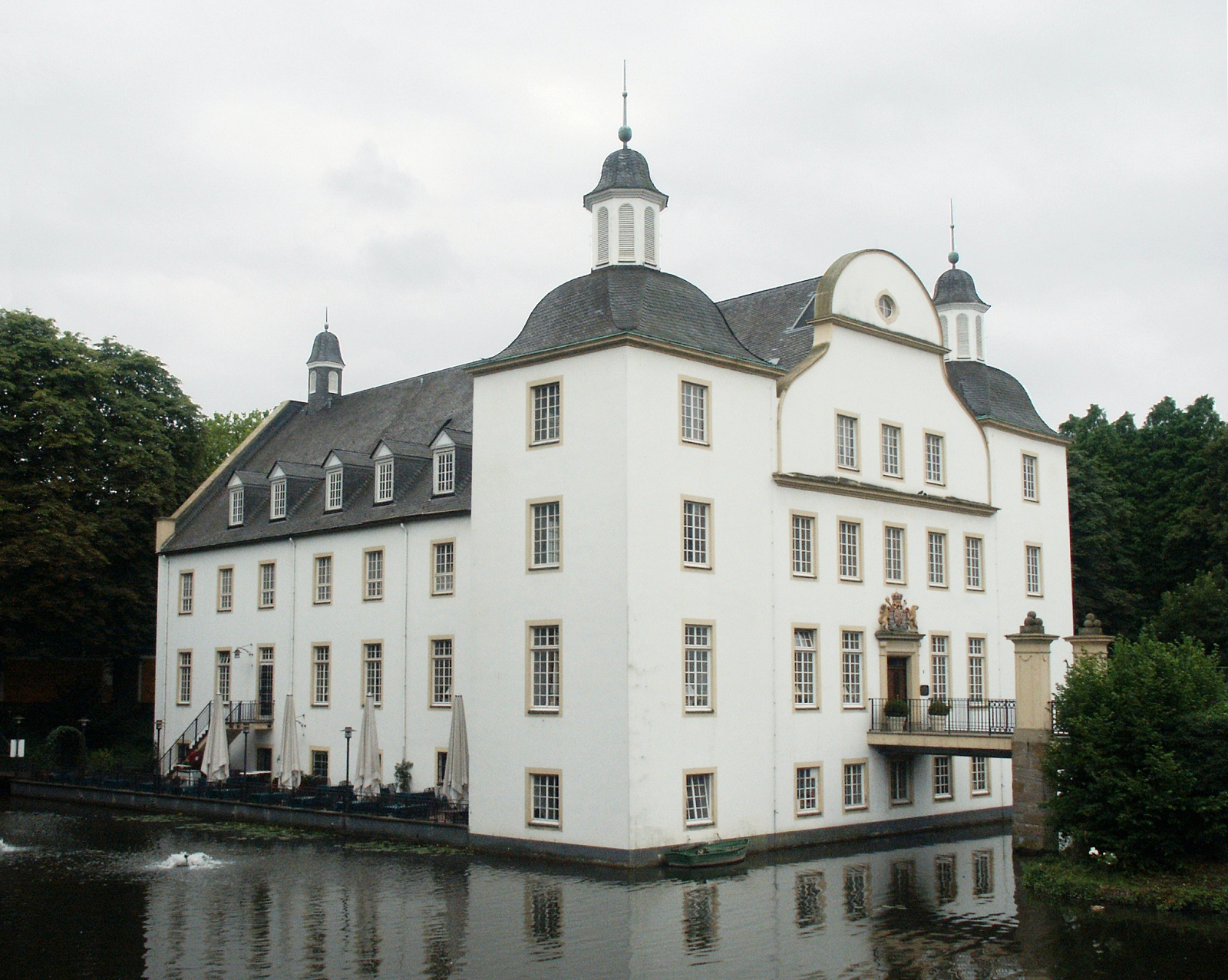
The Abbesses' Castle
The first written mention of the place is from 869, when a small farming commune called Borthbeki appears in the tax records of Essen Abbey, one of nine communes liable for payments to the abbess. The name itself probably means river in a fertile lowland - or, by another reading, river of the Bructeri, the Germanic tribe that once lived along this stretch of the Ruhr. In 1288 the princess-abbess Berta von Arnsberg bought back what were probably mortgaged parcels of the region and built the predecessor of Schloss Borbeck. By the 14th century the moated castle had become the favorite residence of the princess-abbesses of Essen, who governed both spiritual and worldly affairs across a substantial territory. In 1339 the abbess Katharina von der Mark had Borbeck's old Romanesque church remodeled so that she and her entourage could attend mass without inconvenience. When the abbey was dissolved in 1803, the castle stayed.
Coal and Industry
Napoleon's France held Borbeck briefly - it was a French municipality from 1808 - and then the Congress of Vienna gave it to Prussia in 1815. The year without a summer in 1816 brought the last famine the region would know; recovery took until 1819. Then came coal. Industrialization arrived in the 1840s, mine shafts opened across the broader district, and unemployed workers poured in. The population swelled until the great administrative dismemberments of 1862 and 1874 cut Borbeck back to its current shape. Even diminished, it was big. When Essen finally absorbed it in 1915, Buergermeister Rudolf Heinrich used Borbeck's size as leverage - one of the concessions he extracted from Essen was a promise to build a public indoor swimming pool if the new district ever broke 100,000 inhabitants again. The pool, eventually, was built.
The Half-Long Trousers
On one corner of the new market place stands a fountain that commemorates a habit. Across the Ruhr Area the practice is known as Borbecker Halblang, which translates roughly as Borbeck's half-long: the local custom of shortening old trousers for the summer months, or buying clothes a few sizes too large so children could grow into them. It is the kind of thrifty, slightly self-deprecating gesture that defines a working-class district aware of where its money goes. The fountain treats the habit affectionately. Other Borbeck inventions are similarly grounded. The steam beer brewery near the train station, founded in 1896 on the premises of the old castle brewery, was eventually absorbed by the Stauder group in the 1990s. Brewing moved to Stauder's main plant. The building stayed - now a restaurant popular for class reunions and corporate events from around the area.
Schloss Borbeck Today
The castle is now the central cultural institution of both the borough and the broader district. Run by the cultural office of the city of Essen, it hosts exhibitions and concerts, and since 2006 has held a permanent exhibition on the history of the abbey and the city it once governed. Essen's public music school has taught classes there since 1999. The register office uses one of the rooms for marriages. Around the castle spreads a 55-hectare park - the largest in northwestern Essen - cut in two by a street that separates a small section of hilly lawns and a former boxing arena, now used for concerts, from the main grounds. The Alte Cuesterey near the central market place houses a small museum maintained by the cultural historical society.
Local Life
About 13,500 people live in Borbeck-Mitte today, in 3.19 square kilometers - a dense small district at the heart of Stadtbezirk IV. The central pedestrian precinct hosts a street market on Tuesdays and Fridays. A weekly local paper, Borbecker Nachrichten, has reported on the district's news since 1949; once it was the largest local newspaper in Germany, and it stayed independent until 2000, when the Essen-based WAZ-Mediengruppe bought it. The district has a hospital, a local court, a public library branch, and an unusual concentration of secondary schools, including the Maedchengymnasium Borbeck - the only public Gymnasium for girls only in all of North Rhine-Westphalia. Six carnival associations and six sport-shooting clubs keep the calendar full. It is still, in essence, the place it has been for centuries: the old center of a town that grew up around an abbess's castle and now belongs to Essen.
From the Air
Borbeck-Mitte sits at 51.48 N, 6.95 E in the northwestern corner of Essen, in the central Ruhr Area. From the air it appears as a dense district at the western edge of the Essen built-up zone, with the green wedge of Schlosspark Borbeck visible to the southwest of the central market. The terrain is gently undulating Ruhr lowland, drained by small streams that gave the place its name. Nearest airports: Duesseldorf (EDDL) 25 km south, Dortmund (EDLW) 45 km east, Niederrhein/Weeze (EDLV) 50 km northwest, Cologne/Bonn (EDDK) 70 km south. Best viewed at 2,000-3,000 ft; look for the railway line running northeast through the district, the dark green block of Schlosspark, and the moated outline of Schloss Borbeck on its eastern edge.