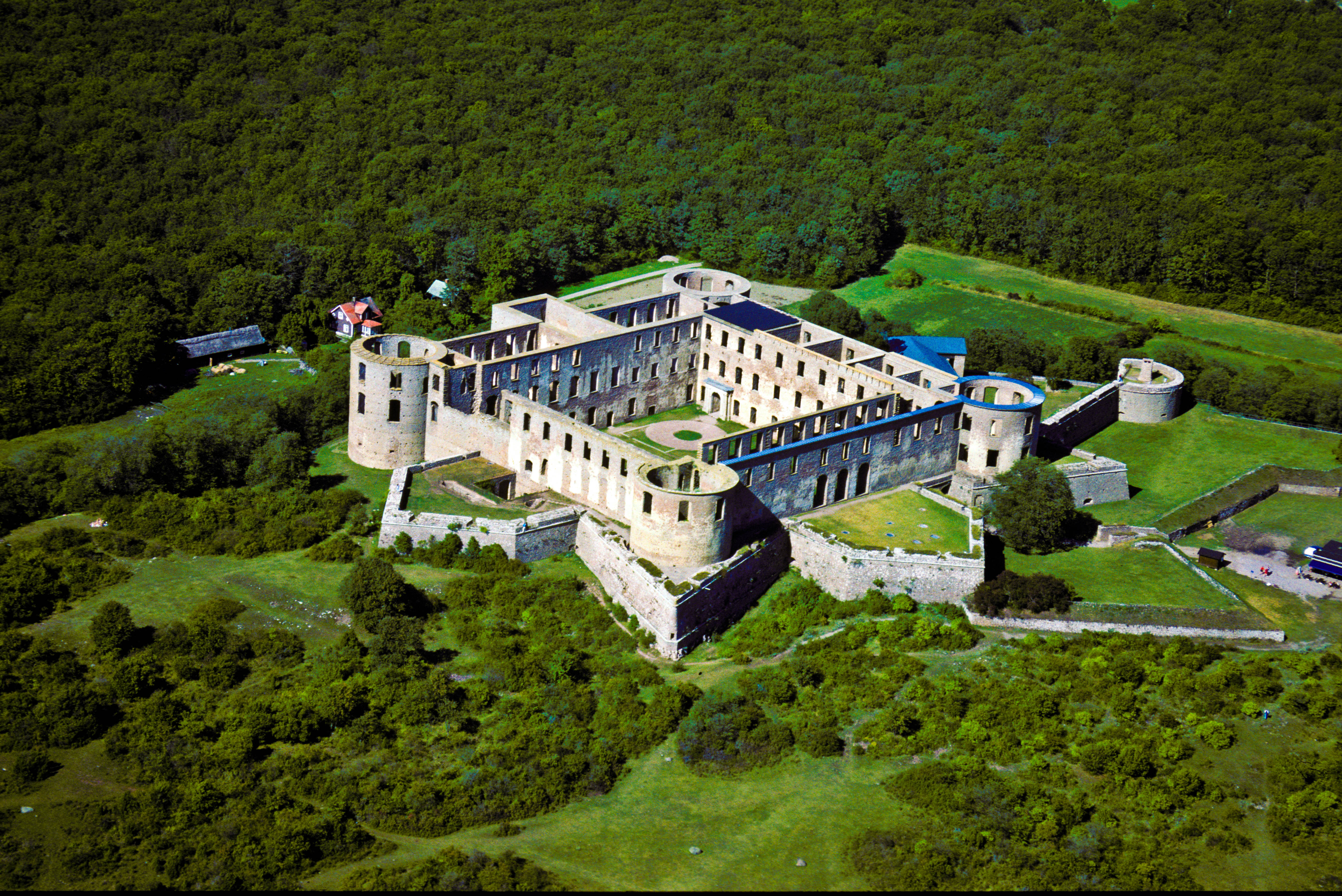
Borgholm Castle
In 1989, Swedish pop duo Roxette filmed the music video for 'Listen to Your Heart' inside a castle that had been roofless for nearly two centuries. The song became a number-one hit on the Billboard Hot 100. Twelve years later, Bob Dylan performed in the same courtyard, his voice echoing off walls that once sheltered kings but now frame only the Oland sky. Borgholm Castle has spent more time as a ruin than it ever did as a functioning fortress, yet this skeletal palace on Sweden's eastern coast may be more alive today than during its centuries of royal service.
Eight Centuries of Rebuilding
The fortress began sometime in the late 12th century, probably ordered by King Canute I, who reigned from 1167 to 1195 and built defenses along Sweden's east coast against Baltic Sea raiders. Over the following three hundred years, towers rose, walls thickened, and enemies arrived. In 1361, Denmark's King Valdemar IV attacked Borgholm during his campaign that would see him conquer Gotland. The castle changed hands, suffered damage, and was rebuilt in an endless cycle that characterized Swedish fortifications during the tumultuous Kalmar Union, when Danes and Swedes fought for control of the Scandinavian crowns.
The Milanese Touch
When Gustav Eriksson dissolved the Kalmar Union and became Sweden's king, he and his successors poured money into repairing their battered fortresses. Gustav's son John III commissioned the most dramatic transformation of Borgholm. In 1572, the Pahr brothers, four engineers and architects from Milan, began converting the medieval stronghold into a Renaissance castle. Under their direction, Borgholm acquired Gothic character and became exemplary of the Italianate bastion style, with elegant proportions that belied its military purpose. Italian hands had shaped Swedish stone into something new.
Conquest and Reconquest
The Kalmar War between Sweden and Denmark reached Borgholm in 1611. The castle surrendered to Danish forces, was reconquered by Swedes that same year, then fell again after a two-week siege in 1612 when commander Peter Michelsen Hammerskiold had no choice but to yield. The Treaty of Knaered returned Borgholm to Swedish control, but the fortress emerged from the war in terrible condition. More than four decades passed before anyone attempted restoration. When King Charles X Gustav finally ordered work to begin in 1654, he had grander ambitions than mere repair: Borgholm would become a baroque palace.
A Palace Born Too Late
Architect Nicodemus Tessin the Elder received the commission to transform Borgholm into royal splendor. When Charles X Gustav died in 1660, construction halted. Work resumed at a glacial pace under Charles XI and Charles XII, finally reaching completion in 1709. The baroque palace stood magnificent on its promontory above the Baltic, the culmination of five centuries of building and rebuilding. Then nothing happened. No royal residence, no grand events, just a hundred years of slow decay. On October 14, 1806, fire broke out in the roof of the north wing. By the time the flames died, Borgholm had become what it remains today: a ruin.
Open to the Sky
The National Property Board of Sweden now manages the castle's remains, and those remains have found an unexpected second life. The roofless inner courtyard, with its exposed stone walls and view of clouds passing overhead, creates a natural amphitheater unlike any concert hall. Theater performances unfold against authentic medieval backdrops. Summer concerts bring contemporary music into spaces where Swedish kings once walked. The fire that destroyed Borgholm's function as a palace may have given it a more enduring purpose. Walls that failed to keep out Danish armies and Baltic weather now welcome thousands of visitors each year who come to see what beautiful ruin looks like.
From the Air
Located at 56.87N, 16.64E on the western coast of Oland, Sweden's second-largest island. The castle ruins sit prominently on elevated ground near the town of Borgholm and are easily visible from the air as a large rectangular structure with intact outer walls but no roof. Nearest airport is Kalmar (ESMQ) on the Swedish mainland, connected to Oland by the Oland Bridge. The long, narrow island stretches north-south in the Baltic, with the Swedish coastline visible to the west across the Kalmar Strait.