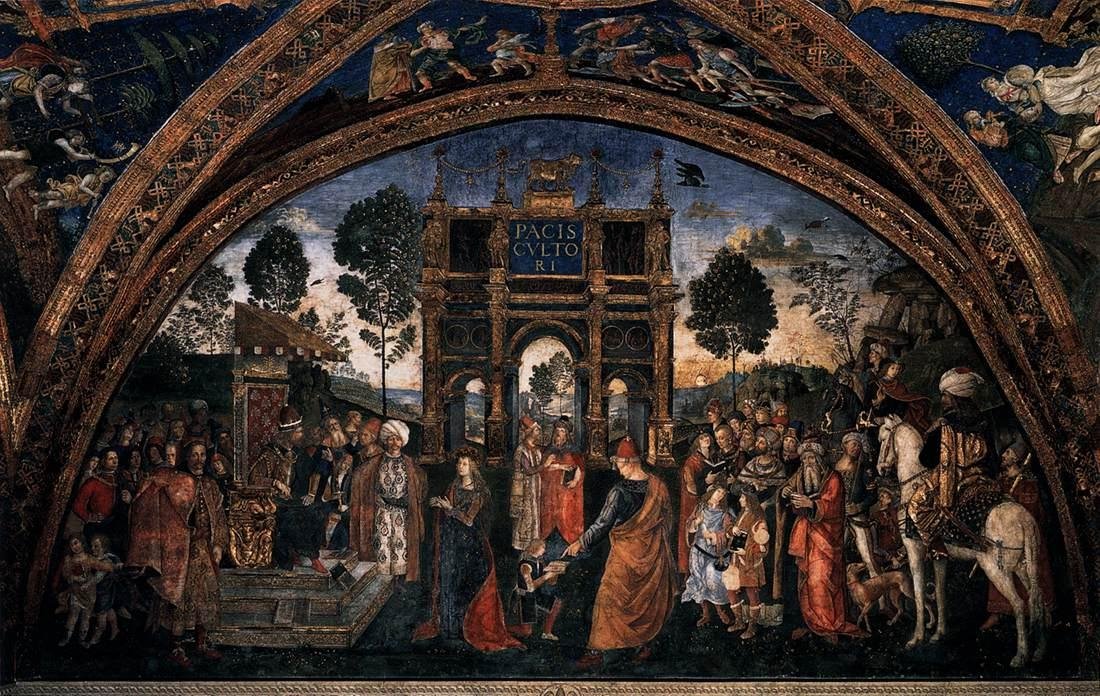
Borgia Apartments
The next pope would not even enter the rooms. When Julius II succeeded Alexander VI in 1503, he abandoned the lavishly frescoed apartments on the palace's lower floors and moved his daily operations upstairs - to rooms that would eventually be painted by Raphael. The Borgia Apartments sat empty, their walls covered in some of the most ambitious frescoes of the late fifteenth century, sealed away not because they lacked beauty but because the name Borgia had become synonymous with corruption, nepotism, and murder. It took nearly four hundred years before another pope, Leo XIII, opened the doors again in 1889.
Pinturicchio's Commission
Between 1492 and 1494, the painter Bernardino di Betto - known as Pinturicchio - and his workshop covered the apartment walls and vaulted ceilings with an elaborate fresco cycle. Pope Alexander VI, born Rodrigo de Borja into the Spanish-Valencian family that Italians called Borgia, wanted something more than decoration. The iconographic program drew on medieval encyclopedias and layered in eschatological themes, all designed to celebrate the supposedly divine origins of the Borgia family. Five of the six rooms feature frescoes in their vaults, with paintings in the upper registers and the lower walls decorated with tapestries and gold. The result was a private world where theology, astrology, and dynastic propaganda fused into a single visual argument for Borgia supremacy.
Sibyls, Stars, and Sacred Forgeries
The Room of the Sibyls gives astrology pride of place - not unusual for Renaissance popes, many of whom took celestial guidance seriously. Pinturicchio painted the sibyls holding scrolls that prophesy the coming of Christ, linking pagan prophecy to Christian fulfillment. Much of the apartment's intellectual framework may have come from Annio da Viterbo, a Dominican friar and humanist who served as master of the papal palace. Annio was also a prolific forger of ancient texts, fabricating documents that conveniently supported the historical narratives his patrons preferred. Whether Alexander VI knew or cared about the authenticity of Annio's sources is unclear. What mattered was the story the rooms told: that the Borgias descended from a lineage blessed by God and foretold by prophets.
From Osiris to the Apostles
The range of the frescoes is extraordinary. The ceiling vaults trace a narrative from ancient Egypt - depicting Osiris's teachings, his marriage to Isis, and his murder by Typhon - through to Christian revelation. The Room of the Creed pairs each of the twelve apostles with an Old Testament prophet, their scrolls bearing the verses of the Apostles' Creed. The Room of the Mysteries unfolds scenes from the life of the Virgin Mary and Christ: the Annunciation, the Nativity, the Adoration of the Magi, the Resurrection. Alexander VI, a devoted follower of the Virgin Mary, had himself painted into the Resurrection scene, kneeling at Christ's feet. Heraldic details of the Borgia coat of arms appear throughout - the double crown of Aragon and Sicily, a crimson flame, an ox, a sun. Cicero accompanies Rhetoric; Euclid extols Geometry. The apartments are simultaneously a chapel, a classroom, and a political manifesto rendered in plaster and pigment.
The Rooms Upstairs
Alexander VI died in August 1503, and the Borgia name became toxic almost overnight. Julius II, his successor, loathed everything associated with the family and moved to the upper floor of the palace. There he commissioned a young painter named Raphael to decorate the rooms that would become the Stanze di Raffaello - among the most celebrated works in Western art. The Borgia Apartments below became a kind of sealed tomb, visited occasionally but never inhabited. When Leo XIII finally ordered their restoration and opened them to the public in 1889, workers repaired plaster and stucco, cleaned centuries of grime from the frescoes, and reworked damaged surfaces. The apartments are now considered part of the Vatican Library's collections. Visitors who make the effort to seek them out - they are less famous than the Raphael Rooms or the Sistine Chapel - find themselves in spaces where the ambitions of a single family produced art that outlasted the scandal of the family itself.
From the Air
Located at 41.90N, 12.46E within Vatican City. The Apostolic Palace is part of the large Vatican complex visible northwest of central Rome, adjacent to St. Peter's Basilica. Fiumicino Airport (LIRF) is approximately 25 km to the southwest. Ciampino Airport (LIRA) is about 20 km southeast. The Vatican complex is identifiable from altitude by St. Peter's Square and the distinctive dome of the basilica.