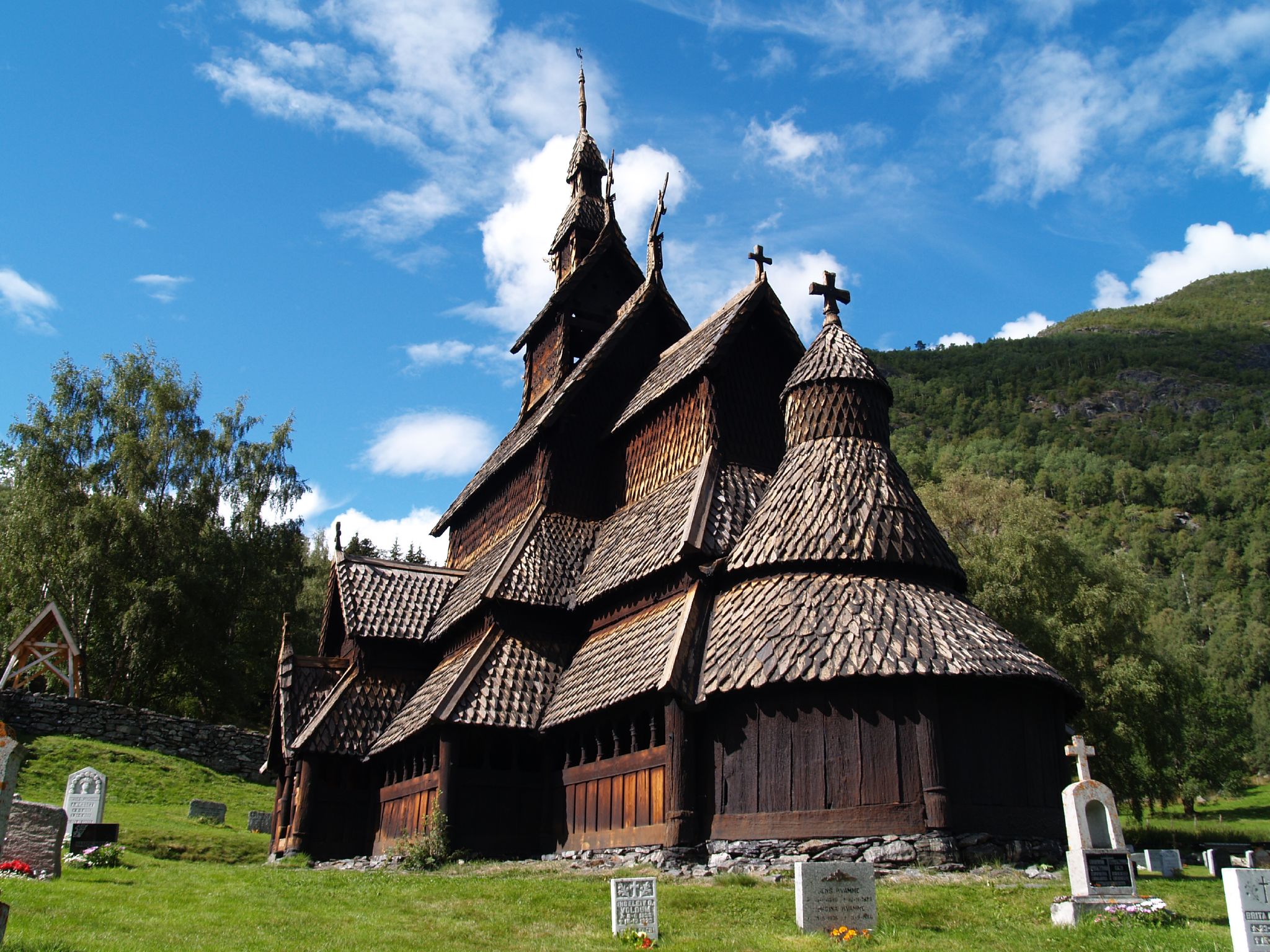
Borgund Stave Church
Scratched into the interior wall of a medieval wooden church in a narrow valley in western Norway is a runic inscription left by a man named Thorir. Written "in the evening at St. Olav's Mass," it blames the Norns, the female beings of Norse mythology who controlled personal destiny, for his misfortunes. The inscription dates to the Middle Ages, centuries after Christianity had officially replaced the old religion in Norway, yet here was a churchgoer hedging his theological bets, invoking pagan fate-goddesses inside a Christian sanctuary. Borgund Stave Church, where Thorir carved his complaint, has stood in the Laerdal valley since approximately 1200 AD. Built from vertical pine timbers blackened with protective tar, its tiered rooflines stacked like a dark wooden wedding cake, the church is the best-preserved of Norway's 28 surviving stave churches. It has not held regular services since 1868, when a newer church was built nearby. But it has held the attention of anyone who has stood inside its dim nave, surrounded by eight centuries of woodcraft, and wondered how pagan and Christian traditions could inhabit the same building.
A Cube Within a Cube
The engineering of Borgund is deceptively sophisticated. Structurally, the building has been described as a cube within a cube, each independent of the other. The inner structure consists of twelve free-standing columns that rise from ground level to support the roof. These columns are linked by arched buttresses and diagonal cross-braces called Saint Andrew's crosses, which carry the visual impression of a second story, though no functional gallery exists above. The walls are formed from vertical planks, or staves, each tongued and grooved to interlock with its neighbors. The staves rise from horizontal ground sills resting on a stone foundation, a critical detail that keeps the wood from direct contact with the damp earth. The steeply pitched roof uses scissor trusses that form an X-shape, distributing weight through the buttresses and columns rather than pushing outward against the walls. The entire exterior is weatherproofed with tar distilled from pine, giving the church its signature dark appearance.
Guardians on the Gables
Four dragon heads swoop from the carved ridge crests of Borgund's gables, their open mouths facing outward as if daring something to approach. Art historians note their resemblance to the carved prows of Norse longships, a visual connection between two of the Viking Age's most ambitious woodworking traditions. The current heads are likely 18th-century replacements, but Borgund is one of the only stave churches to have preserved its crested ridge caps at all. Below the tower, four carved circular cutouts remain difficult to decipher after centuries of tar and weather. Some scholars interpret them as symbols of the four Evangelists: eagle, ox, lion, and man. Others see more dragons biting into each other. The west portal, the main entrance, is framed by an elaborate carving of intertwined dragons seizing each other by neck and tail, with vine stalks sprouting from dragon mouths at the base of the flanking half-columns. Whether protective or cautionary, the carvings sit at the threshold between outside and inside, pagan and Christian, chaos and order.
The Stripped Interior
Step inside Borgund and the first thing you notice is how little is there. Most of the furnishings have been removed. A soapstone baptismal font, a medieval stone altar, a 17th-century altarpiece showing the Crucifixion flanked by the Virgin Mary and John the Baptist, a pulpit from the 1550s, and the original wooden floor with benches running along the nave walls: that is nearly all. In the 1870s, architect Christian Christie led a restoration intended to return the church to its pre-Reformation condition, stripping out the pews, second-floor gallery, ceiling, windows, and interior paintwork added after Protestantism arrived in Norway in the 1530s. What remains is the medieval skeleton, barely lit by eight small windows on the north and south walls. Inauguration crosses are still visible on the south wall's interior. And then there are the antlers. Photographs from the 1990s show deer antlers hung on the lower pillars, said to be all that remains of a whole stuffed reindeer, shot when it allegedly tried to enter during a Mass. A 1668 travelogue confirms the story, noting the animal "marched like a wizard in front of the other animal carcasses."
A Bell Tower and a Global Legacy
South of the church stands Norway's only surviving free-standing stave-work bell tower, built in the mid-13th century. It covers the remnants of the medieval foundry where the church bell was cast, a foundry pit that was left exposed for decades after an old door was removed and never replaced. New cladding walls were built around the tower's exterior in the 1990s to protect what remained. Borgund's influence extends far beyond its valley. The Fantoft Stave Church near Bergen was reconstructed using Borgund as a model in 1883, and again after it was destroyed by arson in 1992. The Gustav Adolf Stave Church in Hahnenklee, Germany, built in 1908, is explicitly modeled on Borgund. Four replicas exist in the United States: in Rapid City, South Dakota; Lyme, Connecticut; Washington Island, Wisconsin; and Minot, North Dakota. The building that Thorir once carved his complaint into has become Norway's most recognizable medieval structure, owned and maintained by the Society for the Preservation of Ancient Norwegian Monuments since the 19th century.
From the Air
Located at 61.05N, 7.81E in Laerdal Municipality, Vestland county. The church sits in the Laerdal valley (Laerdalen) along the route between the Sognefjord and mountain passes to eastern Norway. From the air, look for a dark-timbered structure with distinctive tiered rooflines beside a modern white church and visitor center. Nearest airports: Sogndal/Haukasen (ENSG) approximately 35 km northwest, Bergen/Flesland (ENBR) approximately 175 km southwest. Best viewed at low altitude in clear conditions; the valley is narrow with surrounding mountains.