Borne
Sixteen silver coins, each stamped with the profile of Charlemagne. A sword. A lance. A suit of armor. And the bones of the man who carried all of it into a grave near two ninth-century farmhouses on the edge of what is now Borne. The objects sat in the eastern Dutch soil for roughly a thousand years before archaeologists pulled them back into daylight, and they fundamentally changed what anyone knew about this quiet corner of Twente. The townspeople of Borne carry a different inheritance though, one that has nothing to do with warriors. They are still called Melbuul - flour bag - in the Tweants dialect, a nickname that hints at a town built on grain rather than glory.
Melbuul Country
Long before factories and motorways, Borne was a community of rye and buckwheat farmers working plaggen soil - the slow, deliberate Dutch invention of stacking sods of heather and manure on fields for generations until the topsoil itself became a built thing, an inheritance you could measure in centuries. Cattle grazed the commons. Earthen walls called landweren, overgrown with blackthorn and blackberry, ran through the landscape as living border fences, and a few of those green ridges are still visible today if you know where to look. The flour bag nickname came out of that agricultural world, and the people of Borne have kept it. It is the kind of name a town only earns when its neighbors have decided that what it does best is feed everyone.
The Meijershof and the Abbot
Borne first appears in writing in 1142, when the Meijershof - a manor at the heart of the early village - passed into the hands of the abbot of Ruinen. From that moment, the town has a paper trail. Around the Meijershof clustered a richterambt, a judicial district that gathered the marken of Senderen and Bi den Broeke and the hamlet of Hertme under one administrative roof. Hertme broke free in 1655 to become its own marke, the kind of slow constitutional drift that defined village life in the eastern Netherlands. Bornerbroek slipped away later, absorbed by neighboring Almelo in 2001. What remains today is a municipality of about 23,000 people - Borne proper, Hertme, Zenderen, and a slice of Azelo - tucked between Hengelo, Almelo, and the wider Twente plain.
The Town That Sends Athletes
For a place this size, Borne keeps producing people who end up on world stages. The swimmer Marleen Veldhuis grew up here and went on to win medals at three consecutive Summer Olympics - Athens 2004, Beijing 2008, and London 2012. The footballers Wout Weghorst and Mats Wieffer both came out of Borne and both wear the orange of the Dutch national team. Florien Reesink, born in 1998, plays professional volleyball in the German Bundesliga and competed in Paris in 2024. The cyclist Henk Nieuwkamp raced at the 1968 Mexico City Olympics. Pieter Omtzigt, one of the most consequential Dutch politicians of his generation, grew up here too. Something about the town, the schools, the local clubs - something - has a strange habit of sending its children very far from home.
Crossroads in the Plain
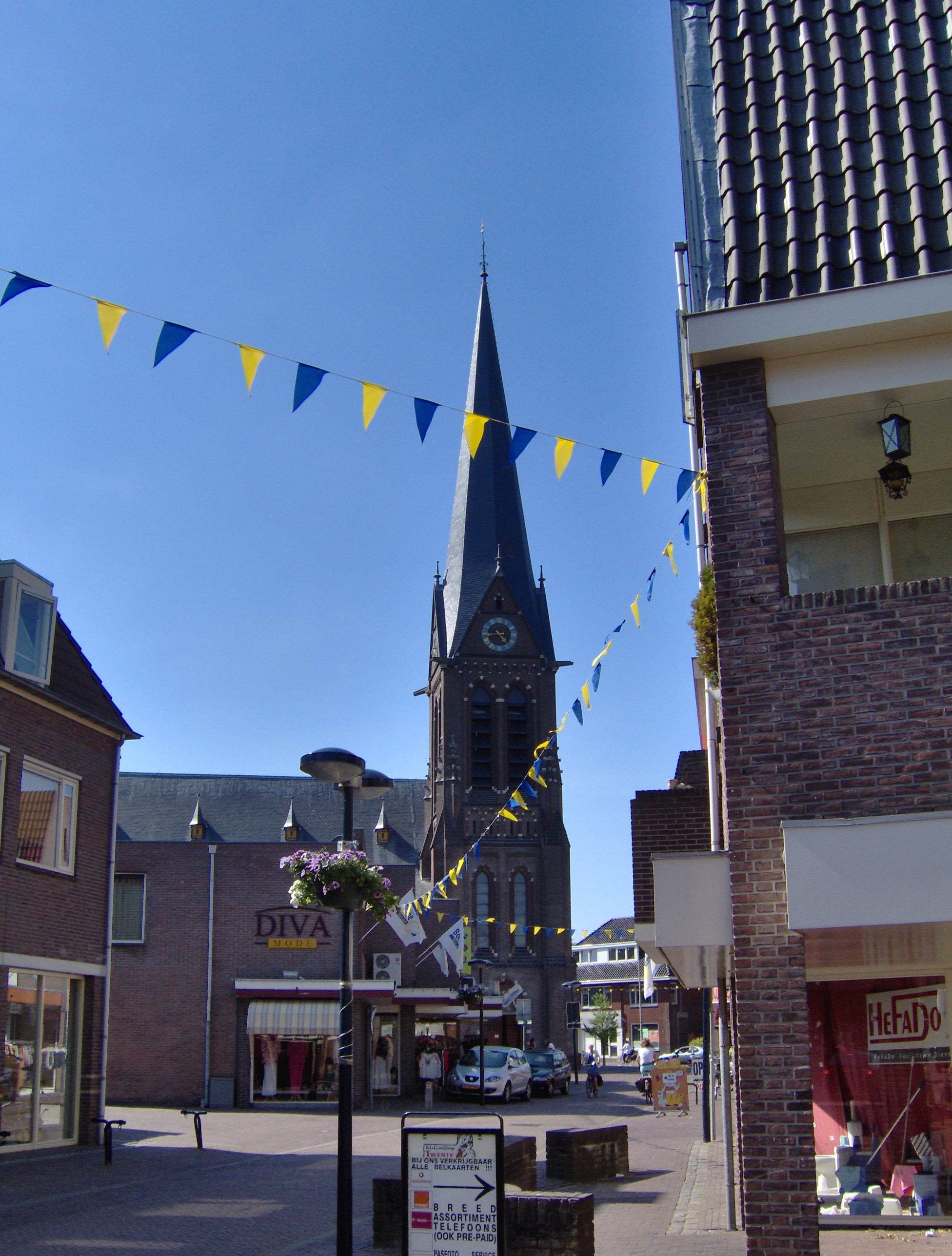
Today Borne sits at the intersection of two motorways and a railway line, which is what gives the town its modern character: a small place at a junction. The Sint Stephanuskerk rises over the old center, the synagogue still stands as a memorial to a Jewish community that did not survive the war, and the regional cycle network threads through quiet streets toward Hengelo and Almelo. From the air, you see the pattern of an old farming village swallowed gently by infrastructure - the geometry of fields giving way to the geometry of roads, the Meijershof's ghost still legible in the bend of a lane.
From the Air
Located at 52.30 degrees north, 6.75 degrees east, in the Dutch Twente region near the German border. Cruising over the eastern Netherlands at FL350, look for the urban cluster of Hengelo immediately to the southeast and Almelo to the northwest - Borne sits in the gap between them. The nearest major airport is Munster Osnabruck (EDDG), about 75 km east. Enschede Airport Twente (EHTW) lies 15 km southeast; the disused runway is still clearly visible. Schiphol (EHAM) is roughly 150 km west. Weather is typical maritime continental: oceanic climate with frequent low stratus, often clearing by midday in summer.