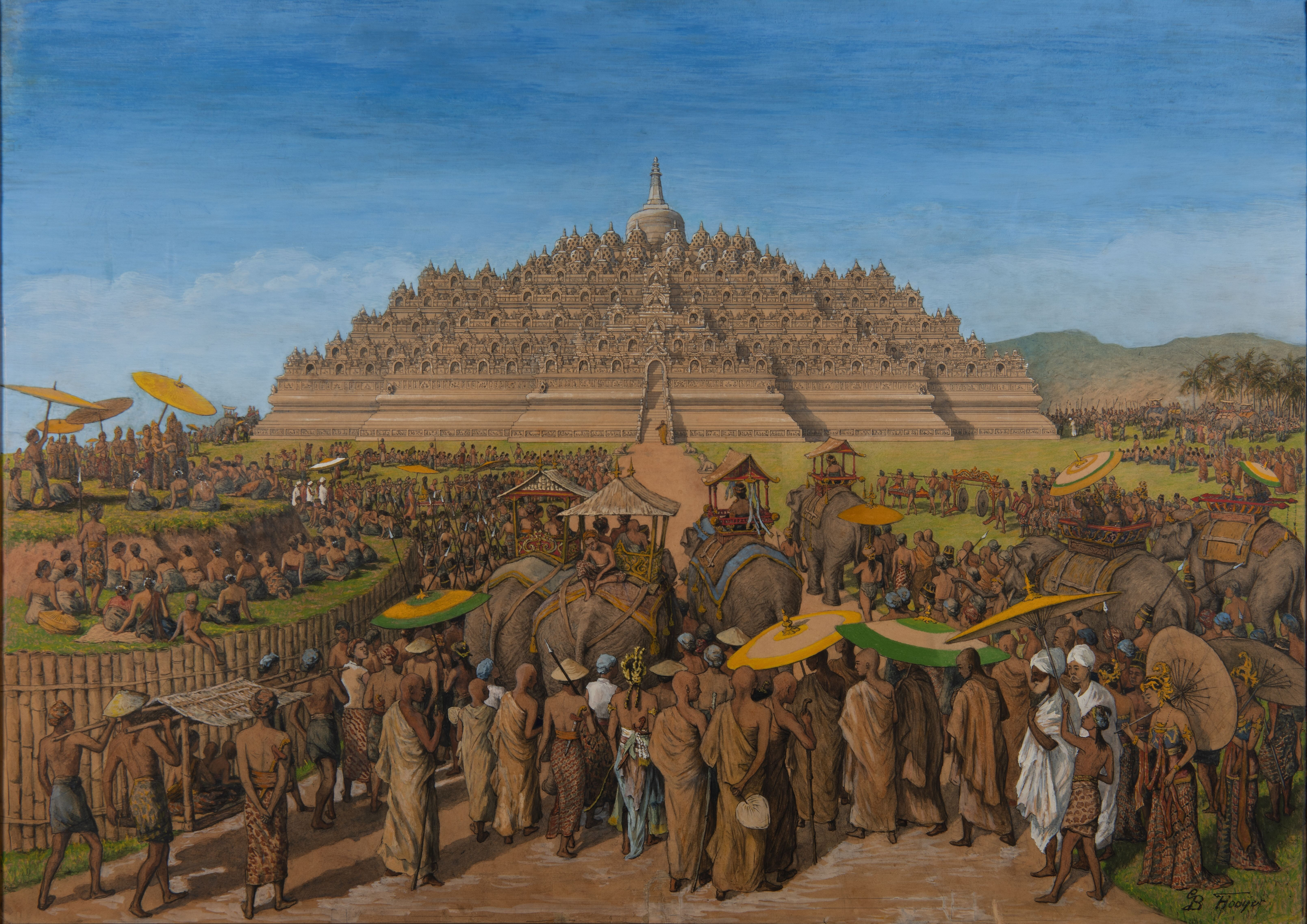
Borobudur: The Temple That Slept Under Volcanic Ash for 1,000 Years
Borobudur is a monument to impermanence. Built in the 9th century as the world's largest Buddhist temple, it was abandoned within 200 years after volcanic eruptions and the shift to Islam in Java. Jungle consumed it. Volcanic ash buried it. For a thousand years, the temple slept. In 1814, a British colonial administrator heard rumors of a mountain of carved stone in the jungle. What he found was 2 million stone blocks, 504 Buddha statues, and 2,672 relief panels - an entire cosmology rendered in stone, waiting to be rediscovered.
The Construction
The Sailendra dynasty built Borobudur between about 780 and 840 AD, during a flourishing of Buddhist culture in Java. The monument is built on a hill, with 2 million blocks of volcanic stone stacked without mortar. The structure rises 115 feet through nine platforms - six square and three circular - representing the Buddhist path from earthly existence to enlightenment.
The labor was immense: cutting, transporting, carving, and assembling millions of stone blocks using only human labor and simple tools. The project took approximately 75 years. Then, around 1000 AD, the temple was abandoned. Volcanic eruptions may have made the area uninhabitable. The rise of Islam in Java ended Buddhist patronage. Whatever the cause, Borobudur was left to the jungle.
The Journey
Borobudur is designed as a physical metaphor for the Buddhist path to enlightenment. Pilgrims begin at the base, walking clockwise through narrow corridors lined with narrative reliefs. The lower levels depict the world of desire - scenes of daily life, karma, and rebirth.
Rising through the monument, the reliefs tell the life of Buddha and stories of bodhisattvas. The upper square terraces represent the world of form. The three circular terraces at the top, with their perforated stupas containing Buddha statues, represent the formless realm. At the summit, an empty central stupa symbolizes the ultimate goal: emptiness and enlightenment.
The Reliefs
Borobudur contains 2,672 relief panels carved into its stone walls - the largest collection of Buddhist reliefs in the world. They stretch for 3 miles if laid end to end. The carvings depict not just religious narratives but daily life in 9th-century Java: ships, houses, musical instruments, and plants that help archaeologists understand the period.
The hidden base - now covered by a stone casing added for structural support - contains 160 additional panels depicting the realm of desire, including scenes of hell. These were discovered in 1885 when the casing was temporarily removed for documentation. They show suffering: torture, punishment, the consequences of bad karma.
The Rediscovery
When Thomas Stamford Raffles governed Java during British occupation (1811-1816), he heard rumors of a massive ruin in the jungle. In 1814, he sent an expedition that found Borobudur buried under volcanic ash and vegetation. Raffles began the first documentation.
Decades of colonial 'restoration' followed, some helpful, some destructive. Stones were rearranged incorrectly. Reliefs were damaged. Buddha heads were stolen and sold to collectors worldwide. Serious scientific restoration began in 1907 and continued sporadically until a UNESCO-led project in 1975-1982 dismantled and rebuilt the monument, solving drainage problems that had caused structural damage.
The Revival
Today, Borobudur is a UNESCO World Heritage Site and Indonesia's most visited tourist attraction. Over 4 million people visit annually. The temple is again an active place of worship - Buddhists celebrate Vesak there each year with candlelit processions.
But Borobudur faces new threats. Air pollution from nearby cities is corroding the stone. Volcanic activity from Mount Merapi, 28 kilometers away, deposits acidic ash. Climate change brings more intense rainfall that erodes carvings. The temple that slept for a thousand years needs constant care to survive its rediscovery.
From the Air
Borobudur (7.61S, 110.20E) sits in central Java, Indonesia, 40km northwest of Yogyakarta. Adisucipto International Airport (WARJ) is 40km southeast. The temple is visible from the air as a stepped pyramid rising from flat agricultural land. Mount Merapi volcano is visible 28km to the east. The surrounding landscape is green rice paddies and palm trees. Weather is tropical - hot and humid year-round, with rainy season November to March.