Borre Mound Cemetery
Road builders started it. In 1851, workers quarrying gravel from one of the large mounds at Borre discovered they were digging through a richly furnished grave built around a Viking ship. By the time antiquarian Nicolay Nicolaysen arrived to examine what remained, much of the burial had been destroyed. What survived, however, was extraordinary -- weapons, riding equipment, and decorative metalwork so distinctive that it gave its name to an entire artistic tradition. The Borre style, with its intricate animal and knot ornaments, is now recognized as one of the signature aesthetics of the Viking Age.
A Power Center on the Fjord
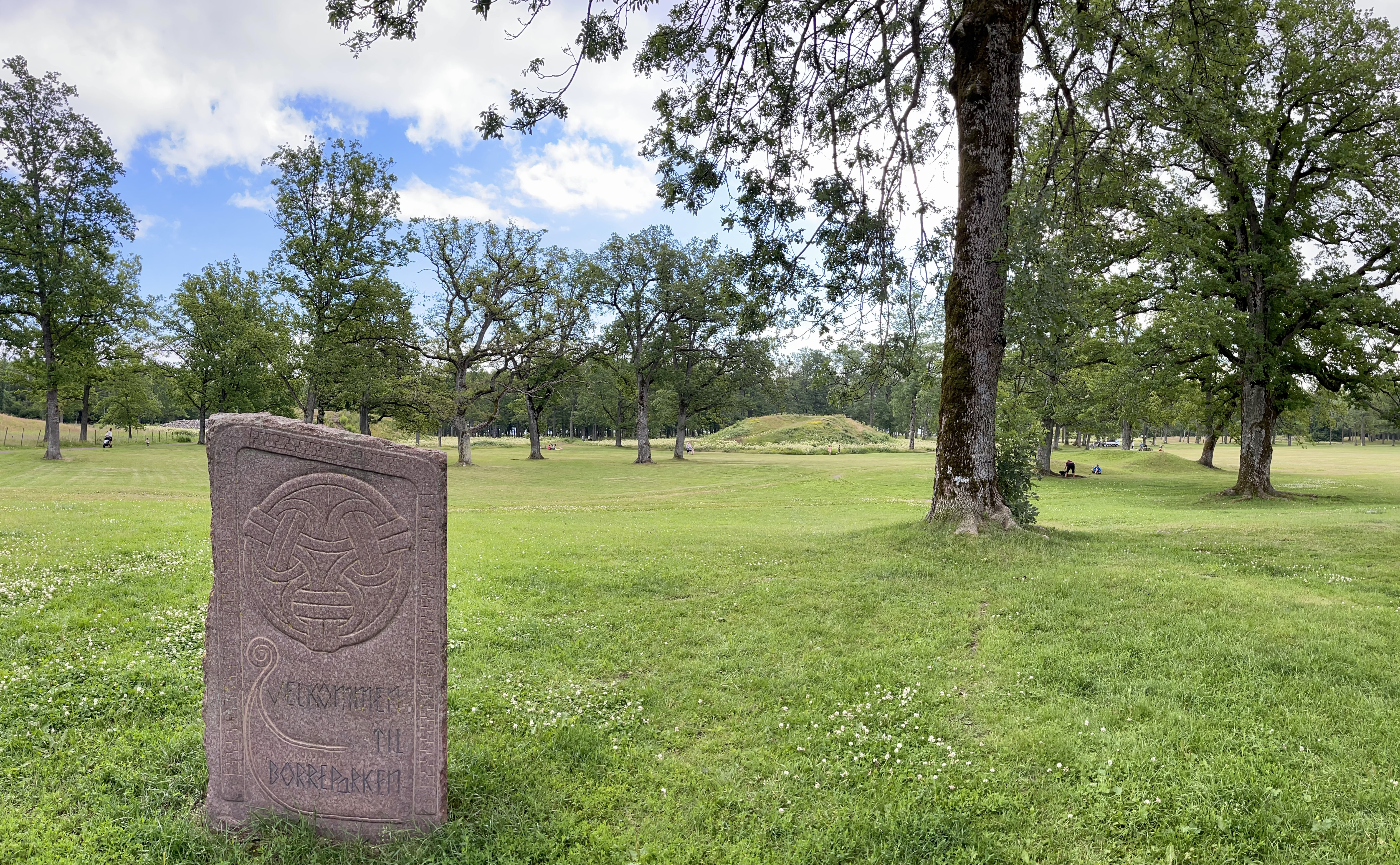
Borre mound cemetery sits within Borre National Park at Horten, on the western shore of the Oslofjord in Vestfold. The park covers 45 acres and contains seven large mounds, one cairn, and at least 25 smaller cairns -- though the cemetery was likely larger before modern development claimed some of its monuments. The biggest mounds exceed 45 meters in diameter and stand up to 6 meters high. Excavations in the 1980s revealed that the oldest mounds date to around 600 AD, well before the Viking Age began. This timeline places Borre as a seat of power stretching from the Merovingian period into the Viking era, a continuity that few sites in Scandinavia can match. Whoever ruled here did so for centuries.
The Art That Bears Its Name
The craft work recovered from the 1851 excavation -- despite the destruction caused by the gravel quarrying -- proved to be among the finest examples of Viking decorative art ever found. The interlacing animal figures and symmetrical knot patterns became the defining characteristics of what scholars now call the Borre style, a tradition that spread across the Viking world from Ireland to Russia. Many of the surviving pieces are harness decorations, objects designed to display wealth and status on horseback. They are now exhibited at the Viking Ship Museum in Oslo, where they represent Vestfold's importance as a center of Viking power and artistic production. Further investigations of smaller cairns in 1925 revealed simpler cremation burials, and archaeologist Bjoern Myhre conducted extensive excavations between 1989 and 1991.
What Radar Revealed
The mounds visible on the surface are only part of the story. In October 2007, ground-penetrating radar surveys conducted by the Swedish Central National Heritage Board discovered the buried remains of two prehistoric hall buildings -- the first substantial building remains found near Borre. A larger GPR survey in March 2013, led by the Ludwig Boltzmann Institute for Archaeological Prospection and Virtual Archaeology, uncovered yet another large hall. In 2015, geomorphological analysis suggested that a prehistoric harbor once existed at Borre, connecting the site directly to the maritime trade routes of the Oslofjord. Then, in March 2019, archaeologists found what appears to be another buried Viking ship -- a ship burial likely constructed as a tomb for a high-ranking individual. Each new discovery reinforces the same conclusion: Borre was far more important than its surface suggests.
Walking Among the Dead
The Midgard Viking Center, opened in 2000 as part of the Vestfold Museum, offers exhibitions and guided tours of the national park. A reconstructed Viking feast hall near the park gives visitors a sense of the scale and atmosphere of the buildings that radar has revealed beneath the grass. But the mounds themselves need no interpretation. They are enormous, grass-covered domes set among birch and oak, arranged along the fjord shore in a pattern that was deliberate even if its precise logic is lost. Walking among them, you are walking through a cemetery that was in continuous use for at least four hundred years -- a place where generation after generation of Vestfold's rulers were laid to rest with their ships, their horses, and the beautiful objects that defined their rank.
From the Air
Located at 59.38N, 10.47E at Horten on the western shore of the Oslofjord, Vestfold county, Norway. The burial mounds are visible from low altitude as a cluster of large, rounded, grass-covered features within the forested national park along the shoreline. Nearest airport is Torp Sandefjord Airport (ENTO), approximately 40 km to the south. Oslo Gardermoen (ENGM) is about 100 km to the north. The site's position on the Oslofjord shore makes it identifiable from the air by the contrast between the park's green space and the surrounding residential areas of Horten. Best viewed at 2,000-4,000 feet AGL.