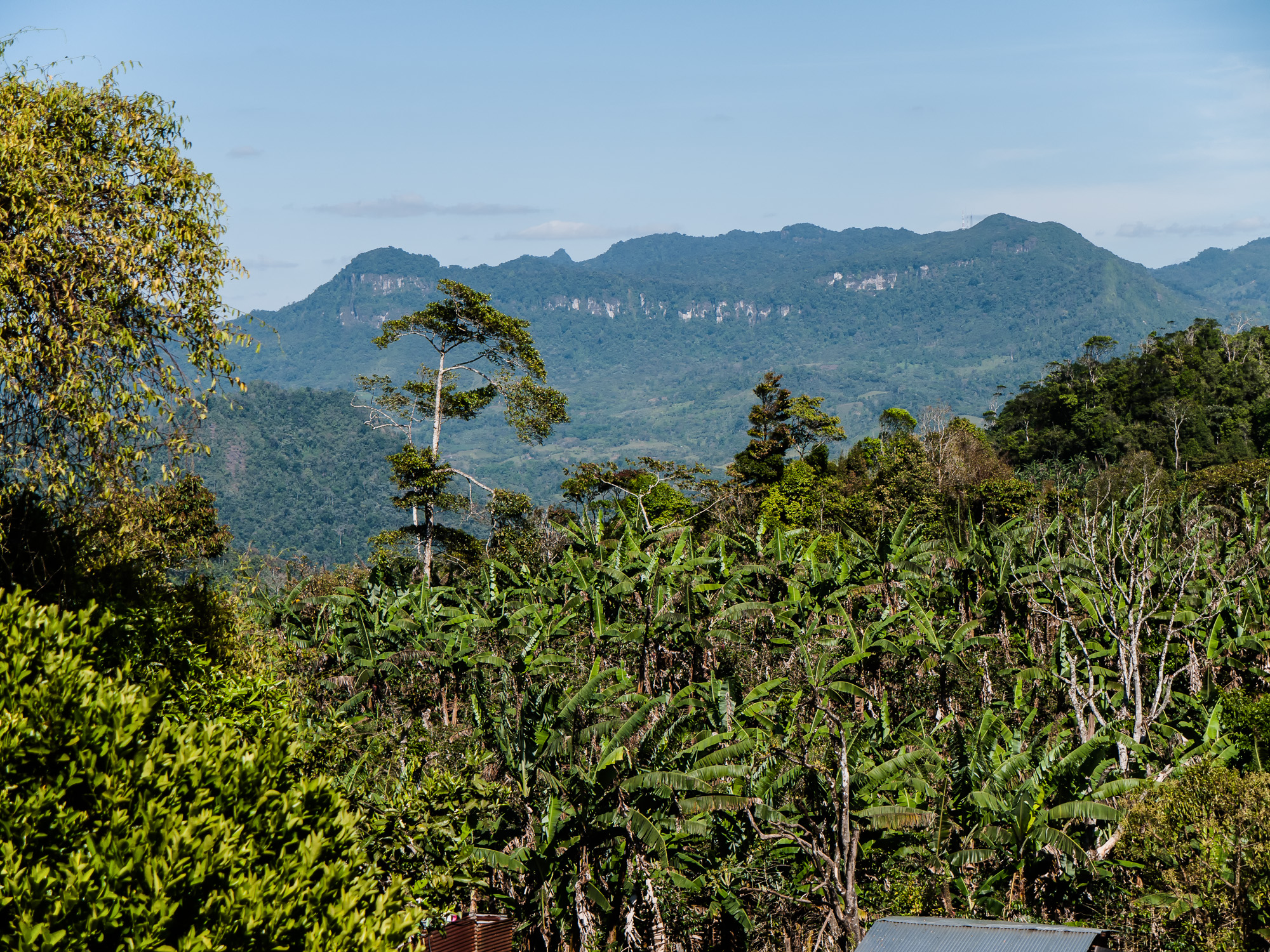
Bosawas Biosphere Reserve
The name is a puzzle solved in three syllables: Bo from the Bocay River, Sa from Mount Saslaya, Was from the Waspuk River. Stitch those three landmarks together and you have Bosawas -- 20,000 square kilometers of tropical rainforest in northern Nicaragua, the second-largest expanse of unbroken forest in the Western Hemisphere after the Amazon. UNESCO designated it a biosphere reserve in 1997, but the Mayangna and Miskito peoples who live within its boundaries have known it far longer than any international body has. Their presence here predates every government that has drawn lines on a map around it.
A Forest Measured in Rivers
Bosawas sprawls across the state of Jinotega in northern Nicaragua, its 2 million hectares comprising roughly 15 percent of the nation's total land area. The Cordillera Isabella cuts through its interior. The Coco River, Central America's longest, forms its northern border with Honduras. Mount Saslaya, the reserve's namesake peak, anchors Saslaya National Park within the larger protected area. The reserve operates as a nucleus surrounded by a buffer zone -- the core alone covers about 7 percent of Nicaragua's territory. It is a landscape defined by water: the Bocay and Waspuk rivers thread through valleys so densely forested that large sections remain essentially unexplored. From the air, the canopy appears as an unbroken green expanse broken only by the silver threads of rivers and the occasional exposed ridgeline of the Cordillera Isabella.
Where Harpy Eagles Still Hunt
Bosawas harbors biodiversity on a scale that scientists can only estimate. Vascular plant species number in the thousands, though a complete inventory has never been attempted. An estimated 100,000 to 200,000 insect species inhabit the reserve -- a figure that researchers acknowledge is probably conservative given how little of the forest has been systematically surveyed. The birdlife alone accounts for a significant share of Nicaragua's 700 recorded species, and BirdLife International has designated Bosawas an Important Bird Area. Quetzals flash iridescent green through the canopy. Macaws call from the ridgelines. And the harpy eagle -- the largest and most powerful raptor in the Americas, with talons the size of grizzly bear claws -- still hunts here, taking Baird's tapirs and other large prey. Pumas and jaguars roam the forest floor as apex predators. Even the amphibians carry distinction: the Saslaya moss salamander exists nowhere else on Earth, its entire range confined to the slopes of its namesake mountain.
Creation Without Consultation
When the Chamorro government established Bosawas in the early 1990s, it did so without consulting the indigenous communities who had lived there for centuries. The Mayangna and Miskito peoples viewed the declaration as a violation of their constitutionally guaranteed territorial autonomy -- a protected area imposed on lands they already governed. The tension was real but not irresolvable. Through negotiation over the following years, indigenous territorial boundaries were demarcated and title was formally granted to the communities. By the late 1990s, the Mayangna and Miskito had embraced the biosphere reserve concept, not because an outside authority told them to, but because it aligned with their own interest in protecting the forest from the external threats pressing in from every direction. The arrangement represented a rare instance of conservation and indigenous sovereignty finding common ground, though maintaining that ground would prove far more difficult.
Blood in the Buffer Zone
The reserve's greatest threat does not come from above the canopy but from its edges. Mestizo settlers -- known locally as colonos -- have pushed steadily into Bosawas, clearing forest for cattle ranching and agriculture, and mining for gold in areas that overlap with indigenous territory. The encroachment has turned violent. In January 2020, several Mayangna people were killed and kidnapped by colonos seeking to seize indigenous land. The killings were not isolated: they formed part of an ongoing series of murders driven by land conflicts within the reserve. In August 2021, nine indigenous people were massacred and indigenous women were sexually assaulted in the community of Sauni As. The United Nations High Commissioner for Human Rights has documented these attacks. For the Mayangna and Miskito, the violence represents something beyond a land dispute -- it is an existential threat to communities whose survival depends on the forest that settlers are destroying.
The Amazon's Smaller Sibling
Bosawas does not have the Amazon's fame or its scale, but it shares the Amazon's fundamental challenge: how to protect a vast, remote forest in a country where economic pressures constantly favor clearing it. Roughly 10,000 square kilometers of forest remain, but that figure has shrunk as illegal settlement advances. The reserve's remoteness, once its greatest protection, has become a liability -- enforcement is difficult in terrain that takes days to cross on foot. Yet the forest endures. Viewed from altitude, Bosawas is a deep green interruption in the patchwork of cleared land that increasingly defines Central America's landscape. It is large enough to sustain complete ecosystems, from apex predators to endemic salamanders. It remains, for now, the Western Hemisphere's second lung -- smaller than the Amazon, closer to collapse, and defended by the indigenous communities who have the most to lose if it falls.
From the Air
Centered at approximately 14.0N, 85.0W in northern Nicaragua. The reserve appears as a vast unbroken forest canopy in the Jinotega department, crossed by the Cordillera Isabella mountain range. The Coco River traces the northern border with Honduras. Mount Saslaya is a prominent peak within the reserve. Nearest airports: MNMG (Augusto C. Sandino International, Managua) to the southwest, MNPC (Puerto Cabezas/Bilwi) to the east on the Caribbean coast. Best viewed at 20,000-35,000 feet to appreciate the sheer scale of unbroken forest cover -- one of the last large tracts remaining in Central America.