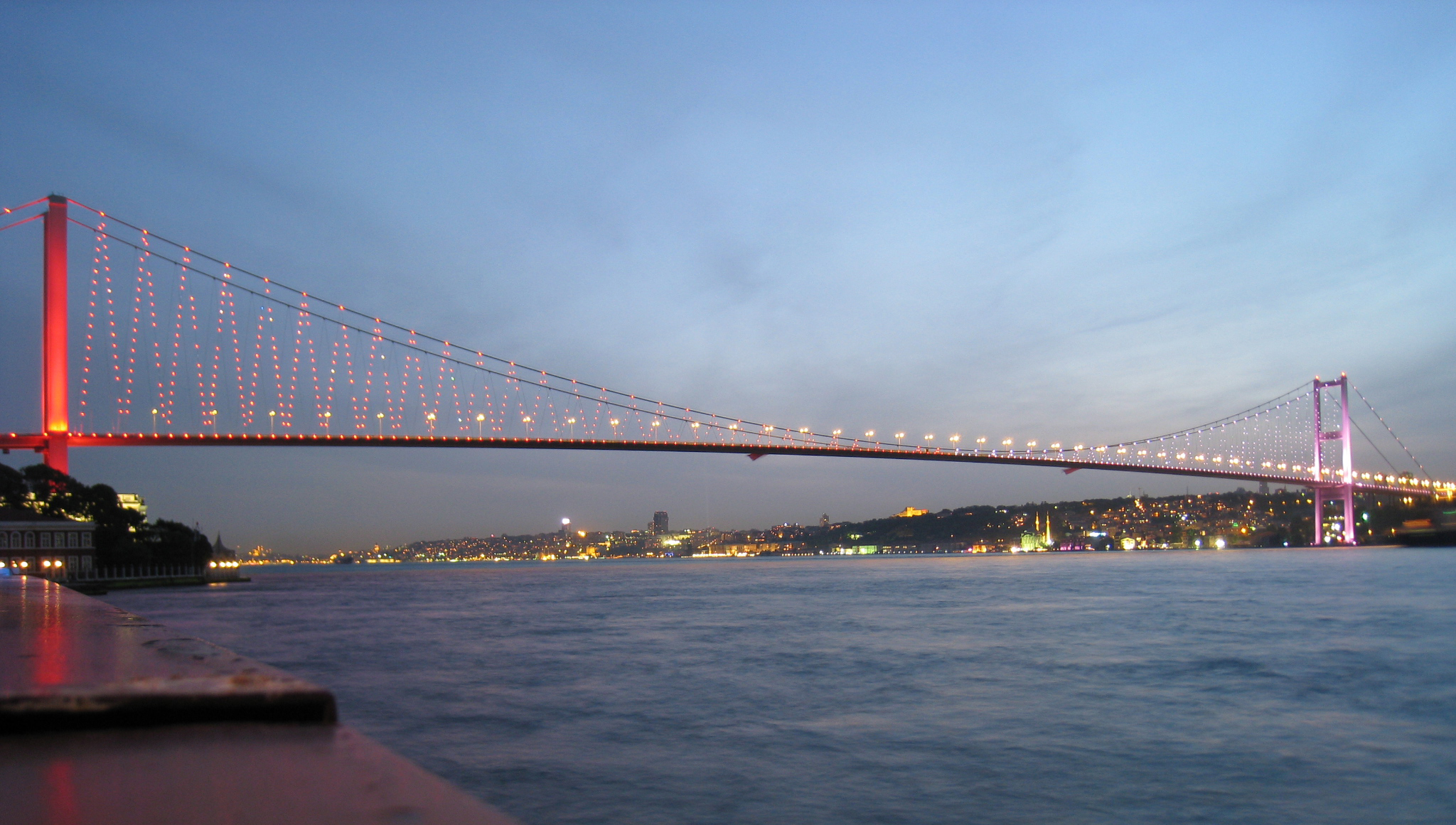
Bosphorus Bridge
The night of 15 July 2016, soldiers from a rogue faction of the Turkish armed forces drove tanks onto the bridge and stopped traffic. They blocked the southbound deck, arrested civilians, and arrested the police officers who came to question them. Across Istanbul, F-16s flew low over the city. State television was seized. The president went on FaceTime through a journalist's phone and asked Turks to come into the streets. They came. By dawn the soldiers on the bridge - some of them young conscripts who had been told they were on an exercise - were surrendering to civilians. Two hundred and fifty-one people died across the country that night resisting the coup attempt. The bridge that connects Asia and Europe was officially renamed the next week: 15 July Martyrs' Bridge.
The Idea That Wouldn't Go Away
Darius the Great floated a pontoon bridge across the Bosphorus in 513 BC, on the orders described by Herodotus, to chase the Scythians north and put an army in the Balkans. The engineer Mandrocles of Samos got the job and a place in Greek history for it. Sixty-five years later Xerxes built a more famous pontoon bridge across the Hellespont to the southwest, the one Aeschylus dramatized and that became Greek synonym for Persian hubris. After those two performances no one tried again for a long time. Boats and ferries did the work for over two millennia. In 1900 the Bosphorus Railroad Company proposed a permanent bridge to Sultan Abdul Hamid II - a span carrying both road and rail, linking the continents at last. The Ottoman Empire ran out of years before the proposal could be acted on. The Republic of Turkey took it up again in 1957, when Prime Minister Adnan Menderes formally decided to build.
British Engineers and Turkish Concrete
The contract for structural engineering went in 1968 to Freeman Fox & Partners of London - the same firm whose engineers Gilbert Roberts, William Brown, and Michael Parsons had designed the Severn Bridge, the Forth Road Bridge, and would later design the Humber. The American engineer David B. Steinman, who had recently completed the Mackinac Bridge, was contracted into the project but died in 1960 before serious design work began. Construction started in February 1970. The Turkish firm Enka Construction led the work, with Cleveland Bridge of England and Hochtief of Germany as co-contractors. The bridge that emerged, completed on 30 October 1973 - one day after the fiftieth anniversary of the Republic - was a gravity-anchored steel suspension span: 1,560 meters total length, a main span of 1,074 meters between the towers, deck width 33.4 meters, towers rising 165 meters above the water. It was the longest suspension bridge in Europe until the Humber opened in 1981, and the longest in Asia until the second Bosphorus bridge - the Fatih Sultan Mehmet, two miles north - opened in 1988.
Eight Lanes Above Two Continents
The bridge carries eight lanes - three traffic lanes, an emergency lane, and a pedestrian lane in each direction - though pedestrians and cyclists are no longer permitted on most days for security reasons. President Fahri Korutuk and Prime Minister Naim Talu walked across at the opening. The roadway runs between the European neighborhood of Ortakoy, where the small Ottoman-era mosque on the waterfront frames almost every photograph of the bridge, and Beylerbeyi on the Asian side, with its 19th-century summer palace just downstream. Since 2007 a computerized Philips LED system has lit the towers and cables at night, the colors changing for holidays and tragedies. Toll collection ran cash until 2006, then switched to electronic systems - first OGS, then KGS, then HGS in 2012. Tiger Woods once teed off from the deck for a publicity stunt. Venus Williams played a tennis match on the bridge in 2005, the first match contested across two continents. David Coulthard drove a Formula One car across in the same year and was fined twenty euros for missing the toll booths.
The Marathon and the Coup
Every October since 1979 the Intercontinental Istanbul Marathon shuts the bridge to vehicles and turns it over to runners crossing from Asia to Europe - the only day of the year a person can legally walk across. The route attracts tens of thousands. Then there is the other event the bridge is now associated with: the night in July 2016 when soldiers blocked the southbound lanes and a country fought back. The bridge's renaming - 15 Temmuz Sehitler Koprusu, July 15 Martyrs' Bridge - was announced ten days later by Prime Minister Binali Yildirim. A monument, museum, and small mosque were built on a hillside near the Asian abutment, in memory of the people who died on the bridge that night. Whether visitors call it the Bosphorus Bridge, the First Bridge, or the Martyrs' Bridge depends mostly on age and politics.
Crossing
The view from the deck remains one of the great experiences of any city. The Bosphorus is a working strait - 200 ships a day, oil tankers from the Black Sea, container traffic, ferries running every few minutes between the European and Asian shores. Looking south from the bridge you can see all the way to the historic peninsula and Hagia Sophia's dome and the Blue Mosque's six minarets, with the Sea of Marmara opening beyond. Looking north, the strait curves away toward the Black Sea past the second and third bridges. The bridge has become so much a part of Istanbul's silhouette that it is hard to remember it is younger than rock and roll. For 2,486 years - from Darius's pontoons in 513 BC to that October day in 1973 - if you wanted to cross from Asia to Europe at the Bosphorus, you got into a boat. Now you can drive.
From the Air
Located at 41.046 N, 29.034 E, spanning the Bosphorus strait between Ortakoy (Europe) and Beylerbeyi (Asia). The bridge towers rise 165 m and are visible from miles around. Best viewed at 2,000-5,000 feet altitude; the strait, the historic peninsula to the south, and the Princes' Islands in the Sea of Marmara are visible from any reasonable approach. Nearest airport is Istanbul Airport (LTFM) on the European side; Sabiha Gokcen (LTFJ) on the Asian side. Civilian overflight of the strait is restricted; consult current NOTAMs.