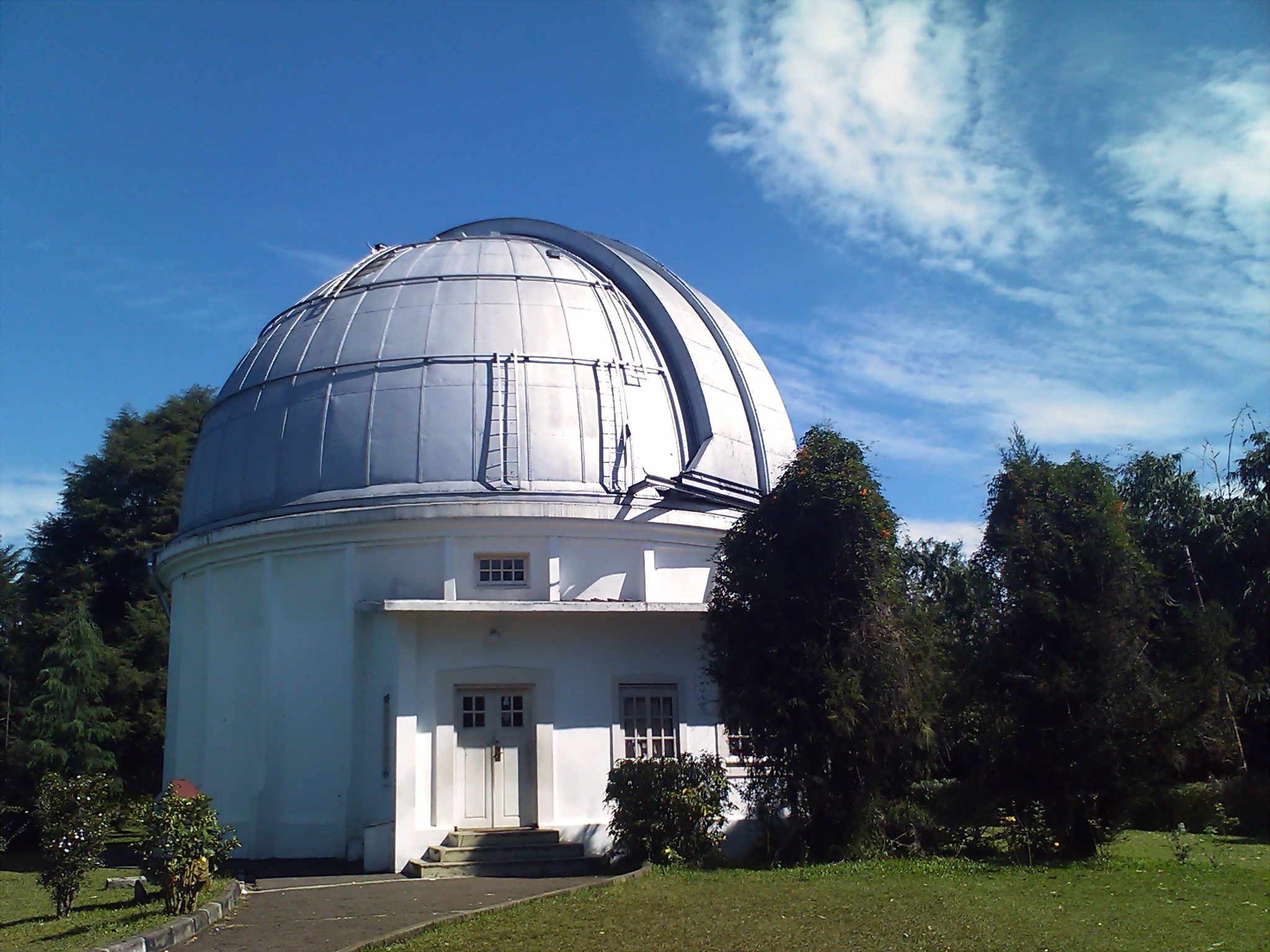
The Tea Planter's Telescope
Karel Albert Rudolf Bosscha made his fortune in tea. His father, Johannes, made his name in physics. Between them, they planted something on a West Java hilltop that would outlast both legacies: a place to watch the stars. In the 1920s, the Dutch-Indies Astronomical Society needed an observatory, and Bosscha offered six hectares of his Malabar tea plantation near Lembang, 15 kilometers north of Bandung. The site was chosen carefully -- hilly terrain with unobstructed sky, 1,310 meters above sea level, and close to a city the Dutch were grooming to replace Batavia as colonial capital. Construction began in 1923. By 1928, the observatory was operational, and Indonesia had its first serious window on the cosmos.
A Colony's Window on the Sky
The observatory's origins belong to the Nederlandsch-Indische Sterrekundige Vereeniging, the Dutch-Indies Astronomical Society, which held its founding meetings in the 1920s with a single ambition: to bring proper astronomical research to the archipelago. The southern hemisphere offered skies that European observatories could not access, and the Dutch East Indies sat squarely in the zone where those skies mattered most. Of every possible site across thousands of islands, the tea hills north of Bandung won out -- elevation, clear air, and proximity to urban infrastructure all counted in its favor. The first international publication from Bosscha appeared in 1922, even before construction finished, a sign of how quickly the facility moved from ambition to output. For two decades, the observatory ran continuously, scanning binary stars, tracking comets, and mapping galactic structure from a latitude few other observatories shared.
War, Silence, and a Second Life
World War II shut the observatory down. Japanese occupation brought research to a halt, and the instruments fell into disrepair. After the war, major reconstruction was required before any telescope could turn again. The handover came on 17 October 1951, when the Dutch-Indies Astronomical Society transferred operations to the newly independent Indonesian government. Eight years later, in 1959, the Institut Teknologi Bandung took control, folding the observatory into Indonesia's premier technical university. That decision transformed Bosscha from a colonial scientific outpost into the foundation of Indonesian astronomy education. Generations of Indonesian astronomers have trained here, learning to read the sky through instruments that predate their nation's independence. The observatory carries the International Astronomical Union code 299 -- a number that places this hilltop tea plantation alongside the world's recognized research facilities.
Five Telescopes, Five Languages of Light
The crown jewel is the Zeiss double refractor, with twin 60-centimeter objective lenses and a 10.7-meter focal length. It was built to study binary stars, photograph lunar craters, and track the movements of Mars, Saturn, and Jupiter -- work it still performs. Alongside it sits the Schmidt telescope, nicknamed Bima Sakti, the Indonesian term for the Milky Way. With a 71-centimeter main lens and a spectral prism angled at 6.10 degrees, it photographs galactic structure and stellar spectra. The Bamberg refractor handles photometric studies of eclipsing stars with its 37-centimeter lens. Then there is the Cassegrain GOTO, a gift from the Japanese government and Bosscha's first computer-controlled telescope, capable of automatically slewing to objects from a digital database. The smallest, the Unitron refractor at just 10.2 centimeters, is dedicated to observing the hilal -- the crescent moon that marks the beginning of Islamic months -- as well as solar and lunar eclipses.
Between the Volcano and the City
Bosscha sits in an uneasy geography. The hills of Lembang offer the elevation and clear air that astronomy demands, but they also sit on the northern rim of the Bandung basin, where the active Lembang Fault runs and the Tangkuban Perahu volcano smokes to the north. Below, Bandung has grown from the modest colonial city of the 1920s into a metropolitan area of millions, and with that growth has come light pollution that increasingly challenges the observatory's optical work. The tension is familiar to observatories worldwide: the same urban proximity that once made a site practical now threatens to make it obsolete. Bosscha has responded partly by expanding into radio astronomy, with a Very Long Baseline Interferometry station that does not care about city lights. Meanwhile, Indonesia has begun constructing the Timau National Observatory in the far quieter skies of Timor, designed to become Southeast Asia's largest telescope facility -- a next-generation complement to the hilltop where it all began.
From the Air
Located at 6.82°S, 107.62°E on the hilly terrain north of Bandung, West Java, Indonesia, at an elevation of 1,310 meters. The observatory sits among tea plantations on slopes leading up toward Tangkuban Perahu volcano. Nearest major airport is Husein Sastranegara International Airport (WICC) in Bandung, approximately 15 km to the south. The white observatory domes are visible from moderate altitude against the green hillside. Best viewed at 4,000-6,000 ft AGL for context of the hilltop setting relative to the Bandung basin below.