Boston Massacre
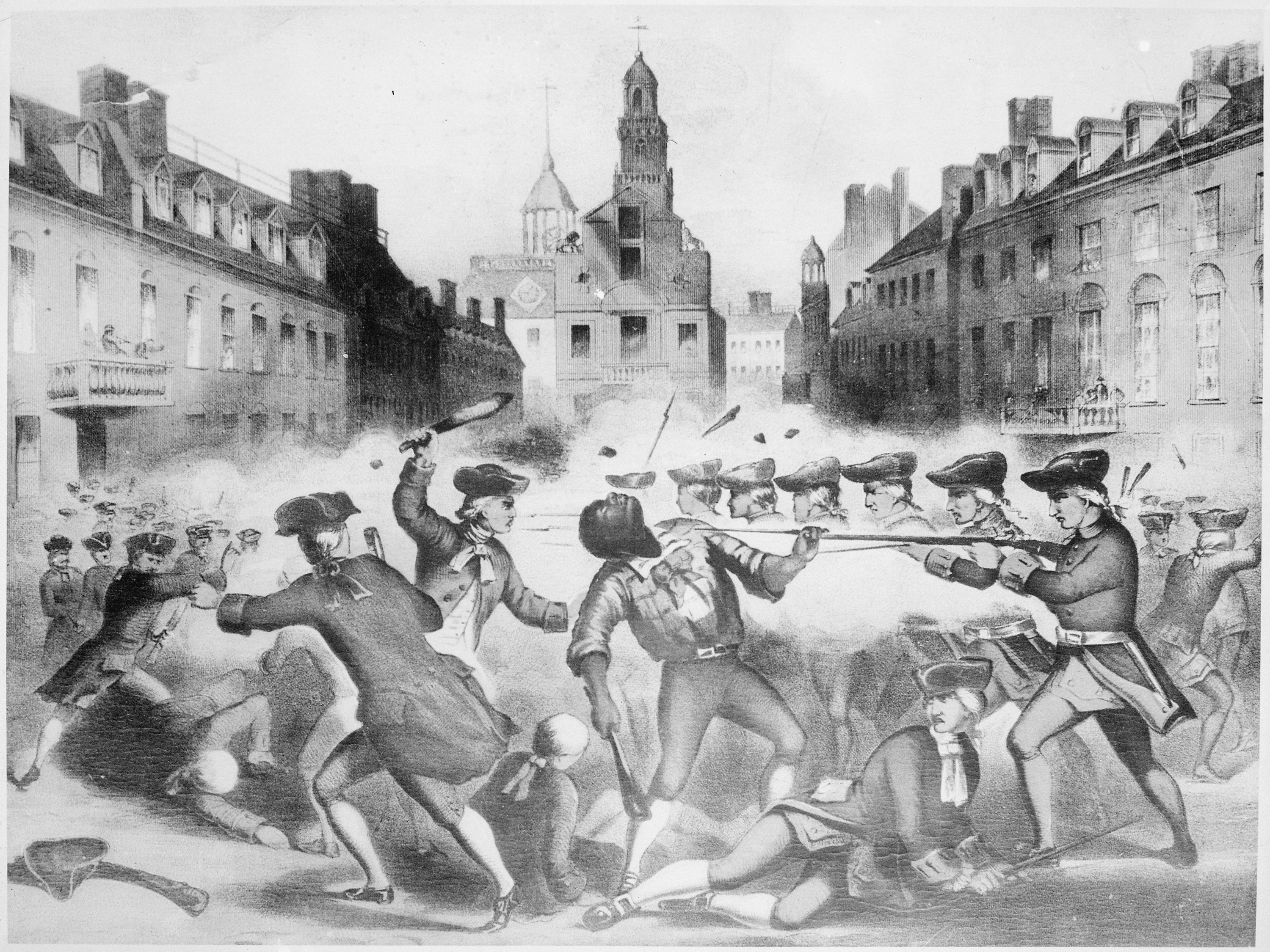
A 13-year-old wigmaker's apprentice started an argument on a cold March evening in 1770, and within minutes, five men lay dead or dying on King Street. The confrontation that became known as the Boston Massacre lasted only a few chaotic moments, but the propaganda war it ignited would burn for years, helping to fuel an entire revolution. What the British dismissed as the "Incident on King Street" became, in the hands of Samuel Adams and Paul Revere, one of the most potent symbols of colonial resistance ever manufactured.
A City on Edge
By 1770, Boston was a powder keg. British troops had been stationed in the city since October 1768, sent to enforce unpopular Parliamentary taxation and support Crown-appointed officials in one of the most defiant cities in the Thirteen Colonies. Two regiments remained garrisoned among a population that viewed them with open hostility. Tensions erupted constantly in small confrontations between soldiers and civilians. Just eleven days before the massacre, an 11-year-old boy named Christopher Seider was killed by a customs informant, and his funeral drew one of the largest crowds Boston had ever seen. Groups of colonists prowled the streets looking for soldiers to harass, and soldiers looked for confrontation in return. The city's chief customs officer had already written to London pleading for military support, warning that government authority was slipping away. Boston was not just restless. It was a city waiting for something terrible to happen.
Ten Minutes on King Street
On the evening of March 5, Private Hugh White stood guard outside the Custom House on King Street. When a teenage apprentice named Edward Garrick accused a passing officer of not paying his bills, White intervened, struck the boy with his musket, and set the night's catastrophe in motion. A crowd gathered quickly, growing to an estimated 300 to 400 people. Captain Thomas Preston marched seven soldiers to White's aid, bayonets fixed. Henry Knox, a 19-year-old bookseller who would later become a Revolutionary War general, grabbed Preston's coat and warned him: "For God's sake, take care of your men. If they fire, you must die." Preston replied, "I am aware of it." The crowd pressed in, hurling snowballs, stones, and insults. Someone knocked Private Hugh Montgomery to the ground. He scrambled up, shouted "Damn you, fire!" and discharged his musket into the crowd without any order from Preston. The other soldiers followed. Rope maker Samuel Gray, mariner James Caldwell, and Crispus Attucks fell dead instantly. Samuel Maverick, a 17-year-old apprentice, was struck by a ricocheting ball and died the next morning. Irish immigrant Patrick Carr took a fatal shot to the abdomen and lingered for two weeks.
The Propaganda Machine
The bodies were barely cold before the battle for public opinion began. Paul Revere produced his famous colored engraving, The Bloody Massacre, depicting Captain Preston calmly ordering his men to fire into a peaceful crowd, with a musket barrel protruding from a window labeled "Butcher's Hall." The image was inflammatory and largely inaccurate, and it was devastatingly effective. Printed in the Boston Gazette and circulated throughout New England, it hung in farmhouses across the colonies. Samuel Adams organized pamphlets drawn from over 90 depositions, painting the shooting as a deliberate attack on law-abiding citizens. The Patriot version of events reached London well before Governor Hutchinson's more measured account, shaping British public opinion against the Crown's own soldiers. Henry Pelham, the original engraver and half-brother of portrait painter John Singleton Copley, had his work copied by Revere without credit. The image became perhaps the most effective piece of political propaganda in American colonial history.
Justice in a Tinderbox
What happened next was remarkable. Despite the white-hot fury of Boston's population, the soldiers received a fair trial, defended by none other than John Adams, a committed Patriot and future president. Adams took the case to ensure that no one could claim the colonists had denied the soldiers justice. He described the crowd as "a motley rabble of saucy boys, negroes, and molattoes, Irish teagues and outlandish Jack Tarrs" and argued that the soldiers had genuinely feared for their lives. The jury agreed. Six soldiers were acquitted outright. Two were convicted of manslaughter and received the relatively mild punishment of branding on the thumb, having pled benefit of clergy. Patrick Carr's deathbed testimony, in which the dying man stated the soldiers had been provoked, helped secure the acquittals. His account became one of the earliest recorded uses of the dying declaration exception in American legal history. Preston was tried separately and also acquitted, the jury convinced he had never given the order to fire.
A Revolution's Foundation Stone
John Adams later wrote that the "foundation of American independence was laid" on March 5, 1770. Samuel Adams and other Patriots turned the anniversary into Massacre Day, an annual commemoration that kept colonial resentment burning for years. The five victims were reinterred together in a prominent grave at the Granary Burying Ground, and in 1888, the Boston Massacre Monument was erected on Boston Common. Crispus Attucks, a former slave of mixed African and Native American heritage, became a powerful symbol for abolitionists nearly a century later when William Cooper Nell organized a commemoration in 1858 to highlight Black contributions to the Revolution. Today, the massacre site on what is now State Street, the Old State House, and the Granary Burying Ground are linked along the Freedom Trail. A cobblestone circle marks where the shooting occurred, though the actual spot was slightly nearby on the busy modern street. The massacre is reenacted annually on March 5, a reminder that a nation's independence can trace its origins to a snowball, a shove, and ten terrible minutes of chaos.
From the Air
Located at 42.359N, 71.057W in downtown Boston, near the Old State House at the intersection of State Street and Congress Street. The site sits along the Freedom Trail, visible from low altitude as part of the dense historic district between Boston Common and the waterfront. Nearest airports: KBOS (Boston Logan International, 2.5nm east). Recommended viewing altitude: 1,500-2,500 feet for context of the historic district. The Granary Burying Ground, where the victims are interred, is visible 0.3nm to the southwest along Tremont Street.