Boston Public Library
The inscription carved above the entrance reads simply: FREE TO ALL. Three words that, when the Boston Public Library opened its doors in 1854, represented a genuinely radical proposition. This was the first large, free municipal library in the United States, born from civic rivalry with New York, French diplomatic gifts of books, and the stubborn conviction of a Harvard professor named George Ticknor that a democracy could not function without an educated public. Today, its central building on Copley Square holds 24 million items, making it the third-largest public library in America, behind only the Library of Congress and the New York Public Library.
Rivalry, Philanthropy, and Paris
The library's origin story reads like a comedy of competing egos and national pride. George Ticknor first proposed the idea in 1826, but could not generate enough interest. In 1839, a French philanthropist named Alexandre Vattemare suggested Boston combine its scattered libraries into one public institution. Most rejected the idea, but Paris sent gifts of books in 1843 and 1847 to help the cause along. Then John Jacob Astor died and left $400,000 to establish a public library in New York. Boston's civic leaders were horrified. The cultural and economic rivalry between the two cities made the bequest intolerable. Suddenly, a public library in Boston became urgent. Mayor Josiah Quincy Jr. anonymously donated $5,000, and financier Joshua Bates contributed $50,000. In 1848, the Massachusetts legislature authorized the library's creation. Edward Capen became its first librarian in 1852, and the doors opened two years later in a temporary building on Mason Street. Ticknor himself traveled extensively to purchase books, set up international book agencies, and personally curate the founding collection.
A Palace for the People
The library outgrew its first permanent home on Boylston Street within decades. By 1880, the Massachusetts legislature authorized a grander building, and the site selected was a prime corner of Copley Square in the Back Bay, directly opposite Henry Hobson Richardson's Trinity Church. The prestigious New York firm McKim, Mead, and White won the commission in 1887, and architect Charles Follen McKim designed a Renaissance masterpiece inspired by the Bibliotheque Sainte-Genevieve in Paris. Completed in 1895, the McKim Building remains one of the finest public buildings in America. Its great reading room, Bates Hall, stretches 218 feet beneath a barrel-vaulted ceiling. Pierre Puvis de Chavannes painted murals for the grand staircase. John Singer Sargent contributed a cycle of paintings on the history of religion that took him decades to complete. The building was designated a National Historic Landmark in 1986. In 1972, architect Philip Johnson added the adjacent Boylston Street Building, a modernist companion that expanded the library's capacity while sparking the kind of architectural debate that Boston has always relished.
Treasures in the Stacks
Behind the Renaissance facade lies one of the most important research collections in the country. The BPL holds over 1.7 million rare books and manuscripts, including medieval manuscripts, incunabula, early Shakespeare editions with several quartos and a First Folio, and the personal 3,800-volume library of President John Adams. The George Ticknor collection of Spanish literature remains a world-class resource. The abolitionism archives include the papers of William Lloyd Garrison, and a major collection documents the Sacco and Vanzetti case that riveted the nation in the 1920s. The library holds the archives of the Handel and Haydn Society, scores from the estate of conductor Serge Koussevitzky, and the papers and grand piano of American composer Walter Piston. Historian David McCullough called the Boston Public Library one of the five most important libraries in the United States, alongside the Library of Congress, the New York Public Library, and the university libraries of Harvard and Yale. It is one of only two public libraries that belong to the Association of Research Libraries.
Branches Across a City
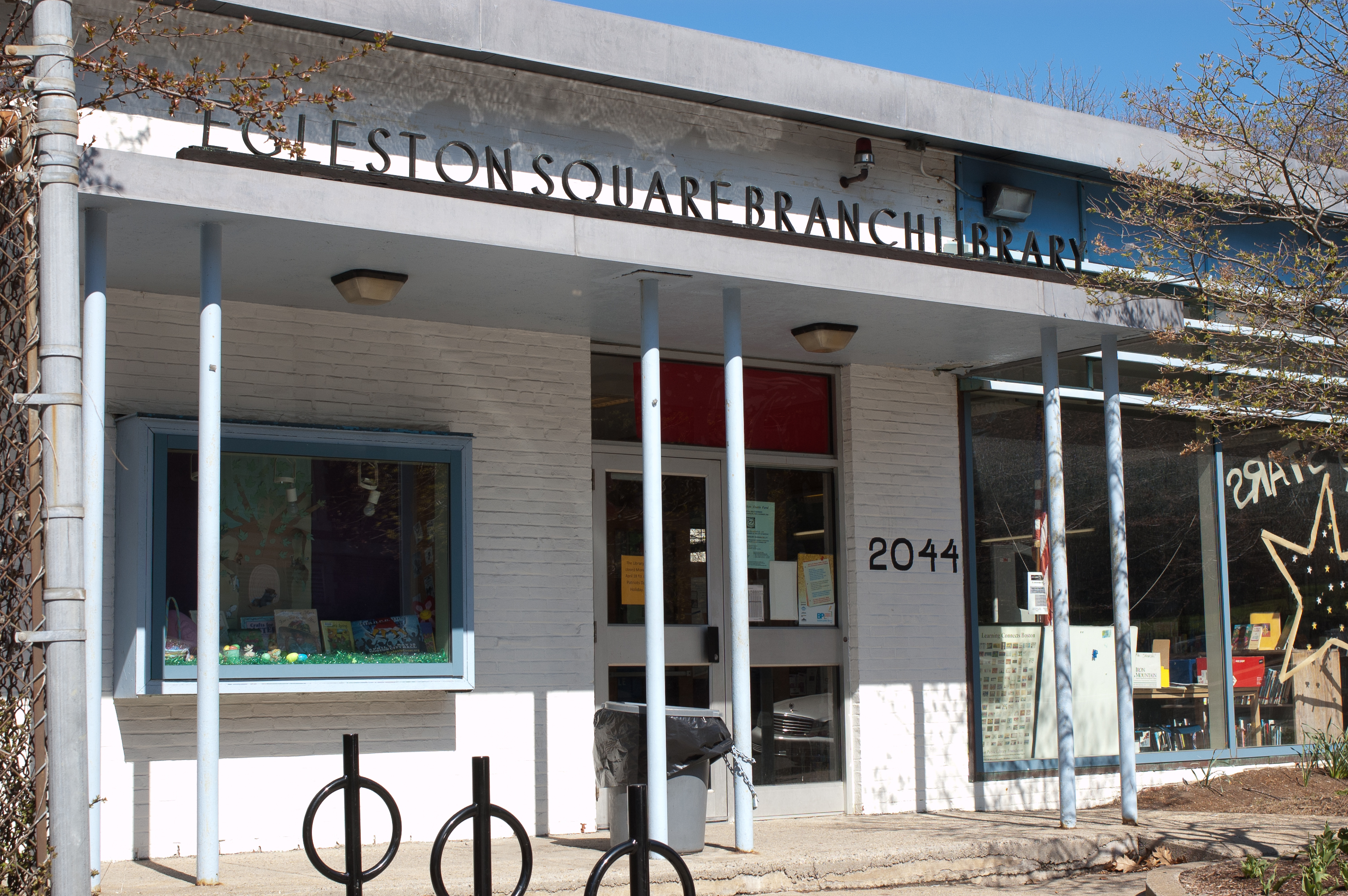
The BPL pioneered the branch library concept in America. In 1870, it opened the first municipally supported branch library in the United States, in East Boston. Today, 25 branches serve Boston's diverse neighborhoods, each with its own architectural character and community identity. The South Boston Branch, opened in 1872, was the second branch library in the nation. The Jamaica Plain Branch, built after a fire in 1908, features distinctive schoolhouse windows and two fireplaces. The Parker Hill Branch in Roxbury occupies a Gothic-style building designed by Ralph Adams Cram in 1931. The Honan-Allston Branch, designed by Machado and Silvetti Associates and opened in 2001, represents the modern evolution of the system. Each branch carries a lineage that often traces back to a delivery station in a drugstore or a reading room above a bank, the modest beginnings from which a citywide network of knowledge grew. The Shaw-Roxbury Branch, the largest in the system outside the Central Library, was renamed in 2025 to honor Sarah-Ann Shaw, Boston's first Black woman television reporter.
Free to All, Still
As Massachusetts's Library for the Commonwealth, the BPL extends borrowing and research privileges to every adult resident of the state. In 2017, the library welcomed 3.8 million visitors across all locations, circulated nearly 5 million items, and recorded almost 10 million website visits while gaining over 82,000 new cardholders. The library's digital collections now make medieval manuscripts, historical maps from the Norman B. Leventhal Map Center, anti-slavery archives, and silent films available to anyone with an internet connection. The renovation of the Boylston Street Building, completed in phases between 2015 and 2016, earned joint awards from the American Institute of Architects and the American Library Association. The building that George Ticknor dreamed of nearly two centuries ago has become something he likely never imagined: a digital hub, a community center, a research powerhouse, and an architectural landmark, all still governed by those three words above the door.
From the Air
Located at 42.349N, 71.078W on Copley Square in Boston's Back Bay neighborhood. The McKim Building's distinctive Renaissance facade and green copper roof are visible from altitude, situated directly across from Trinity Church. The library complex occupies the prominent corner of Boylston Street and Dartmouth Street. Nearest airports: KBOS (Boston Logan International, 3nm east). Recommended viewing altitude: 2,000-3,000 feet to appreciate the Copley Square context, including Trinity Church, the John Hancock Tower, and the Back Bay grid. The Charles River is 0.4nm to the north.