Botanical Garden of Medellin
Walk beneath the Orchideorama and you will feel like you have shrunk. Ten hexagonal structures of wood and steel rise more than fifty feet overhead, their branching canopies modeled on the geometry of flowers and trees, collecting rainwater and sheltering orchids and butterflies below. The structure looks organic, as if the forest itself had decided to build architecture. It opened in 2006, designed by Plan B Architects and JPRCR Architects, and it has become the defining landmark of Medellin's Botanical Garden -- a fourteen-hectare green space in the middle of a city that once made global headlines for very different reasons.
From Bathhouse to Botanical Garden
In the late nineteenth century, this patch of land was a farm known as La Casa de Banos El Eden -- the Bathhouse of Eden -- owned by Victor Arango and later by his sisters and extended family. How it evolved from a private farm into a public garden is a story that mirrors Medellin itself: gradual, sometimes interrupted, eventually triumphant. The garden acquired its formal name, the Joaquin Antonio Uribe Botanical Garden, in 1972, when the facilities were expanded to include a much larger collection of plant species along with an auditorium, library, museum, and dining areas. The name honors Joaquin Antonio Uribe, a pioneering Colombian botanist from Antioquia who devoted his career to cataloging the region's extraordinary plant diversity.
The Garden That Almost Disappeared
During the worst years of Medellin's drug violence in the late 1980s and early 1990s, the botanical garden was temporarily closed. Crime rates in the surrounding neighborhoods made the park dangerous, and plans were drawn up to demolish it entirely. That the garden survived at all is a testament to the stubbornness of the people who valued it. Instead of demolition, the city chose renovation. The decision to invest in public spaces rather than abandon them became a hallmark of Medellin's transformation -- a philosophy that would eventually earn the city international recognition. The botanical garden was one of the first test cases of an idea that now defines Medellin: that architecture and green space can reclaim territory from violence.
Engineering a Forest
When the garden needed a new structure to house its orchid collection, a competition was held for local architects. The winning design, by Plan B Architects and JPRCR Architects, rejected the idea of a conventional greenhouse. Instead, they created the Orchideorama: a modular system of hexagonal 'flower-tree' structures, each one a column of steel and wood that branches into a canopy overhead. The hexagonal plan allows flexibility -- additional modules can be added as needed, expanding the covered area like a growing honeycomb. The canopy's polycarbonate roof panels collect rainwater, which irrigates the gardens below. Inaugurated on August 25, 2006, during Medellin's annual Flower Festival, the Orchideorama was built in just six months. It now shelters an orchid collection and butterfly reserves beneath what amounts to an artificial forest canopy.
Life Under the Canopy
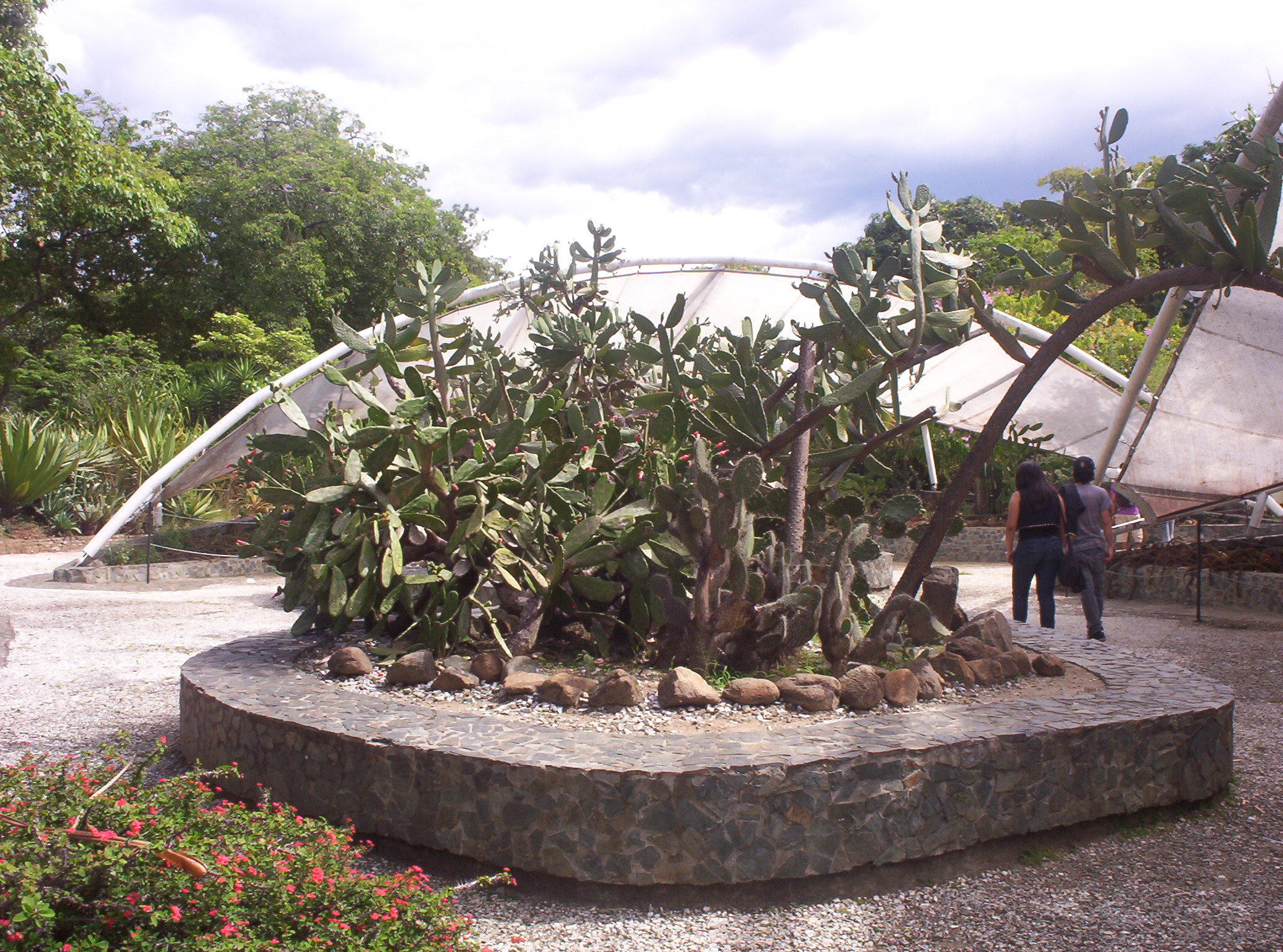
The garden today holds 4,500 flowers and 139 recorded bird species. Great egrets wade through the central pond. Green iguanas drape themselves over branches above the lagoon. A butterfly house, cactus garden, and exhibition spaces fill the grounds, and the entrance pavilion -- designed by architects Lorenzo Castro and Ana Elvira Velez -- sets the tone with its clean, modern lines. But the real life of the garden is social. On any given weekend, families spread picnics on the grass, students study beneath the Orchideorama's shade, and couples walk the paths between beds of tropical plants. For a city of nearly four million people crammed into the narrow Aburra Valley, the botanical garden is a pressure valve -- a place where the density of urban life gives way, temporarily, to the density of leaves.
From the Air
Located at 6.271N, 75.564W in the northern part of central Medellin, along the Medellin River. The garden's 14 hectares of green space are visible as a distinct patch of vegetation in the dense urban grid, near the Universidad metro station. Best viewed from approaches to SKMD (Olaya Herrera Airport, 2.5 km south of the garden) or during descent into SKRG (Jose Maria Cordova International, Rionegro). The Orchideorama's distinctive canopy structure may be visible at lower altitudes. Elevation approximately 1,460 meters.