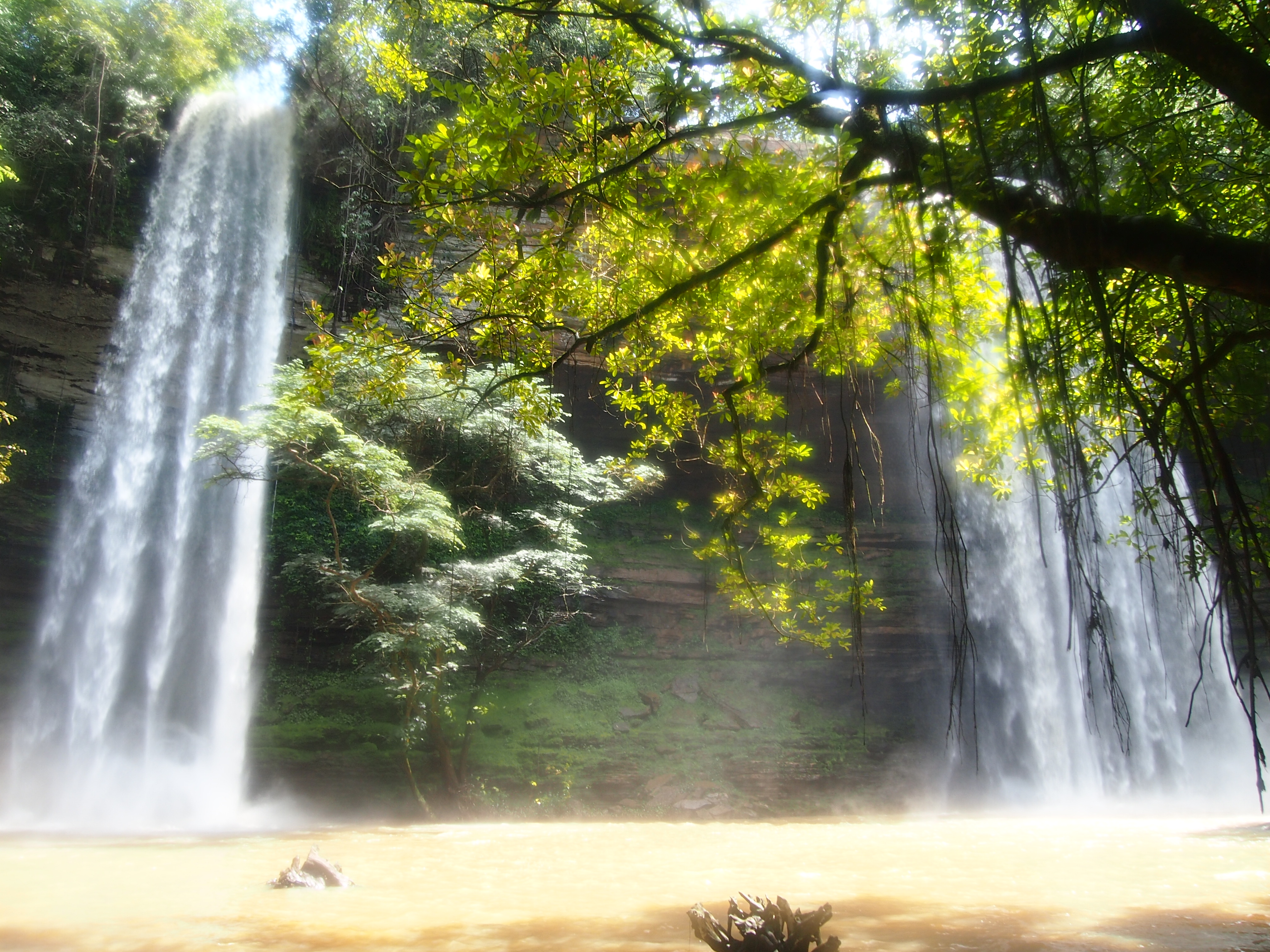
Boti Falls
During the dry months, they fall separately. Two streams of water drop 30 meters down a rock face in Ghana's Eastern Region, side by side but not quite touching, divided by a narrow ridge of stone. The locals call one the male, the other the female. Then the rains come, June through August, and the Ponmpon River swells until the two cascades crash into each other midway down the cliff. Spray fills the canyon. And if the sun catches the mist at the right angle, a rainbow arcs across the point where the two falls meet. The people of Boti call this the mating ceremony.
The Priest, the President, and the Forest
Oral history holds that a Catholic priest surveying the forest around Huhunya first stumbled upon the falls. The jungle had hidden them completely, their roar swallowed by dense canopy. Once revealed, Boti Falls drew attention quickly. By the early 1960s, the waterfall had become famous enough to attract President Kwame Nkrumah himself, who visited in 1961 and reportedly declared it the most attractive place in the Eastern Region. Nkrumah's endorsement gave the falls a profile that has endured for decades, even as the infrastructure around them has cycled through periods of investment and neglect. Today, the falls are managed by Kingdom Ventures, and 250 concrete steps lead visitors down into the canyon where the water pools at the base. The descent is steep but straightforward, and on busy weekends the steps are crowded with families, student groups, and tourists making the 90-minute drive from Accra or the shorter 30-minute trip from the regional capital, Koforidua.
A Canyon of Falling Water
At full flow, the experience of standing at the bottom of Boti Falls is immersive in the most literal sense. Water cascades from both directions, the canyon walls amplify the sound into a continuous roar, and the mist soaks anyone who lingers near the plunge pool. Many visitors swim in the pool at the base, the water cold and silty from its passage through the Huhunya forest reserve upstream. The larger cascade, designated the male fall, hits the rock with enough force to send spray several meters outward. The smaller female fall is gentler, its stream thinner and more diffuse. During peak rainy season, the distinction blurs as both flows intensify and the two columns of water merge into a single curtain. It is this merging that generates the conditions for the rainbow that anchors the local mythology, a phenomenon that depends on precise alignment of sun, mist, and the observer's position in the canyon.
Beyond the Falls
Boti Falls sits within a broader landscape of natural attractions in the Yilo Krobo District. Seven kilometers away, Umbrella Rock offers a challenging forest hike to a geological oddity, and many visitors combine the two sites in a single day trip. The forest between them is thick and humid, threaded with trails that pass through the Huhunya forest reserve. The Ponmpon River, which feeds the falls, winds through this forest canopy before reaching the escarpment edge. For visitors from Accra, the falls represent the closest dramatic waterfall experience, and the tourism infrastructure reflects that demand. Guided tours are standard, and the entry fee covers both the hike and access to the surrounding forest trails. The area around the falls has also become a venue for community events and festivals, drawing crowds that extend well beyond the usual tourist demographics.
Timing and the Rain
Boti Falls rewards patience and calendar awareness. Visit in December or January and you may find a single thin stream trickling down the rock face, picturesque but modest. Return in July and the same cliff face becomes a wall of water. The seasonal variation is dramatic enough that the falls are effectively two different destinations depending on when you arrive. June through August delivers the full spectacle: both falls at maximum volume, the canyon filled with spray, and the conditions ripe for the rainbow that draws photographers and storytellers alike. The rocks at the base grow slippery during peak flow, and the mist can reduce visibility to a few meters. For those who want to see the mating ceremony that gives Boti Falls its mythic resonance, the rainy season is the only option.
From the Air
Located at 6.16N, 0.20W in the Eastern Region of Ghana, approximately 17 km northeast of Koforidua. The falls are hidden within the Huhunya forest reserve and not visible from altitude, but the escarpment edge and river valley are identifiable from the air. Nearest major airport is Kotoka International (DGAA/ACC) in Accra, roughly 90 km to the southwest. Koforidua is the nearest significant town. Best approach from the south, following the road corridor northeast from Koforidua into the forested hills.