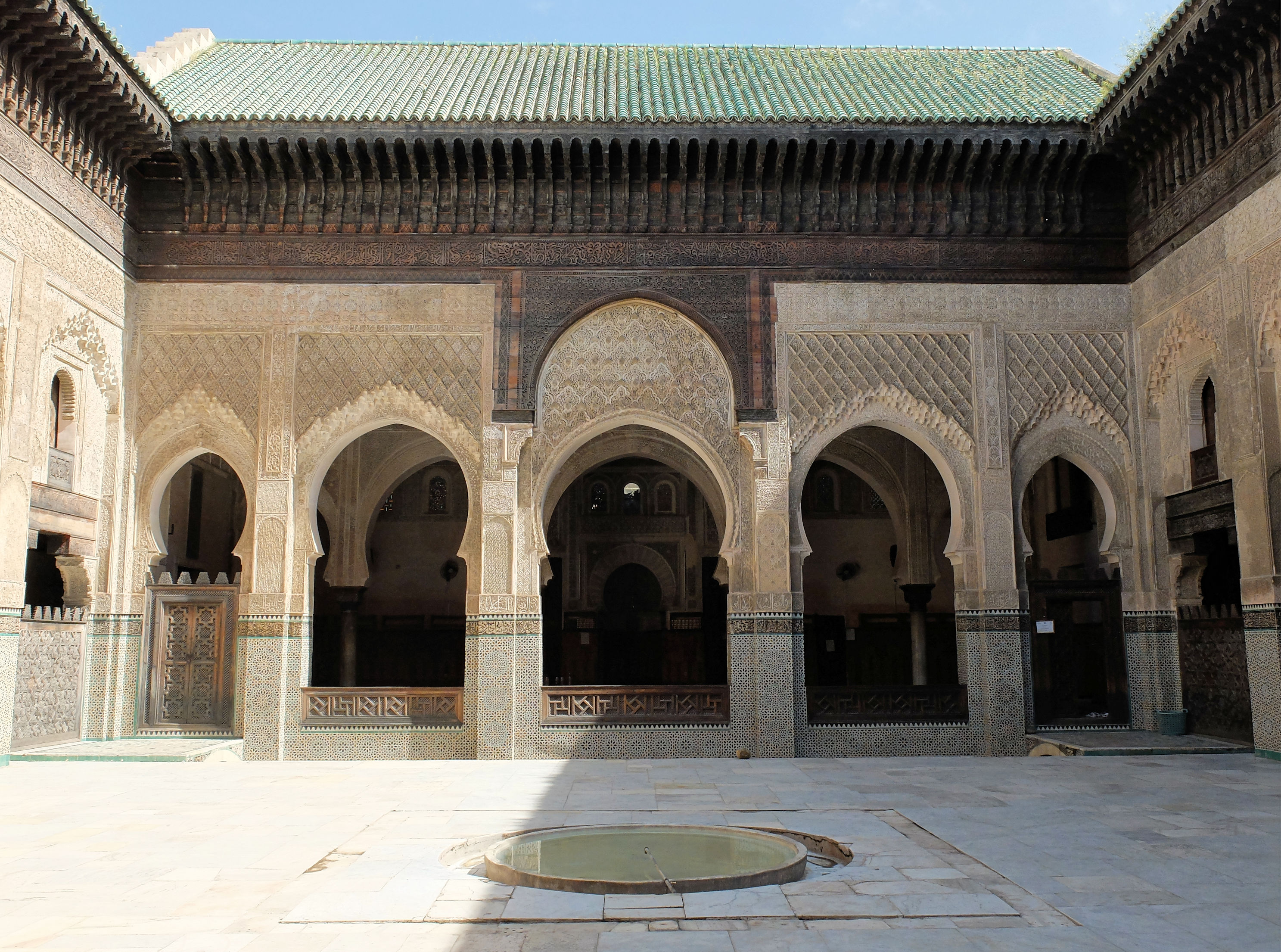
Bou Inania Madrasa
Across the street from the Bou Inania Madrasa, embedded in a stone facade, sit the remains of an elaborate hydraulic clock -- thirteen wooden consoles intricately carved in cedar, twelve windows surrounded by stucco decoration, and a mechanism that once marked the hours with falling bronze balls. The Dar al-Magana, the "House of the Clock," has not functioned in living memory. Multiple restoration attempts have failed to coax it back to life. It stands there anyway, a puzzle from the 14th century that refuses to yield its secret, keeping time with silence. The madrasa it faces has proven more forthcoming. Built between 1350 and 1355 by the Marinid sultan Abu Inan Faris, it remains one of the most lavishly decorated buildings in Morocco.
A Sultan's Singular Ambition
Abu Inan was the son and successor of Sultan Abu al-Hasan, under whose reign the Marinid empire reached its apogee, stretching east all the way to Tunis. The younger sultan inherited both his father's ambition and his taste for monumental architecture. He originally named his creation the Madrasa al-Muttawakkiliya, but history has preferred the simpler Bou Inania. What made this building unique among Moroccan madrasas was its hybrid function: it served not only as a theological school with student lodging but also as a congregational mosque, complete with a prominent minaret -- a combination found nowhere else in the country. The sultan endowed it with an extensive list of habous properties whose revenues would fund its operations in perpetuity, a common Islamic charitable mechanism that linked real estate income to institutional survival.
A Vocabulary in Three Materials
The madrasa sits on the south side of Tala'a Kebira street, its interior organized around a courtyard surrounded by galleries with student quarters on the second floor. Two classroom chambers flank the courtyard, and a wide prayer hall opens beyond. The decorative program follows the classic Marinid layering: zellij mosaic tilework on the lower walls, finely carved stucco filling the middle register with arabesques, muqarnas honeycomb vaults, and flowing Arabic calligraphy. Cedar wood takes over above, carved with more arabesques and inscriptions, projecting in a wooden canopy supported by corbels that casts rhythmic shadows across the courtyard. A canal runs through the courtyard, serving both aesthetic and practical purposes for ablutions -- a feature also found in the madrasa of Chellah, linking this building to a broader architectural tradition.
The Minbar's Lineage
Inside the prayer hall stands a minbar -- the stepped pulpit from which Friday sermons are delivered -- that carries a lineage reaching back to the earliest Islamic architecture in the western Mediterranean. Made of wood, including ebony and other costly species, it is decorated with a mix of marquetry and carved pieces assembled into patterns centered on eight-pointed stars. Bands decorated with ivory inlay interweave and repeat across the surface, with the spaces between them filled by panels of intricately carved arabesques. The design follows the tradition established by the celebrated Kutubiyya minbar in Marrakesh, which in turn drew on the artistic heritage of Umayyad Al-Andalus. The slightly later Almohad minbar of the Kasbah Mosque in Marrakesh, commissioned between 1189 and 1195, belongs to the same family. An inscription above the first step, now partly disappeared, identifies Abu Inan and his titles.
Surviving the Centuries
The madrasa has weathered earthquakes, political upheaval, and the slow erosion of centuries. A damaging earthquake in the 17th century required significant reconstruction. During the reign of Sultan Mulay Sliman between 1792 and 1822, entire wall sections were rebuilt. Yet the building's essential character has survived these interventions. The two entrances -- one on Tala'a Kebira aligned with the mihrab and central axis, the other on Tala'a Seghira at the rear -- still funnel visitors through vestibules whose ceilings are carved in cedar muqarnas. The horseshoe arch doorways still frame views of the courtyard within. And the water clock across the street still keeps its silence, waiting for someone to solve the mechanism that once made this corner of Fez tell time.
From the Air
Coordinates: 34.062N, 4.983W. Located on Tala'a Kebira street in Fes el Bali, the old medina of Fez. The madrasa's minaret is one of many visible from the air across the medina skyline. Nearest airport: Fes-Saiss (GMFF), approximately 15 km south. From altitude, the medina appears as a dense warren of flat rooftops punctuated by minarets and the distinctive green-tiled roofs of mosques and madrasas.