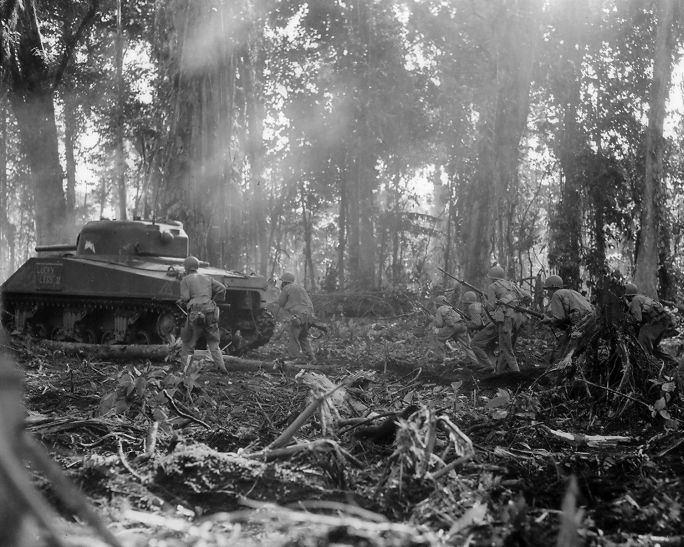
Bougainville Counterattack
Lieutenant General Harukichi Hyakutake had an 18,000-man army on Bougainville and orders to drive the Americans into the sea. What he did not have was accurate intelligence. He believed the U.S. garrison around Torokina numbered perhaps 30,000 men. It was closer to 62,000, dug into coral-sand bunkers reinforced by a full artillery complement and fronted by veteran Marines turned infantry. When his March 1944 offensive crashed against those lines, the Japanese army on Bougainville effectively broke against them. Some 5,000 Japanese soldiers would die in two weeks of fighting that the American defenders barely had to shift reserves to repel.
The Beachhead They Could Not Push Back
The Americans had come ashore at Cape Torokina on Bougainville's west coast in November 1943, not because it was the best landing site but because it was the worst. Japanese commanders had fortified the obvious beaches around Buin in the south and Buka in the north. Empress Augusta Bay, swampy and malarial with no road inland, seemed to need no defense. That was the point. Once the Seabees pushed an airfield out of the jungle mud, Allied fighters and bombers could finally reach Rabaul - the great Japanese base 400 kilometers north that had anchored the southwest Pacific for two years. By March 1944, Rabaul was being systematically bombed out of relevance. Hyakutake's counterattack was the desperate attempt to close the airfield and reopen that northern corridor.
Hyakutake's Plan
The 17th Army had marched through the island's interior for weeks to reach the American perimeter - a punishing movement over mountain spurs and through rainforest that left troops underfed before they ever fired a shot. Hyakutake split his force into three columns aimed at Hill 700, Hill 260, and a ridge that would come to be called Cannon Hill. His artillery, such as it was, consisted of mountain guns that had been broken down into parts and carried up the ridges on soldiers' backs. The Americans, by contrast, had howitzers registered on every draw and spur in front of their lines. When the Japanese assault hit on 8 March 1944, the U.S. artillery had been waiting for months to do exactly this work. A single battalion of 155mm guns fired more shells in the first day than Hyakutake's entire artillery park had ammunition for.
The Fight at Hill 260
Hill 260 was one of the few places the Japanese briefly held ground. The position was anchored on a giant banyan tree whose roots ran along the ridgeline, and Japanese soldiers tunneled into its buttress roots and fought from inside them. American flamethrower teams and satchel charges eventually burned the tree out over several days of close combat that the U.S. official history described with unusual understatement. On 24 March the Americans retook the hill. The 2nd Battalion of the 4th South Seas Garrison Unit covered the Japanese withdrawal, and the shattered 17th Army began the long march back to its starting positions. Many of the wounded never made it. Starvation and disease killed hundreds more in the weeks that followed. Several Japanese units were disbanded because there were not enough survivors left to rebuild them.
The Soldiers History Forgot
Among the troops who held the expanded perimeter in the weeks after Hill 260 were the African American soldiers of the 24th Infantry Regiment and the 93rd Infantry Division. The Army had sent them to Bougainville primarily to give them combat experience, a careful formulation that acknowledged without quite admitting that the segregated Army had kept Black soldiers out of frontline infantry roles for most of the war. They patrolled the ridges beyond Torokina and took casualties doing it. The 93rd Division would be the only African American infantry division committed to ground combat in the Pacific. Their service on Bougainville remains one of the war's most undertold chapters - overshadowed by Tuskegee aviators and the 92nd Division in Italy, filed away in an official history that described their role in a single paragraph.
The Australians Take Over
By late 1944, the U.S. Army's priorities had shifted to the Philippines. Lieutenant General Stanley Savige's Australian II Corps relieved the Americans around Torokina that November, and Australia inherited a problem the Americans had chosen to leave alone. Some 25,000 Japanese soldiers remained scattered across the island, mostly starving, but still armed and capable of local attacks. Savige decided on a three-pronged offensive to destroy them - a decision Australian historians have debated ever since, given that Japan's defeat was already certain. The fighting that followed - at Slater's Knoll, Tsimba Ridge, Porton Plantation, Ratsua, along the Hongorai River - killed thousands more on both sides and continued almost to the day of the Japanese surrender in August 1945. For the Bougainvilleans whose villages sat between the armies, the war had never really paused. They would be the ones still living there when the bomber wrecks, tanks, and rusting artillery pieces became landmarks - relics that today stand in jungle as silent monuments to a campaign that mattered less than the men fighting it had been told.
From the Air
Located at 6.19S, 155.08E in central Bougainville, between the Torokina beachhead on the west coast and the Crown Prince Range interior. From altitude, the Laruma River valley and the rugged spurs of Hills 260 and 700 appear as deep green folds. Nearest airports: Aropa Airport (AYIQ) at Arawa, Buka Airport (AYBK). Tropical rainforest climate with frequent cloud cover over the ridges.