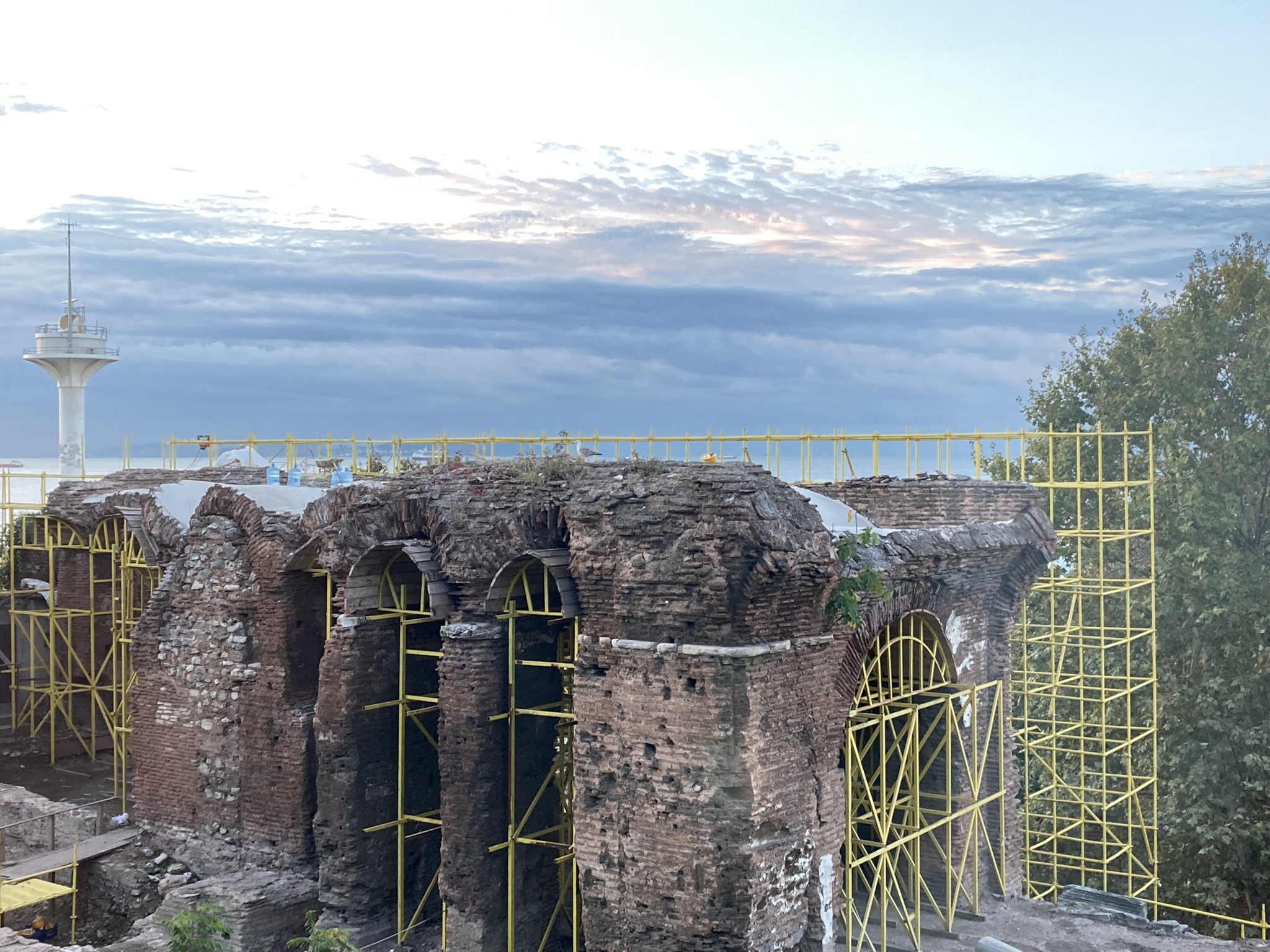
Boukoleon Palace
Drive along the Sea of Marmara coastal road from Sultanahmet, past the railway tracks and the small fish restaurants, and at one stretch of weed-grown ruin three openings stand in a high stone wall. They are framed in marble, their lintels intact, their proportions imperial. They look out over a low retaining wall toward the modern boulevard - and beyond it, at last, the sea. Once they opened from a balcony above a private harbor where the imperial galleys docked. Once a marble bull and a marble lion stood at the harbor entrance, and gave the palace its name. The bull is long lost. The lion sits today in the Istanbul Archaeology Museum a kilometer away, watching tourists from a glass case.
Names and Beginnings
The palace took its name from those vanished statues. Boukoleon comes from the Greek bous, ox or bull, and leon, lion - bull-and-lion, the linked figures of the harbor. Before that the area had been called Hormisdas, after a Sasanian Persian prince named Hormizd who had taken refuge in Constantinople in the fourth century. The palace itself was probably built during the reign of Theodosius II in the early fifth century, on a site at the southern edge of what would become the sprawling Great Palace complex. It sat directly on the seaward walls, with windows opening onto the Marmara. Emperor Theophilos in the ninth century rebuilt and expanded the structure, adding the great facade above the sea wall. In 969 Nikephoros II Phokas - the soldier-emperor - built a circuit wall to fortify it. By the eleventh century, when the Komnenos dynasty moved the imperial residence to the Palace of Blachernae at the city's northern wall, Boukoleon had been the working home of Byzantine emperors for almost six hundred years.
Diplomats, Saints, and Stolen Brides
Even after the court moved to Blachernae, Boukoleon stayed in use for state ceremony. In 1161 Emperor Manuel I Komnenos received Sultan Kilij Arslan II of Rum here. In 1166 he held a church council in its halls. In 1171 he hosted King Amalric of Jerusalem. The palace chapel housed sacred relics - fragments of the True Cross, holy nails, vestments that had touched saints - which were considered too precious to display freely but which somehow still drew Christian pilgrims, suggesting a back door for the well-connected faithful. Then came 1204 and the Fourth Crusade. Boniface of Montferrat, one of the leaders of the army that had just sacked Constantinople, rode along the shore to Boukoleon and accepted the palace's surrender on terms - the lives of those inside would be spared. The chronicler Geoffrey of Villehardouin recorded what Boniface found: 'The larger number of the great ladies who had fled to the castle, for there were found the sister of the King of France, who had been empress, and the sister of the King of Hungary, who had also been empress, and other ladies very many. Of the treasure that was found in that palace I cannot well speak, for there was so much that it was beyond end or counting.' Boniface married one of those ladies - Empress Margaret of Hungary, daughter of Bela III - presumably with whatever consent a captured former empress could give. The Latin emperors continued to use Boukoleon as a residence until 1261, when Michael VIII Palaiologos retook the city for the Greeks.
Slow Forgetting
The Byzantine restoration did not save Boukoleon. The court stayed at Blachernae and the old palace by the sea was gradually abandoned, its stone quarried, its mosaics flaking, its private harbor silting up. When Mehmed II rode into the captured city in 1453 he visited the palace and reportedly recited a couplet by the Persian poet Saadi about the impermanence of empires - the spider weaving curtains in the palace of Caesars, the owl calling the watches in the towers of Afrasiab. The palace stood, in ruin, for another four centuries. In 1873 a railway line was driven through to Sirkeci Terminal and the workers blasted away most of what remained. What survived was the section of facade with the three marble-framed doorways, a fragment of the seaward wall, and very little else.
Restoration
For the next century and a half the ruin sat behind the railway line and the coastal road, mostly ignored, occasionally photographed by Byzantine scholars. In 2018 the Istanbul Metropolitan Municipality announced a restoration program, and the Cultural and Natural Heritage Conservation Board began the slow work of stabilizing what was left. In 2021, archaeologists working on the site uncovered a Byzantine-era fountain, sixteen hundred years old, whose existence had been forgotten. Plans call for an open-air museum here - a timber walking trail, an interpretive museum, a reflecting pool that will gesture at the harbor that used to lap at the foundations. As of 2025 the work continues. The marble lions that named the palace are still in the Archaeology Museum's collection, and there has been talk of returning at least one to the site. Whether that will happen, and on what terms, is a slower decision.
What Three Doorways Hold
Stand at the foot of the surviving facade in late afternoon, with traffic running on the coastal road behind you, and look up at the three openings. They are too high above the modern street to enter. They are the wrong shape for the wall that frames them - too generous, too imperial, too clearly meant to look out over an open view rather than a four-lane boulevard. Through them an emperor once watched ships come into a private harbor. Through them, possibly, a Persian prince once watched the Sea of Marmara catch the morning light. They are very plain marble, well-cut, weather-worn. They have outlasted six empires. The sea they were built to face is half a kilometer away now, beyond pavement and walls, but on a quiet night with the windows of the modern city behind you, you can hear the Marmara still.
From the Air
Located at 41.0025 N, 28.976 E, on the south coast of Istanbul's historic peninsula, just east of the Little Hagia Sophia and below the Sultanahmet district. Best viewed at 1,500-3,000 feet altitude; the surviving facade is small but the seaward walls of Constantinople run east-west along this coast for several kilometers. The Sea of Marmara opens to the south. Nearest airport is Istanbul Airport (LTFM); Sabiha Gokcen (LTFJ) is on the Asian side.