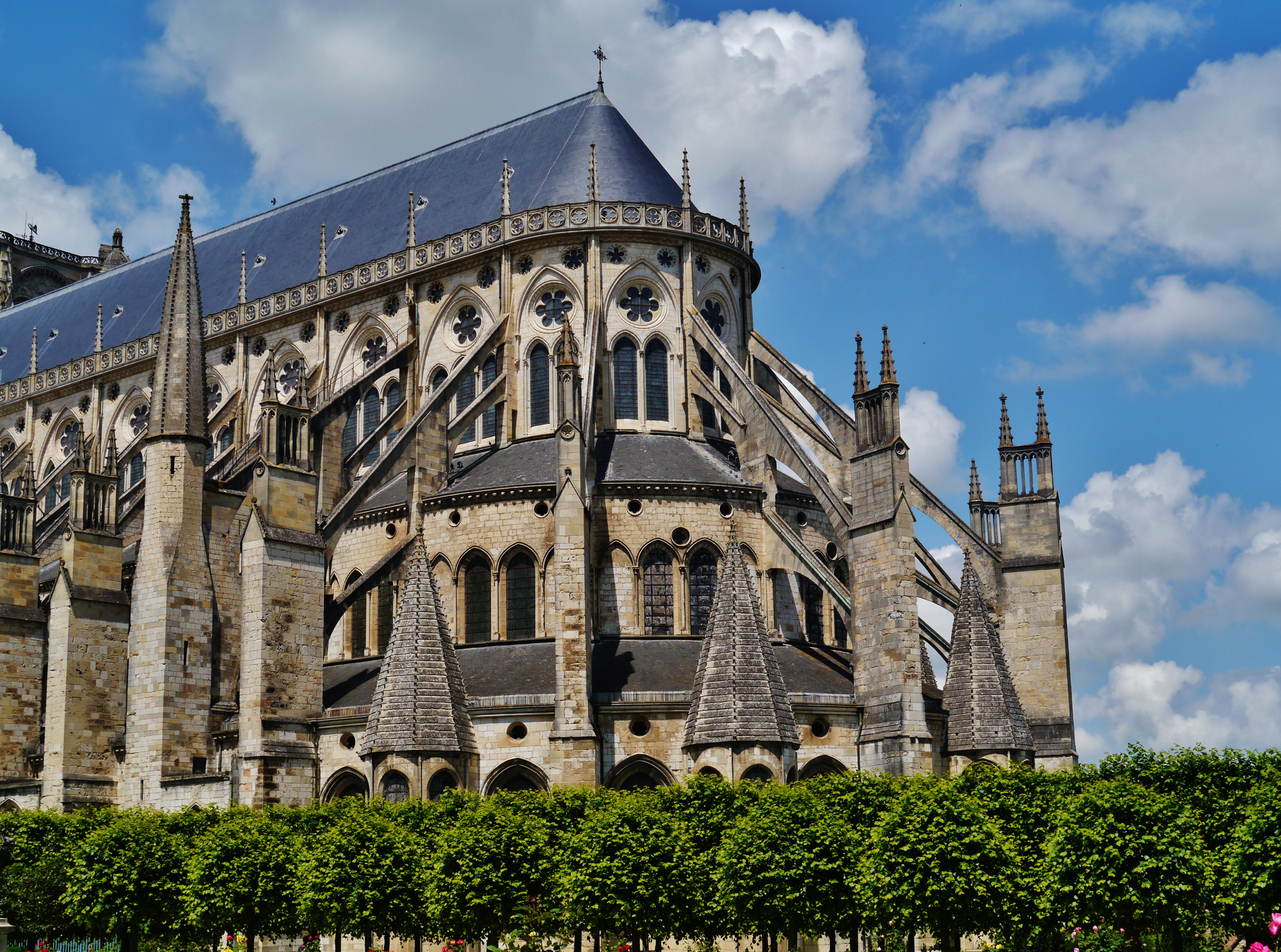
Bourges Cathedral
Bourges Cathedral has no transept. Walk through the west front -- five portals wide, more than Notre-Dame de Paris -- and the interior opens without interruption from entrance to apse, 118 meters of unbroken space. Most Gothic cathedrals divide their interiors with crossing arms that create a cruciform plan. The builders at Bourges rejected that convention. Instead, they designed a double-aisled nave where the collateral aisles rise in steps of different heights, allowing light to cascade down through three tiers of windows. The result is an interior of extraordinary luminosity and spatial unity, completed in roughly sixty-three years from groundbreaking in 1195 -- a record pace for a Gothic cathedral. UNESCO recognized the building as a World Heritage Site in 1992.
From Roman Capital to Gothic Ambition
The walled city of Avaricum, capital of the Gallic tribe of the Bituriges, was conquered by Julius Caesar in 54 B.C. and became the capital of the Gallo-Roman province of Aquitaine. Christianity arrived with Saint Ursinus around 300 A.D. A church 'magnificent' enough to impress Gregory of Tours existed by the sixth century. The site was rebuilt in the ninth century, then again between 1013 and 1030 under Bishop Gauzelin. In 1145, Louis VII held his Christmas court at Bourges with Eleanor of Aquitaine in the older Romanesque cathedral on this site. But the real transformation began under Archbishop Henri de Sully, who in 1195 launched the total reconstruction of the building. Work started at the east end, where builders first constructed a lower church six meters deep in the space where old ramparts overlooked the city. This subterranean structure, with its double ambulatory, was finished by about 1200 and served as the foundation for the soaring chevet above.
Light in Three Registers
The architectural innovation at Bourges lies in its cross-section. Where Chartres, begun at nearly the same time, gave its collateral aisles equal height, Bourges stacked them in ascending steps from the outer wall to the center. Both the nave and the inner aisle have three-part elevations -- arcade, triforium, and clerestory windows -- so light enters at multiple heights through separate banks of glass. The effect is a triangular cross-section that admits considerably more illumination than conventional double-aisled designs like Notre-Dame. The nave rises 37.15 meters to its vaults, taller than Notre-Dame's 33 meters though shorter than the 42 meters at Amiens. Each sexpartite vault covers two traverses, and the pillars of the arcade reach 21 meters -- more than half the total interior height. The design was influential: Toledo Cathedral copied it, as did the choir at Le Mans. Nine hundred oak trees were felled to build the wooden roof framework between 1240 and 1255, and the cathedral was substantially complete by 1259.
Windows of Fire and Parable
The thirteenth-century stained glass of Bourges is among the finest surviving anywhere, and much of it is displayed at ground level -- an unusual advantage that allows visitors to study details normally lost to distance. In the ambulatory chapels of the apse, windows from around 1215 depict the life of Joseph searching for his brothers, the parable of Lazarus and the Rich Man (funded by the stonemasons' guild, who included images of themselves at work), the Passion, the Good Samaritan, and the Apocalypse. Art historian Louis Grodecki identified three distinct masters or workshops in the glazing. Later centuries added their own glass: the Annunciation Window in the Chapel of Jacques Coeur, made in 1453, is one of the finest achievements of fifteenth-century stained glass. A sixteen-scene window devoted to Joan of Arc, installed in 1517 in the Chapel of Saint Joan of Arc, renders her life with precise Renaissance detail. Many of the original high windows were replaced in the eighteenth century with plain grisaille glass to conform with new Vatican doctrines favoring brighter interiors -- a loss that shifted the character of the light but could not diminish the ground-level masterpieces.
The Clock, the Tower, and the Butter Tax
In November 1424, with the royal court based in Bourges during the Hundred Years' War, an astronomical clock was installed for the baptism of the Dauphin -- the future Louis XI. Designed by the canon and mathematician Jean Fusoris and built by André Cassart, the clock shows the hour, the moon's phase and age, and the sun's position in the zodiac. Its bells chime the first four notes of the Salve Regina on the hour. After restorations in 1782, 1822, 1841, and a complete overhaul in 1872, a 1986 fire badly damaged it. The clock was reinstalled in 1994 with a replica mechanism; the original is on display nearby. The cathedral's north tower, meanwhile, has its own troubled history. Completed after years of work, it collapsed on December 31, 1506. To fund its reconstruction, Archbishop Guillaume de Cambrai offered dispensations allowing the faithful to eat butter during Lent in exchange for contributions -- earning the rebuilt structure the nickname 'the Butter Tower.' It was repaired between 1508 and 1524.
Survival Through Revolution and War
Protestant forces under Gabriel de Lorges seized Bourges by surprise on May 27, 1562, pillaging the treasury, overturning statues, and smashing bas-relief sculpture. De Lorges was preparing to demolish the cathedral entirely before others persuaded him to convert it into a Protestant church instead. The building survived. During the French Revolution, the cathedral became a Temple of Reason. Reliquaries were melted for gold, and ten of twelve bells were recast as cannon. The eighteenth century had already stripped the medieval choir of its original decoration, replacing the Gothic altar and thirteenth-century rood screen with Baroque marble and wrought-iron grills. What the Revolution did not destroy, nineteenth-century restorers sometimes reinvented -- adding pinnacles and balustrades of questionable historical basis. Yet the core remains: the five-portal west front, the double-aisled nave, the ground-level glass that glows with eight hundred years of accumulated craft. From the air, the cathedral's silhouette dominates the low roofline of Bourges, its single finished tower and its buttressed walls announcing themselves across the flat terrain of the Berry region.
From the Air
Located at 47.082°N, 2.399°E, in the center of Bourges. The cathedral is the tallest structure in the city and easily identifiable from the air by its single completed north tower and extensive flying buttresses. Nearest airports: Bourges Airport (LFLD) approximately 5 km northwest. Best viewed at 1,500-3,000 ft AGL. The flat terrain of the Berry region makes the cathedral's vertical profile especially prominent.