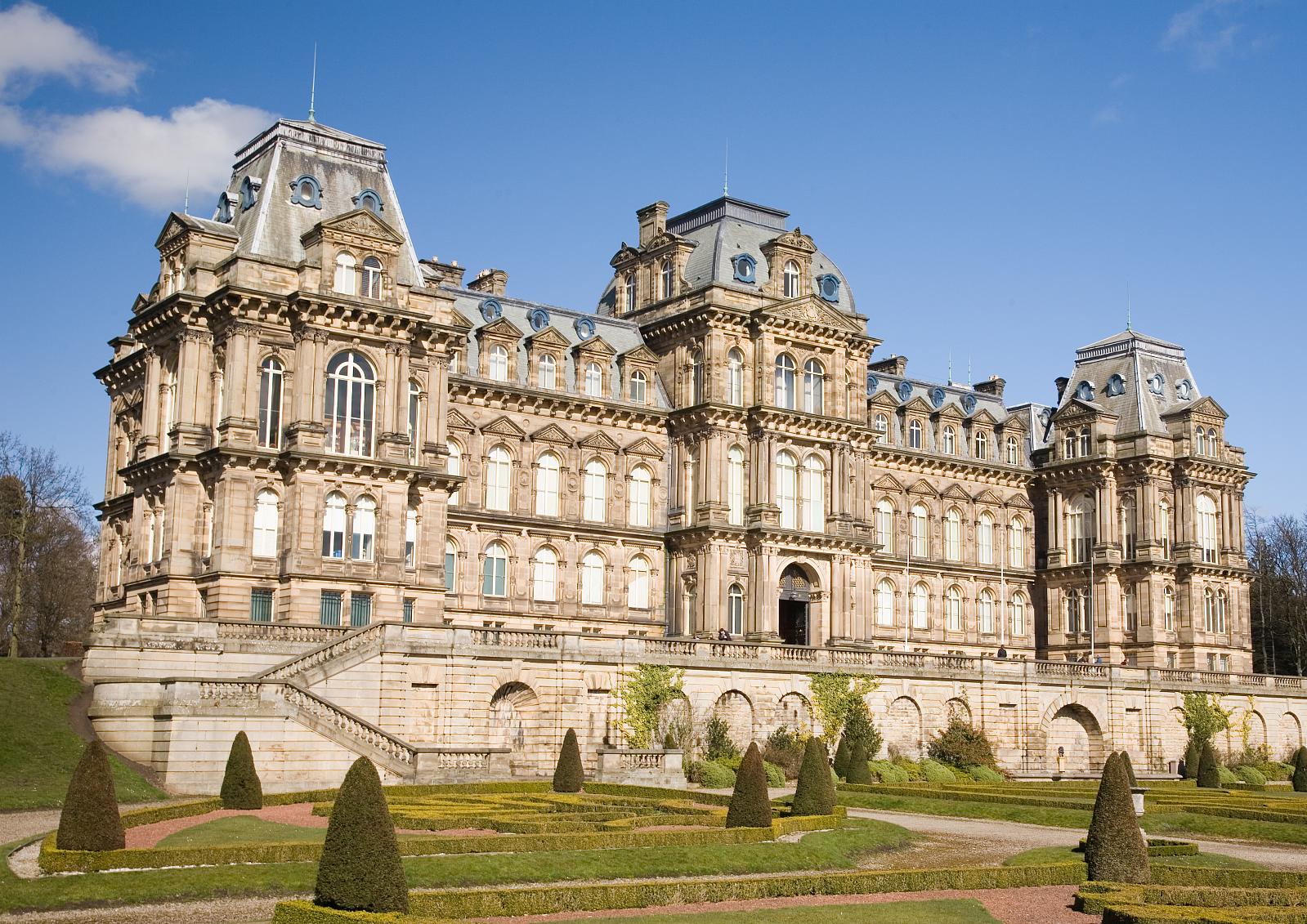
Bowes Museum
It looks like a hallucination. A grand French chateau, 500 feet long and 50 feet high, with mansard roofs and engaged columns and projecting bays, rising from the market town of Barnard Castle in County Durham. The architectural historian Nikolaus Pevsner called it "big, bold and incongruous, looking exactly like the town hall of a major provincial town in France." He meant it as criticism. Most visitors take it as a compliment.
An Unlikely Love Story
The Bowes Museum exists because of John Bowes and Josephine Coffin-Chevallier, and their story is as improbable as the building itself. Bowes was the son of the 10th Earl of Strathmore and Kinghorne, but because his parents married only on his father's deathbed, Scottish law deemed him illegitimate and denied him the title. He inherited the fortune but not the name. Josephine was a French actress who became Countess of Montalbo. They married in 1852, and from their base in Paris they began buying art with the specific intention of building a public museum in Teesdale. Not a private gallery for aristocratic friends, but a public institution, free and open to all. Construction began in 1869 on a design by French architect Jules Pellechet and Newcastle architect John Edward Watson. Neither John nor Josephine lived to see it open. She died in 1874, he in 1885. The museum welcomed its first visitors in 1892, seven years after his death.
The Collection Within
What the Bowes amassed in their decades of collecting is staggering. Paintings by El Greco, Goya, Canaletto, Fragonard, and Boucher line the galleries. Porcelain, textiles, tapestries, clocks, and costumes fill room after room. Some early works by the Art Nouveau glass master Emile Galle were commissioned directly by Josephine. In total, the couple left an endowment and 800 paintings, with their collection of European fine and decorative arts amounting to 15,000 pieces. In 2013, an art historian browsing the Your Paintings website spotted a grimy portrait in the museum's online catalogue. It turned out to be a previously unknown Anthony van Dyck, buried under layers of varnish and dirt in a Bowes storeroom. The Portrait of Olivia Porter had been hiding in plain sight, catalogued but unrecognized.
The Silver Swan
The museum's most beloved exhibit is not a painting but a machine. The Silver Swan is a life-size 18th-century automaton that sits in a glass case, surrounded by silver rods representing a stream. When activated, the swan turns its head, preens its feathers, appears to notice a fish swimming below, then dips its neck and catches it. The mechanism, driven by clockwork, produces movements so fluid that the swan seems almost alive. Mark Twain saw it at the 1867 Paris Exhibition and wrote about it. It is a fitting symbol for the museum itself: something beautiful and mechanical and slightly magical, placed where you would least expect to find it.
Gloriously Inappropriate
Pevsner's judgment that the building was "gloriously inappropriate" for its setting has aged into something like a mission statement. The Bowes Museum is not supposed to make sense in Barnard Castle. A chateau of this scale belongs on a Parisian boulevard, not in a North Pennines market town of a few thousand people. That is precisely what makes it extraordinary. A major redevelopment beginning in 2005 added new galleries for fashion, textiles, silver, and English interiors, while temporary exhibitions have showcased works by Monet, Raphael, Turner, and Toulouse-Lautrec. The building endures as a monument to two people who believed that world-class art belonged not behind the gates of aristocratic estates but in the places where ordinary people could reach it. The chateau on the hill is still gloriously inappropriate, and County Durham would not have it any other way.
From the Air
Located at 54.54N, 1.92W near Barnard Castle in County Durham. The large French-style chateau is visible from moderate altitude as a distinctive rectangular building with formal gardens, standing apart from the surrounding market town. Nearest airports include EGNH (Blackpool) and EGNM (Leeds Bradford). Teesside International (EGNV) is approximately 25 miles east. The North Pennines provide dramatic terrain to the west.