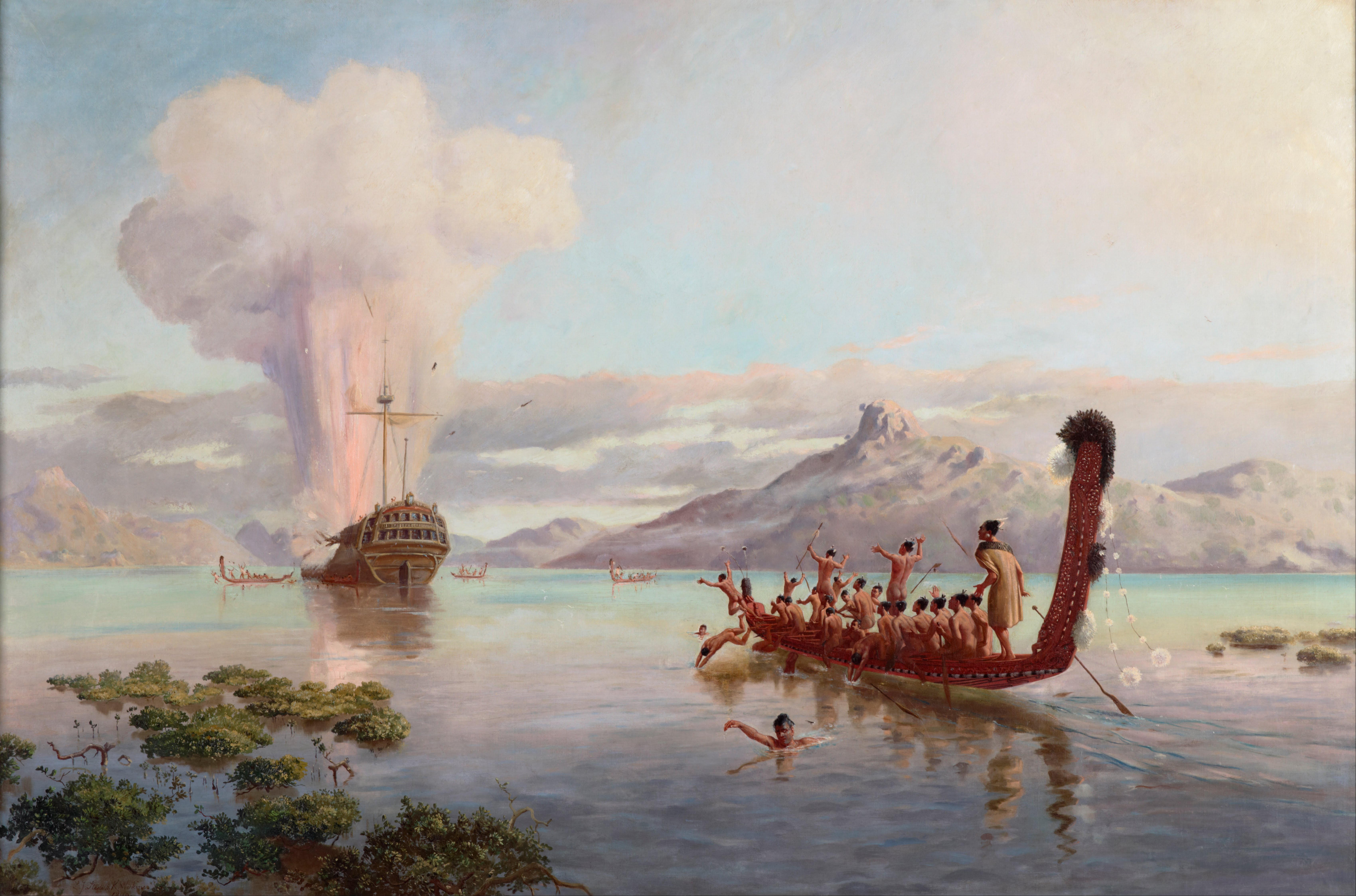
Boyd Massacre
The whipping took less than a minute. Its consequences lasted years. Sometime during the Boyd's October 1809 voyage from Sydney Cove to New Zealand's Northland coast, Captain John Thompson had Te Ara -- a young Maori chief's son returning home to Whangaroa -- tied to a capstan and flogged with a cat-o'-nine-tails. The reasons remain disputed: some accounts say Te Ara refused to work his passage because of illness or his status as a rangatira's son; another claims the ship's cook accused him of stealing pewter spoons to cover up his own mistake. Whatever the cause, the punishment triggered a concept the captain did not understand and could not have survived: utu, the Maori principle of reciprocal justice. Within days, between 66 and 70 people aboard the Boyd were dead.
A Ship of Convicts and Timber
The Boyd was a 395-ton brigantine that had carried convicts to New South Wales before turning north toward New Zealand in search of kauri spars -- the straight, strong timber that European shipbuilders prized. Captain Thompson's crew of about 70 included ex-convicts who had completed their sentences, ordinary passengers, and four or five Maori returning to their homeland. Among them was Te Ara, also called George by the crew, who had spent more than a year aboard various vessels including a sealing expedition to the Southern Ocean. Te Ara guided the Boyd into Whangaroa Harbour, assuring the captain it was the best place to find the timber he wanted. He had regained Thompson's trust after the flogging -- or seemed to. What Thompson read as reconciliation was preparation.
Nightfall at Whangaroa
Three days after the Boyd moored at Whangaroa, Maori warriors disguised themselves and manned the ship's longboat at dusk. At nightfall they slipped alongside and were greeted by unsuspecting crew. Other canoes waited for the signal in the darkness. An officer died first. The attackers moved through the ship methodically, killing every crew member they could find. Passengers were called to the deck, then killed and dismembered. Five people managed to hide in the rigging above, where they spent the night watching the violence below. The next morning, a large canoe entered the harbour carrying Te Pahi, a Ngapuhi chief from the Bay of Islands who had come to trade. The survivors in the rigging called out for help. Te Pahi gathered them and headed for shore, but two Whangaroa canoes gave chase. As the survivors scattered along the beach, their pursuers caught and killed all but one.
Five Who Lived
The massacre spared five people: Ann Morley and her baby, hidden in a cabin; apprentice Thomas Davis, concealed in the hold; the second mate; and two-year-old Elizabeth Broughton, taken by a local chief who placed a feather in her hair and kept her for three weeks. The second mate's reprieve was temporary -- forced to make fish-hooks, his captors found his work unsatisfactory and killed him too. Merchant Alexander Berry eventually secured the return of the remaining survivors by capturing two Maori chiefs and negotiating their exchange. Berry's ship carried the survivors toward the Cape of Good Hope, but storms forced them to Lima, Peru, where Ann Morley died. Young Davis eventually reached England, later worked for Berry in New South Wales, and drowned exploring the Shoalhaven River in 1822. Betsy Broughton was taken to Rio de Janeiro, returned to Sydney in 1812, married Charles Throsby's nephew, and lived until 1891 -- a lifetime measured against the night that nearly ended it.
Wrong Target, Wider Damage
In March 1810, sailors from five whaling ships launched a retaliatory attack -- but struck the wrong people. Their target was the pa on Motu Apo Island belonging to Te Pahi, the very chief who had tried to rescue the Boyd's survivors. Te Pahi's name had been confused with Te Puhi, one of the actual plotters, and his acceptance of a small boat from the Boyd's wreckage seemed to confirm his guilt. Between 16 and 60 Maori and one European sailor died in the raid. A notice circulated through Europe warning against visiting "that cursed shore" of New Zealand, and shipping to the country fell to almost nothing for the next three years. The first missionary visits were delayed. The Boyd's wreckage itself had an unexpected end: the Maori who seized it tried to extract gunpowder from the hold, struck a flint, and the resulting explosion burned the ship to its copper-sheathed waterline. They declared the charred hull tapu -- sacred, untouchable. It sat in Whangaroa Harbour as a monument to a collision between two systems of justice that neither side had the language to negotiate.
From the Air
Whangaroa Harbour (35.05S, 173.75E) is a deeply indented inlet on the northeast coast of New Zealand's Northland Peninsula. The harbour is surrounded by steep, bush-covered hills and is accessible from the sea through a narrow entrance. Kaikohe Airport (NZKK) lies approximately 40 km to the southwest. From the air, the harbour's dramatic rock formations and sheltered bays are visible -- particularly the narrow entrance where the Boyd would have sailed in. The Bay of Islands, where Te Pahi's people were based, is visible approximately 60 km to the southeast. Weather is subtropical maritime with warm, humid summers.