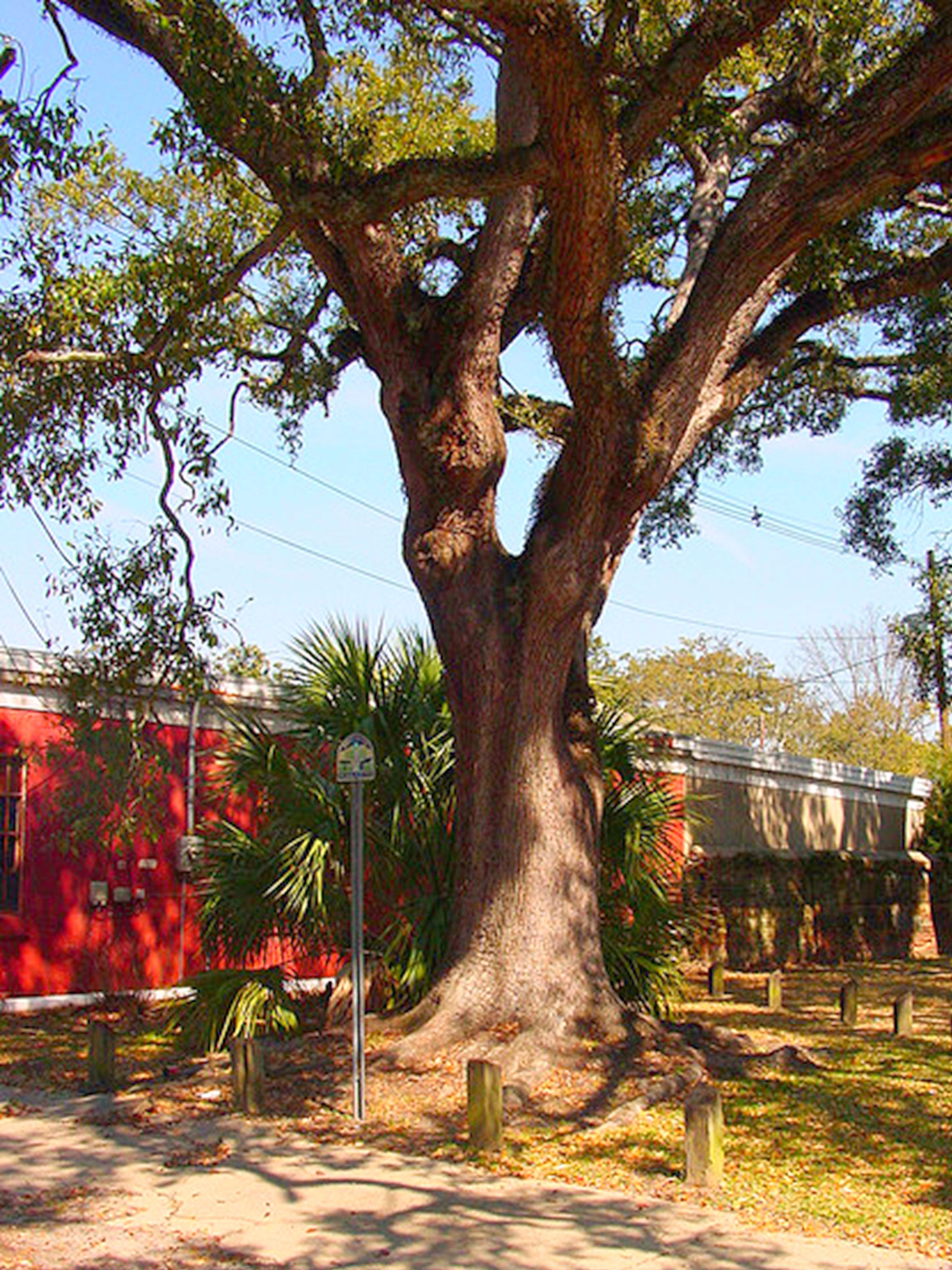
Boyington Oak
On February 20, 1835, Charles R.S. Boyington stood on the gallows in Mobile, Alabama, and made a prophecy. He had been convicted of murdering his friend and roommate Nathaniel Frost, but he swore to the crowd that he was innocent. As proof, he declared, a mighty oak tree would spring from his heart after his burial. They hanged him anyway, buried him in the potter's field at the northwestern corner of Church Street Graveyard -- and an oak tree grew from the grave. Nearly two centuries later, the Boyington Oak still stands at the edge of Bayou Street, its gnarled limbs spreading over the cemetery wall like a verdict that arrived too late.
A Printer from Connecticut
Charles R.S. Boyington arrived in Mobile from Connecticut in 1833, during the city's years of rapid growth and expansion. He was a young printer by trade and a gambler by habit, living in one of the many boarding houses that dotted the booming port city. His roommate was Nathaniel Frost, a friend to whom Boyington reportedly owed money. On the evening of May 11, 1834, the two men were seen walking together toward Church Street Graveyard, which then sat on the outskirts of town. Frost never returned. His body was found near the cemetery, stabbed to death and robbed. Boyington was the obvious suspect -- the last person seen with Frost, a man who owed him money -- and despite the absence of eyewitnesses to the crime, he was arrested, tried, and found guilty of murder.
The Prophecy at the Gallows
Boyington never wavered in his claims of innocence. Throughout his trial and imprisonment, he insisted he had not killed Nathaniel Frost. On the day of his execution, he made his final and most dramatic declaration: that a great oak tree would grow from his grave as proof that an innocent man lay beneath the soil. The citizens of Mobile watched him hang, and he was buried without ceremony in the potter's field section of Church Street Graveyard -- the ground reserved for the unclaimed and the condemned. Whether anyone believed his prophecy that day is lost to history. But the ground kept his promise for him.
The Tree That Grew
An oak tree did eventually rise from Charles Boyington's grave. A southern live oak -- the species that defines Mobile's landscape, with their massive spreading canopies and ancient, twisting limbs. The Boyington Oak grew tall and strong from the potter's field corner. Originally, both the grave and the tree stood inside the brick wall that surrounded Church Street Graveyard, but shortly after the turn of the twentieth century, the wall was moved back from this section. Today the Boyington Oak stands just outside the cemetery wall, on the edge of Bayou Street, rooted in the same ground where Boyington was buried. In a city famous for its live oaks -- trees celebrated for their age and enormous size -- the Boyington Oak is singular for the story it carries.
Whispers and Confessions
Ghost stories have clung to the Boyington Oak for generations. Visitors report hearing crying and whispering sounds near the tree, particularly at night. The legend has been published in numerous books, including Kathryn Tucker Windham's Jeffrey's Latest 13: More Alabama Ghosts and John S. Sledge's Cities of Silence. But the most remarkable chapter of the story came decades after the hanging. According to local accounts, two men separately confessed on their deathbeds to being the actual killers of Nathaniel Frost. If those confessions are true, then the oak tree did exactly what Boyington said it would -- it stood as living proof that the man in the grave below was innocent all along.
From the Air
Located at 30.686°N, 88.052°W in downtown Mobile, Alabama. Church Street Graveyard is a small historic cemetery that may be difficult to spot from altitude -- look for the tree canopy at the corner of Bayou Street and the cemetery's northwestern edge. Best viewed below 2,000 feet AGL. The dense live oak canopy of downtown Mobile is distinctive from the air. Nearby airports: KBFM (Mobile Downtown Airport, 2 nm southwest), KMOB (Mobile Regional Airport, 8 nm west). The tree is roughly 0.5 nm northwest of the Cathedral Basilica of the Immaculate Conception.