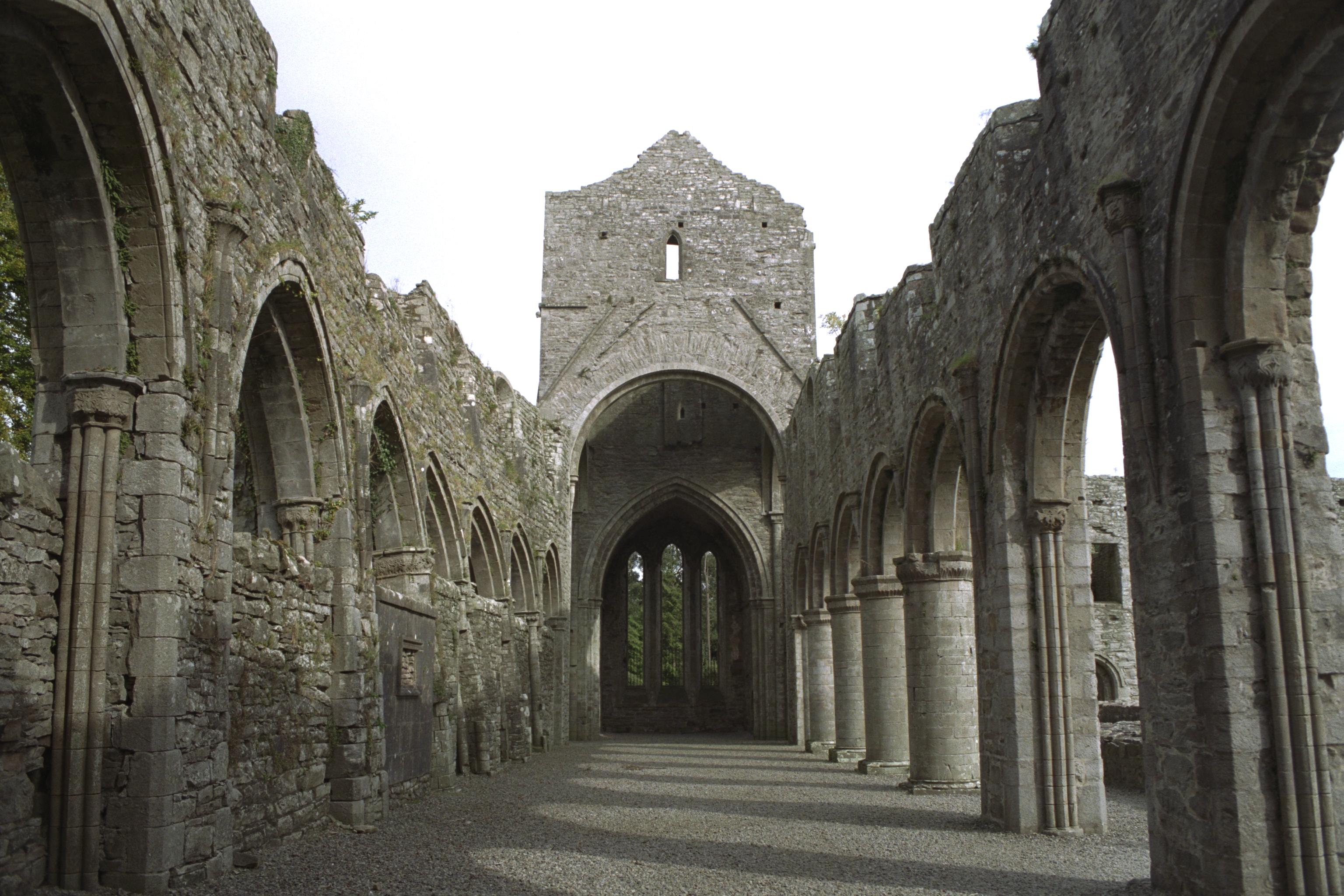
Boyle Abbey
Walk down the nave of Boyle Abbey and you can read the building's troubled construction in its columns. On the south side, cylindrical Romanesque piers with ornately carved capitals. On the north, pointed Gothic arches of a different generation entirely. The abbey took 57 years to complete -- from its founding in 1161 to its consecration around 1218 -- interrupted by war, fire, and the Anglo-Norman invasion of Ireland. The mismatched styles are not a design choice. They are evidence of a building that kept getting destroyed and rebuilt, each time in whatever fashion was current.
The Cistercian Experiment
In the 12th century, Saint Malachy traveled to France and encountered the Cistercians -- an austere monastic order whose emphasis on self-sufficiency and manual labor stood in sharp contrast to the older Irish church, which Malachy believed had drifted from the European mainstream. He arranged for young Irish men to train at Clairvaux Abbey under Bernard himself. The first Irish Cistercian house was Mellifont, founded in County Louth in 1142. From Mellifont, monks were sent west to Connacht. Peter O'Mordha and twelve companions tried three sites before settling at Boyle, where a local chieftain named McGreevy gave them an old Celtic monastery called Assylin in what was described as "pure free and perpetual alms" -- no strings attached. The monks, being vegetarian, needed arable land and running water. Assylin sat too high above the river, so they moved to the present site a few kilometers east.
Conspiracy and Conflict
Prosperity came quickly. The Cistercians received land grants totaling about 50,000 acres scattered west of the River Shannon, organized into 27 farms called granges. Boyle founded two daughter houses: Knockmoy Abbey in County Galway and Assaroe Abbey in County Donegal. But the tranquility was illusory. In 1202, a war over the kingship of Connacht brought soldiers into the abbey, leaving it badly damaged. In the 1220s, Boyle became entangled in the Conspiracy of Mellifont, when the mother abbey and its daughter houses attempted to break free from Norman control. Further attacks came in 1235 and 1284. As newer mendicant orders -- Franciscans, Dominicans, Augustinians -- arrived in Ireland and attracted recruits with a lifestyle more suited to local culture, the Cistercians lost their lay brothers. The granges were leased out. The monks carried on.
From Cloister to Barracks
By the late 15th century, local chieftains had effectively taken control of the abbey, regularly installing one of their own as abbot. When Elizabeth I suppressed the monastery, the new owner actually allowed the remaining Cistercians to stay -- a rare mercy. But the last abbot, Gelasius O Cuileannain, was executed in Dublin in 1580. The Elizabethans converted the cloister into a barracks in 1592, and the Cromwellians besieged the site in 1645, completing the destruction of the cloister garth. Between military conversion and stone quarrying over the centuries, little of the domestic buildings survives.
The Masons' Signature
What does survive is extraordinary. A squat square tower added above the crossing in the 13th century still dominates the ruins. The nave with its side aisles, the transepts with their paired chapels, the chancel with its replaced 13th-century windows -- all follow the Cistercian architectural canon. But the details tell a more complex story. The design shows influence from Burgundy, where the Cistercians originated, while the cylindrical piers of the south arcade echo the style of western England. The carved corbels and capitals were likely the work of local masons belonging to the so-called "School of the West," who produced some of the most inventive architectural sculpture of the early 13th century in Ireland. Today the abbey is a national monument in state care, and a small piece of its stone has traveled to the other side of the world -- placed on the headstone of an Irishman named Bartholomew Higgins in Sydney's Rookwood Necropolis.
From the Air
Located at 53.97°N, 8.30°W in the town of Boyle, County Roscommon. The abbey ruins are visible from low altitude near the Boyle River. Nearest airport: Ireland West Airport Knock (EIKN), approximately 35 km to the west. Lough Key and the surrounding forest park provide visual landmarks to the northeast.