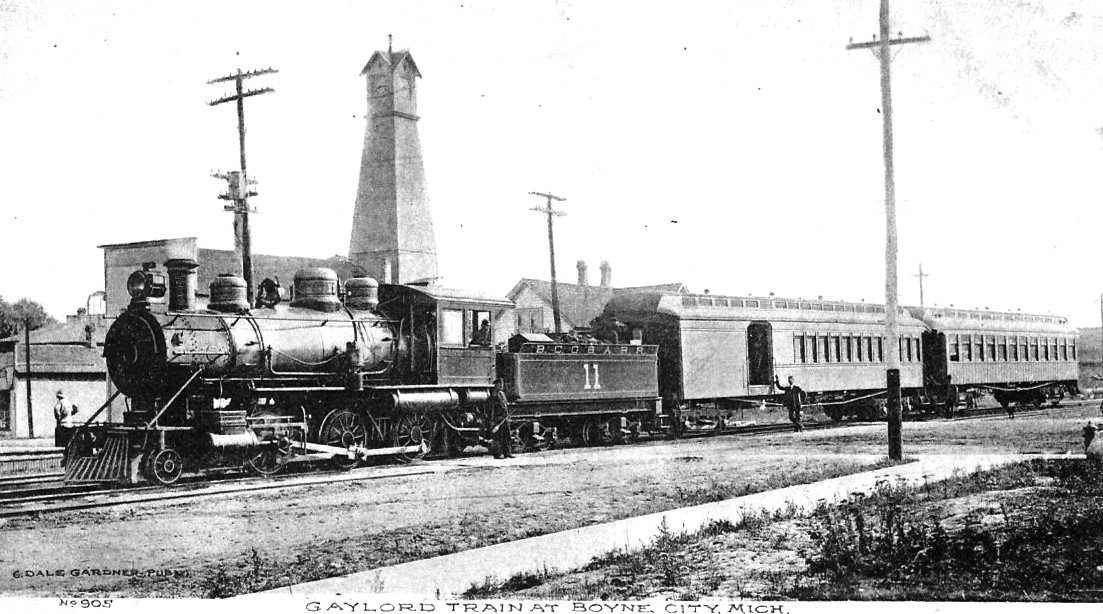
Boyne City Railroad
The pitch was simple: come to northern Michigan, buy cheap farmland, and ship your crops on our railroad. What the W.H. White Company neglected to mention was that the land had just been stripped of every marketable tree, the growing season was brutally short, and the soil beneath the stumps was poor. European immigrants and farmers from Ohio and Indiana took the bait anyway, settling cut-over land along the Boyne City, Gaylord & Alpena Railroad. When the timber revenues dried up and the settlers could not make the land pay, the railroad went bankrupt and was sold for scrap. The story of the Boyne City Railroad is the story of northern Michigan's lumber era in miniature: ambition, exploitation, collapse, and -- eventually -- a forest that grew back.
White's Empire on the Dock
William Howard White of Boyne City was the kind of industrialist the Gilded Age mass-produced. By the 1890s, his W.H. White Company operated saw mills in Boyne City, a commercial dock on Lake Charlevoix, the White Transportation Steamship Company with routes to Chicago, Buffalo, and Georgian Bay, and vast timberlands surrounding Boyne Falls. The missing piece was transportation from forest to mill. In 1893, White established the Boyne City Southeastern Railroad, starting at Mile 0 on the White Lumber Dock in Boyne City and running east to Boyne Falls, where it met the Grand Rapids & Indiana Railroad mainline. From there, a branch pushed north and east to Thumb Lake, accessing timber camps one through three. The railroad also gave White's steamship line an edge: freight arriving by rail at Boyne City's commercial docks could now compete with the established steamship terminals at the Port of Petoskey.
Gaylord, Alpena, and the Receiver
On March 28, 1905, the railroad reincorporated as the Boyne City, Gaylord & Alpena Railroad Company, with ambitions to span the width of the northern Lower Peninsula from Lake Michigan to Lake Huron. By November that year, tracks reached Gaylord, intersecting the Michigan Central mainline. Branch lines pushed into the Upper Jordan River Valley -- the junction called 'Project' is now the parking lot of Boyne Mountain Resort. But the White brothers were overextended. In November 1913, the Michigan Trust Company of Grand Rapids was appointed receiver after the companies missed all mortgage payments. Liabilities stood at roughly $2 million. The railroad stalled at the Thunder Bay River, short of Alpena, out of money. A 1917 reorganization plan required $800,000 in bonds, personal guarantees from William, Thomas, and James White -- who pledged all their capital stock -- and court approval from both the Michigan Bankruptcy Court and the Railroad Commission. On December 20, 1918, the BCG&A finally reached Alpena on Lake Huron, connecting with the Detroit and Mackinac Railway.
The Immigrant Trap
With the timber gone, the White Company faced a problem: thousands of acres of worthless cut-over land and property taxes it could not pay. The solution was to sell the land to settlers. The company marketed to farmers in Ohio, southern Michigan, and Indiana, and to European immigrants looking for a fresh start. The pitch emphasized the BCG&A as a modern transportation system -- not just for getting to northern Michigan, but for shipping farm products to market and receiving goods in return. What the marketing failed to convey was that northern Michigan has one of the shortest growing seasons in the Midwest and that most of the clear-cut land was of poor agricultural quality. The settlers came. The farms failed. The BCG&A, which had counted on these new settlers becoming its passengers and freight customers, could not survive on diminished revenue. In 1935, the railroad went bankrupt and the line was sold for scrap. The W.H. White Company, unable to pay taxes on its vast cut-over holdings, forfeited the land to the State of Michigan. Much of it was reorganized into the Mackinaw State Forest, dedicated to long-term rehabilitation of the damaged landscape.
The Short Line and Its Ghosts
A remnant survived. From 1935 to 1978, the Boyne City Railroad operated as a short line on the original roadbed between Boyne City and Boyne Falls, hauling freight to connect with trunk lines run successively by the Pennsylvania Railroad, Penn Central, and Michigan Northern. In its final two years, renamed the Boyne Valley Railroad, it offered excursion passenger service only. The last passengers rode in the summer of 1978. The tracks were formally abandoned in 1982 and removed entirely. But the old roadbed refuses to disappear. Along the Jordan River Valley, road builders followed the grade, and bridge pilings still cross the river. O'Brien Pond was formed by the old rail bed of the Boyne City & Southeastern. Near Gaylord, power lines follow the right-of-way through sand hills where cuts and embankments remain visible. At the Thunder Bay River, the 1931 Alpena Power Company dam flooded part of the grade, but traces are still visible on satellite imagery.
Survivors Scattered Across America
Pieces of the BCG&A live on, scattered improbably far from northern Michigan. A Russell snowplow sits at the Mid-Continent Railway Museum in North Freedom, Wisconsin. Caboose number 802 -- later renumbered Boyne City Railroad number 2 -- rests on the grounds of the Kalamazoo Model Railroad Historical Society. Most remarkably, Locomotive number 18 is still running, pulling excursion trains on the Arcade & Attica Railroad in western New York. The 'Flying Duchess,' originally built by Robert Stephenson and Hawthorns as MEA No. 2 for Meaford Power Station and later briefly owned by the Boyne City Railroad, stands on static display in La Grange, Kentucky. Two former British Rail Mark 1 coaches that once rode these tracks are on display at the former Michigan Central train station in Standish. The railroad is gone, the forests have returned, and the immigrant farms are mostly memory. But the machines that built and served William White's empire keep turning up in the most unexpected places.
From the Air
Located at 45.09N, 84.85W. Boyne City sits at the south end of Lake Charlevoix in Charlevoix County, Michigan. The original railroad ran east from Boyne City to Boyne Falls (visible as a small town at the base of Boyne Mountain ski resort), then continued east through Gaylord to Alpena on Lake Huron -- a route spanning the full width of the northern Lower Peninsula. Old railroad grades are visible from the air in several locations: along the Jordan River Valley, through sand hills near Gaylord, and along power line rights-of-way. Boyne Mountain Resort's parking lot marks the former 'Project' junction. Nearest airports: Boyne City Municipal Airport (N98) approximately 2nm northwest, Gaylord Regional Airport (KGLR) approximately 25nm east. Recommended viewing altitude: 3,000-5,000 feet to trace the old railroad corridor through the forested landscape.