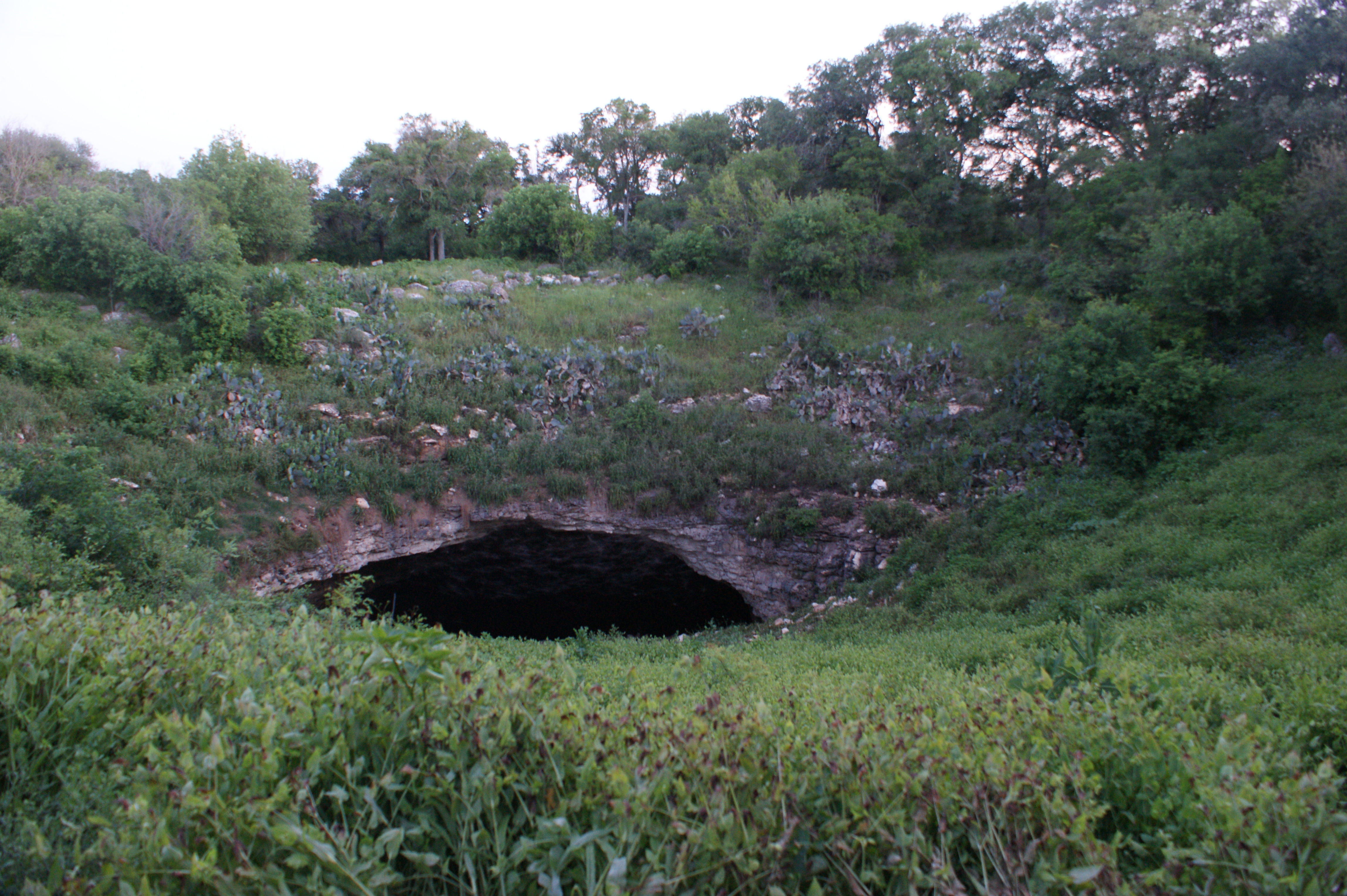
Bracken Cave
Every evening from March through October, something happens in southern Comal County that registers on Doppler weather radar. It is not a storm. It is not a flock of birds. It is a living column of twenty million Mexican free-tailed bats spiraling upward from a crescent-shaped hole in the ground, fanning out across the Texas Hill Country sky in a stream that stretches for miles. Bracken Cave holds the largest known colony of bats on Earth -- and by extension, the largest known concentration of mammals anywhere. The emergence takes hours. The last stragglers leave the cave well after dark, chasing the same agricultural pests that make this nightly spectacle one of the most consequential events in Texas farming.
The Mouth in the Earth
Bracken Cave is not a cave you walk into through a mountainside. Its entrance is a wide, crescent-shaped opening at the bottom of a sinkhole, formed when the limestone roof above the cavern collapsed. The opening sits in the scrubby ranchland northeast of San Antonio, unremarkable from above -- a depression in the rolling terrain of the Edwards Plateau that gives no hint of what lives below. The cave and the undeveloped land surrounding it are owned by Bat Conservation International, based in Austin, which purchased the initial property from the Marbach family in 1992. The Nature Conservancy has assisted in ongoing preservation. Access is tightly restricted to protect the habitat, though Bat Conservation International offers guided evening tours for visitors willing to stand at the sinkhole's rim and watch twenty million animals take flight.
Five Hundred Pups per Square Foot
The bats that arrive each spring are almost entirely pregnant females. They have flown hundreds of miles from Mexico to reach this single cave, and within weeks of arriving, each mother gives birth to a single pup. The nursery conditions inside Bracken Cave are staggering: researchers have recorded densities of up to 500 pups clinging to a single square foot of cave wall. The pups huddle together for warmth in the dark interior while their mothers leave each evening to hunt. A returning mother can locate her own pup among millions by its unique cry and scent. By late summer, the young bats join the nightly emergence, and by October the entire colony departs south for Mexico. The cycle has repeated for thousands of years, long before the cave had a name or the land above it had fences.
Guardians of the Cotton Fields
The agricultural value of Bracken Cave's colony is enormous and largely invisible. Each night, the bats consume hundreds of tons of insects, many of them agricultural pests. According to a USDA wildlife biologist stationed at nearby Randolph Air Force Base, the bats emerge between 6 and 8 p.m. and fly southeast on a direct collision course with cotton bollworm moths and army cutworm moths being pushed away from crops by prevailing southwest winds. The economic benefit to Texas farmers runs into the hundreds of millions of dollars annually in avoided crop damage and reduced pesticide use. In 2014, San Antonio, a local developer, and conservation groups struck a $20 million deal to ensure that suburban sprawl would not encroach on the cave, and critically, that the sky above the colony's flight path would remain dark at night. Artificial light disrupts the bats' emergence patterns, and light pollution from development was the single greatest threat to the colony's survival.
Counting the Uncountable
The figure of twenty million bats is an estimate, and the honest answer is that nobody knows the true population. Counting methods have proven unreliable at this scale. Leonard Ireland, an animal behavior expert who studied the Bracken Cave bats through the 1960s and 1970s, once described the emerging clouds of bats as stretching miles long and wide. Modern researchers have used thermal imaging, radar tracking, and acoustic monitoring, but the sheer density of the colony -- millions of animals pouring from a single opening in a continuous stream that lasts hours -- defeats precise measurement. The colony may number fifteen million or it may number thirty million. What is certain is that the nightly emergence, when viewed from the sinkhole's edge, looks less like animals leaving a cave and more like smoke pouring from the earth, a dark river flowing upward into the fading Texas sky.
From the Air
Located at 29.687N, 98.353W in southern Comal County, about 20 miles northeast of downtown San Antonio. From the air, look for a sinkhole depression in otherwise flat-to-rolling ranchland on the Edwards Plateau. The cave entrance is not visible from altitude, but during summer evenings (March-October, 6-8 p.m. local time), the bat emergence column is unmistakable and has been detected on weather radar. Best viewed at 2,000-4,000 ft AGL during evening hours. Nearest airports: KSAT (San Antonio International, 18 nm SW), KBAZ (New Braunfels Regional, 10 nm E). Note proximity to Randolph AFB (KRND) military airspace to the south. The Natural Bridge Caverns tourist complex sits less than a mile to the northeast.