Braemar Castle
The graffiti on the window shutters reads 'John Chestnut, Sergeant, 1797.' A Hanoverian soldier, posted to a castle deep in the Cairngorms, scratching his name into wood to prove he existed. His mark has outlasted empires. Braemar Castle, sitting beside the River Dee near the village of Braemar in Aberdeenshire, has spent four centuries being built, burned, seized, garrisoned, planted with millions of trees, and finally handed back to the community that surrounds it. It is a story of shifting loyalties in a landscape where loyalty was the most dangerous commodity of all.
Built to Counter a Clan
John Erskine, Earl of Mar, constructed the castle in 1628 as a hunting lodge -- but also as a statement of power against the rising influence of the Farquharsons, the dominant clan in the upper Dee valley. The site replaced an older building that succeeded nearby Kindrochit Castle, which dated from the 11th century and controlled historic crossings of the Grampian Mounth. A five-storey L-plan tower of granite covered in harl, Braemar was designed for both comfort and defence. Three-storey angle turrets command the approaches. The main entrance retains its original iron yett, and heavy iron grilles protect the windows. In the floor of a ground-level passage, an iron grill covers the Laird's Pit -- a hole in the rock used as a dungeon.
The Black Colonel's Fire
The castle's first destruction came from the very family it was built to contain. During the Jacobite rising of 1689, John Farquharson -- known as the Black Colonel of Inverey -- attacked and burned Braemar Castle to prevent government troops from using it as a garrison. The Earl of Mar then led the 1715 Jacobite rising, and the castle was forfeited to the Crown as punishment. The Farquharsons, now positioned on both sides of the conflict, bought the castle and its lands -- but left the building in ruins. In 1748, two years after Culloden, the government leased the ruin from the Farquharsons for fourteen pounds a year and rebuilt it as a Hanoverian garrison. The architect was John Adam, Master Mason to the Board of Ordnance. A star-shaped curtain wall with six sharp-angled salients was added -- the same kind of defensive geometry used at Fort George on the Moray Firth.
Sixteen Million Trees
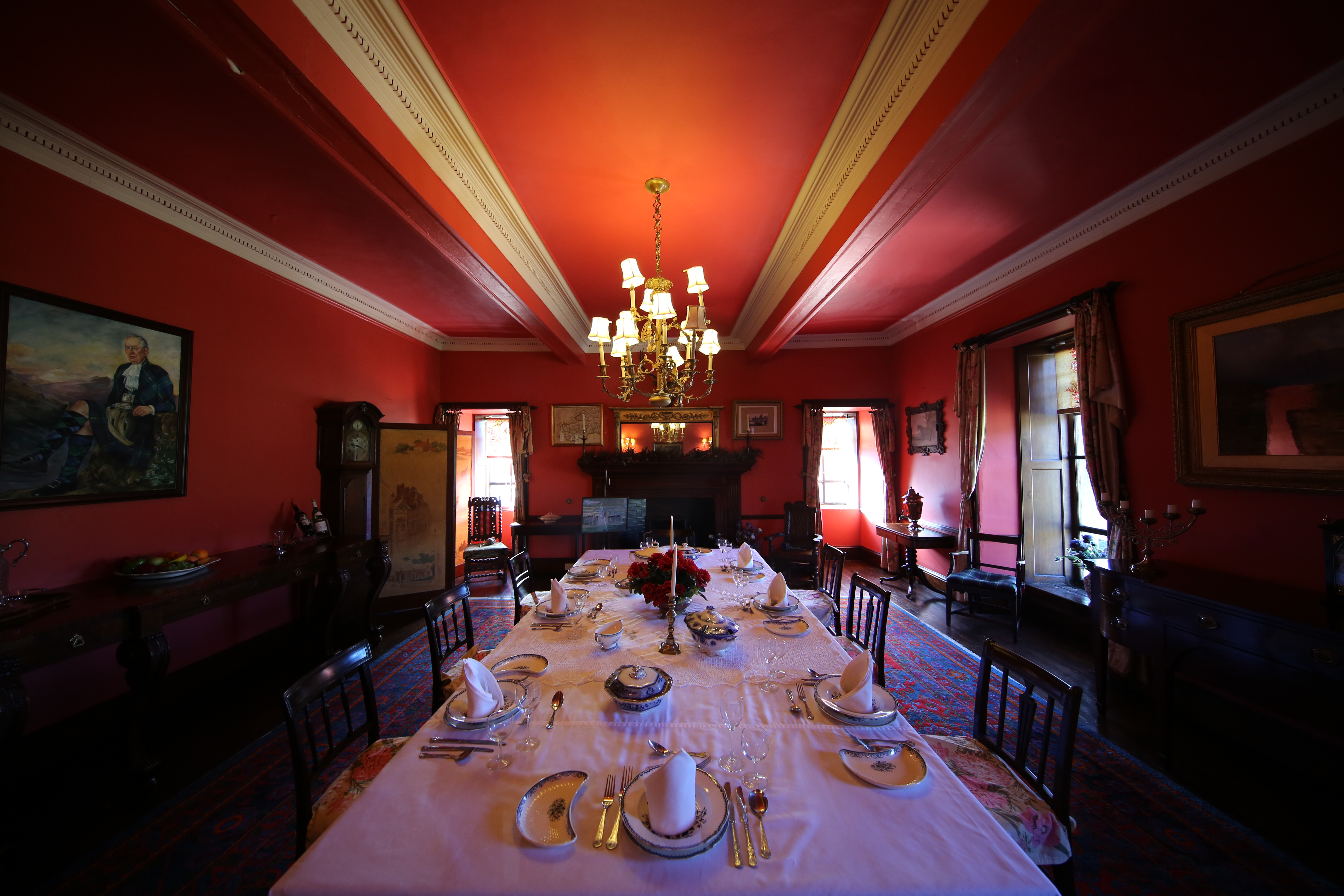
The military purpose faded, but the estate found new life. Between 1760 and 1806, James Farquharson of Invercauld planted sixteen million fir trees and two million larch across the grounds -- a staggering act of reforestation that transformed the landscape around the castle. The Victorian era brought the Farquharson family back to the upper floors as seasonal residents. The Dining Room, Morning Room, Laird's Day Room, and Rose Room were furnished for domestic life. A bathroom was installed in 1901 between two of the upper rooms, the castle's grudging concession to modernity. The Four Poster Bedroom, Ladies Guest Bedroom, and Principal Bedroom occupied the highest floors, where the family retreated during their visits to a castle that had once been a military outpost.
The Community's Castle
In 2007, the castle was leased to the local community. It is now run by Braemar Community Ltd, staffed by local volunteers, and open to the public since 2008 following an ambitious restoration programme. Walking through the rooms, a visitor encounters the full arc of the castle's history: the stone-vaulted guardroom and ammunition store on the ground floor, the government soldiers' graffiti scratched into the Drawing Room shutters, the domestic furnishings of the Victorian Farquharsons upstairs. The castle sits in a landscape where the Cairngorm mountains press close, where the River Dee runs cold and fast, and where the annual Braemar Gathering has drawn visitors since the days when clan chiefs tested their warriors in games of strength. Sergeant Chestnut, if he could see the place now, would find it much changed -- but his name is still there on the wood, still legible after more than two centuries.
From the Air
Located at 57.01N, 3.39W near the village of Braemar in upper Deeside, Aberdeenshire. The castle is in a valley setting surrounded by Cairngorm mountains. Aberdeen Airport (EGPD) is approximately 55 miles east. Best viewed at 2,000-3,500 ft AGL. The River Dee is visible running through the valley, and the village of Braemar is immediately nearby.