Braga Cathedral
Before Portugal existed, Braga Cathedral was already standing. Consecrated on August 28, 1089, when the region was still part of the Kingdom of Leon, this was the first cathedral built on Portuguese soil. The diocese it serves dates to the 3rd century AD, making Braga one of the oldest Christian seats on the Iberian Peninsula and the nerve center for the Christianization of the entire northwest. That antiquity is not just a footnote; it shaped the political destiny of the country itself. Archbishop Paio Mendes, who served from 1118 to 1137, leveraged Braga's influence at the papal court to help secure the Papal Bull Manifestis Probatum, the document that recognized Portugal's independence and made a new nation legitimate in the eyes of Christendom.
A Church That Built a Country
The story begins with Bishop Pedro, who started construction around 1071 after Braga was reclaimed from Moorish control. Only the eastern chapels were finished by consecration day. Count Henry of Burgundy, who ruled the County of Portugal from 1093, made Braga his capital and pushed the building forward, convincing the Pope to elevate it to an archbishopric in 1107. The archbishop's authority stretched across most of Portugal and into Galicia, a reach that gave the cathedral outsized political weight. When Afonso Henriques fought to establish Portuguese independence, it was the Archbishop of Braga who traveled with him, counseled him, and worked the diplomatic channels in Rome. Count Henry and his wife Countess Theresa, parents of that first king, are both buried here in the Chapel of the Kings, their 16th-century tombs bearing recumbent figures that watch over the nave they helped create.
Nine Centuries Carved in Stone
Walk through Braga Cathedral and you walk through every major architectural movement that touched Portugal. The original 12th-century structure followed the Burgundian Romanesque style of the monastery church at Cluny, and it influenced churches across the country for generations. But successive centuries refused to leave it alone. Between 1486 and 1501, a late Gothic entrance gallery called the galilee was added, its ribbed vaulting decorated with statues and gargoyles that once channeled rainwater away from the walls. In 1509, Cantabrian architect Joao de Castilho rebuilt the main chapel in the Manueline style, threading its exterior with late Gothic tracery, pinnacles, and a tender statue of the Madonna breastfeeding the infant Jesus. The 18th century brought baroque towers and an explosion of gilded woodwork inside. The result is not confusion but accumulation, each generation adding its own layer of devotion to the stone.
Gilt, Tile, and the Weight of the Dead
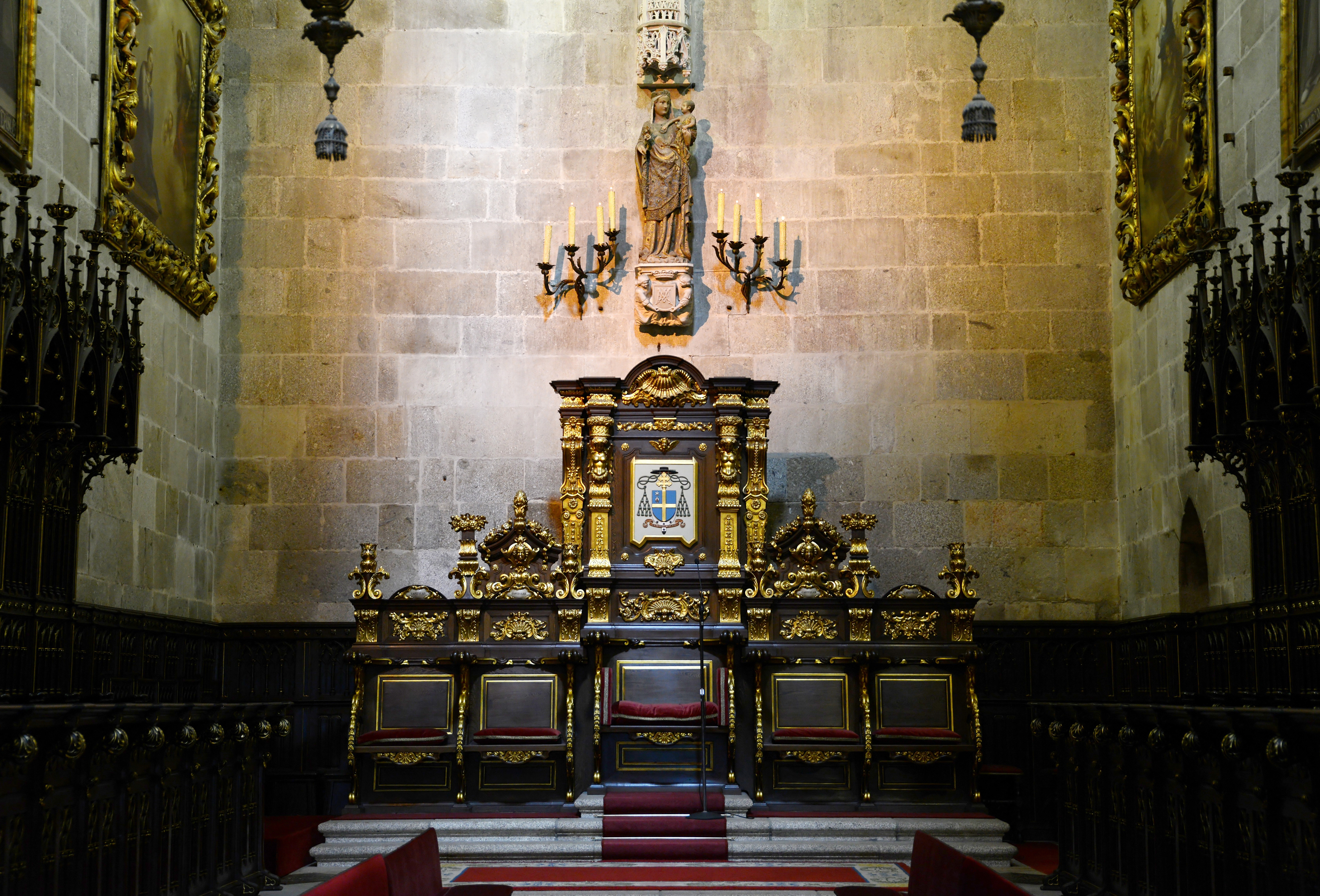
The interior rewards slow attention. Two gilt wood organs carved by sculptor Marceliano de Araujo in the 1730s flank the high choir, their surfaces heavy with baroque and fantastical motifs. They rank among the most impressive talha dourada works in Portugal. Below them, the nave has been stripped back to its Romanesque bones by a 20th-century restoration, revealing the austere rhythm of columns and arches that the original builders intended. In the Chapel of Saint Peter of Rates, blue-and-white azulejo tiles by painter Antonio de Oliveira Bernardes narrate the life of the saint traditionally considered Braga's first bishop. The Gothic Chapel of the Glory, built between 1326 and 1348, contains a tomb guarded by six stone lions. Archbishop Goncalo Pereira lies atop it in life-size effigy, his head resting on a pillow held by angels, surrounded by carved images of apostles and clergymen.
Archbishops, an Antipope, and a Mummified Warrior
The people connected to this cathedral read like a roster of Iberian power. Pope John XXI, born Pedro Juliao in Lisbon, served as Archbishop of Braga before his election in 1276. Maurice Bourdin, the second Archbishop, became embroiled in a dispute between Emperor Henry V and the papacy, was declared Antipope Gregory VIII, and died imprisoned in an Italian convent. Perhaps the most vivid presence belongs to Archbishop Lourenco Vicente, who fought alongside King John I at the Battle of Aljubarrota in 1385, earning a scar across his face. He helped retake Guimaraes and was buried in the Chapel of the Kings, where his naturally mummified body remains on display. The cathedral's museum holds treasures that span the centuries: a 10th-century chalice of Saint Gerald, an 11th-century Arab ivory box, and the magnificent Manueline chalice of Archbishop Diogo de Sousa.
From the Air
Located at 41.55N, 8.43W in the heart of Braga, northern Portugal. The cathedral's towers are visible from low altitude amid the dense old-town fabric. Nearest airport is LPBR (Braga) for light aircraft, or LPPR (Francisco Sa Carneiro/Porto) approximately 55 km south. Best viewed from 2,000-3,000 ft AGL for context within the city. The Bom Jesus do Monte sanctuary on the hillside east of the city provides a useful visual reference.