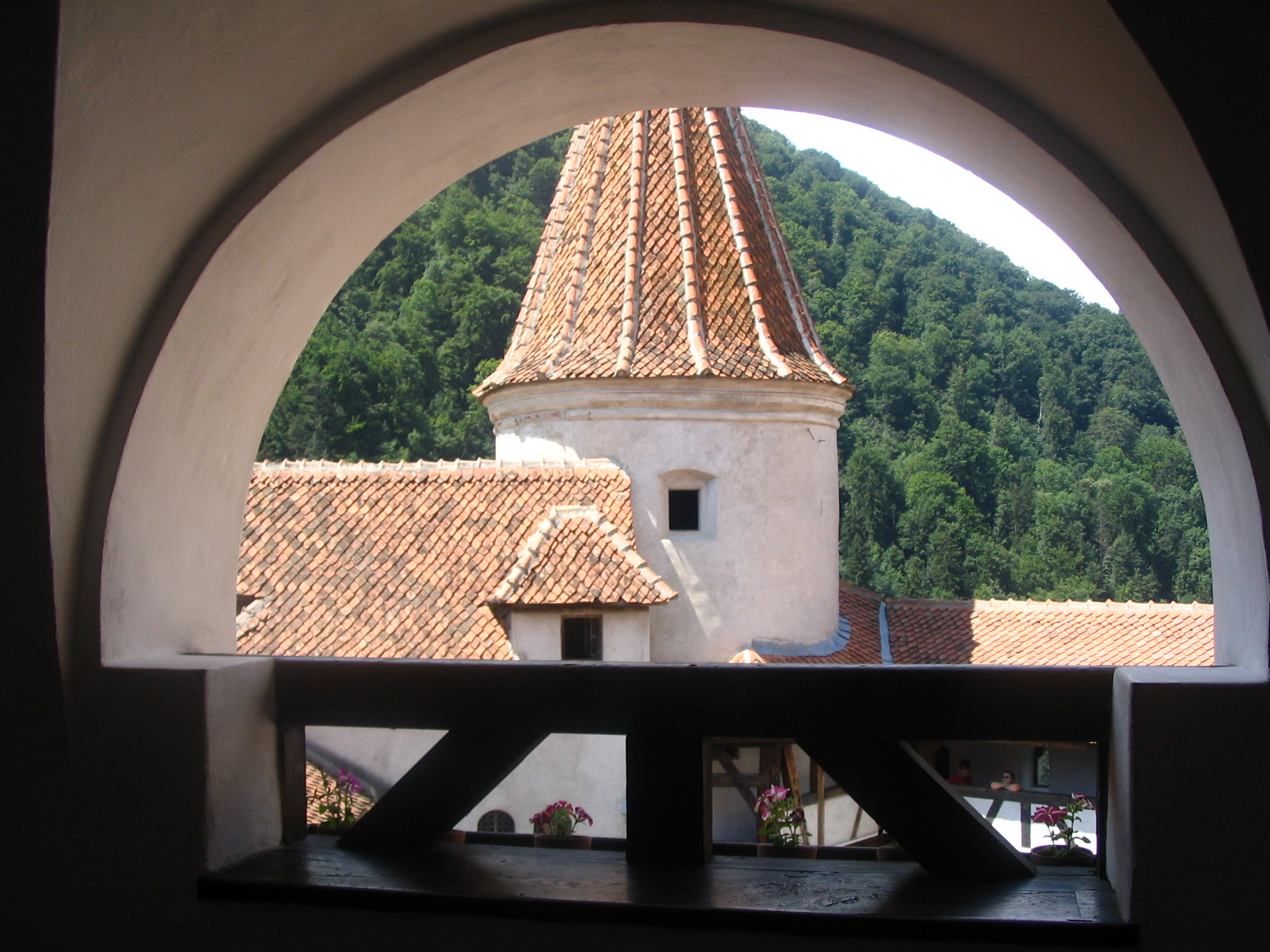
Bran Castle
Here is something Bram Stoker probably never knew: Bran Castle exists. The Irish novelist set his 1897 novel in a crumbling Transylvanian fortress surrounded by wolves and precipices, but there is no evidence he was aware of this particular castle perched on a cliff 25 kilometers southwest of Brasov. The real Bran Castle does not crumble. It sits solidly on its rock, a national monument built by Saxons in 1377, and its actual history -- involving medieval border wars, a beloved Romanian queen, a World War II hospital, communist confiscation, and a legal battle that reached the Constitutional Court -- turns out to be considerably more interesting than anything involving vampires.
Fortress on the Pass
Louis I of Hungary granted the Saxons of Brasov the right to build a stone fortress at Bran in 1377, on the Transylvanian side of the historical border with Wallachia. The location was strategic: the Bran Gorge was a key passage through the mountains, and whoever held the castle controlled trade and military movement between the two regions. Earlier fortifications may have stood on or near the site -- a contested chronicle attributes an 11th-century castle here to the Szekelys, built to defend against Cuman and Pecheneg raids -- but the 1377 structure is the one that endured. Mircea the Elder of Wallachia is believed to have briefly held Bran Castle during his reign in the late 14th century, establishing a customs point at the pass. By 1533, the city of Brasov had reclaimed the fortress after Hungary's King Vladislas II failed to repay loans. In 1530, the Voivode Moise of Wallachia sent an army to take the castle, but Szekely soldiers under the castle lord Denes repelled the attack. Bran held its military significance into the mid-18th century.
The Queen's Retreat
The Treaty of Trianon in 1920 redrew the map of Central Europe, and Hungary lost Transylvania. The Saxons of Brasov, who had maintained the castle for centuries, offered it to the Romanian royal family -- they had no further use for it and no desire to finance the aging property's repairs. Queen Marie of Romania fell in love with it. She commissioned an extensive renovation, transforming a medieval border fortress into her favorite residence, and filled its rooms with the art and furniture that visitors can still see today. Her daughter, Princess Ileana, inherited the castle and ran a hospital within its walls during World War II. In 1948, the communist regime seized the property and expelled the royal family. The castle sat in state hands for nearly six decades.
Dracula Was Never Here
The Dracula connection is Bran Castle's most famous feature and its most persistent fiction. Vlad III, the 15th-century Wallachian ruler whose cruelty earned him the name Vlad the Impaler and whose patronymic 'Draculea' inspired Stoker's character, almost certainly never lived here. Most historians agree the castle was neither a friendly place for him to visit nor under his rule. He passed through the Bran Gorge on occasion -- it was, after all, a major route through the mountains -- but that is the extent of the connection. An earlier theory that Vlad was imprisoned at Bran after the Hungarians captured him in 1462 has been abandoned; historians now conclude he was held in a fortress in Budapest. Stoker's description of Dracula's castle -- crumbling, isolated, perched above a thousand-foot precipice -- bears no physical resemblance to Bran. The 'Dracula's Castle' branding is a marketing invention, but it has proved remarkably effective at drawing visitors who arrive expecting fiction and discover genuine history instead.
Returned to the Habsburgs
On May 18, 2006, after years of legal proceedings, the Romanian state returned Bran Castle to the heirs of Princess Ileana: Archduke Dominic and his sisters, Archduchess Maria Magdalena and Archduchess Elisabeth. The transfer was not without controversy. Romania's Parliament declared the retrocession illegal in September 2007, arguing it violated property and succession laws. The Constitutional Court rejected the Parliament's petition a month later, and a government investigation commission confirmed the restitution's legality in December. On June 1, 2009, the Habsburg family opened the refurbished castle to the public as Romania's first private museum. They partnered with the village of Bran to maintain the castle's role in the regional tourist economy. At the foot of the castle hill, a small open-air museum displays traditional Romanian peasant structures -- cottages, barns, water-driven mills -- from the surrounding area. The castle that Stoker never knew about, that Dracula never lived in, and that a queen loved enough to renovate now belongs to the descendants of the princess who once ran a hospital in its rooms.
From the Air
Bran Castle is located at 45.515N, 25.367E, perched on a cliff in the Bran pass between Transylvania and Wallachia, 25 km southwest of Brasov, Romania. From 3,000-5,000 feet AGL, the castle is visible on its rocky promontory at the entrance to the gorge, with the Piatra Craiului mountain ridge rising to the west. Brasov-Ghimbav International Airport (LRBV) is the nearest major airport, approximately 30 km to the northeast. The terrain is mountainous with the Southern Carpathians dominating the landscape. Winds can be variable in the mountain passes. Excellent visibility in summer; snow cover and cloud in winter create dramatic views.