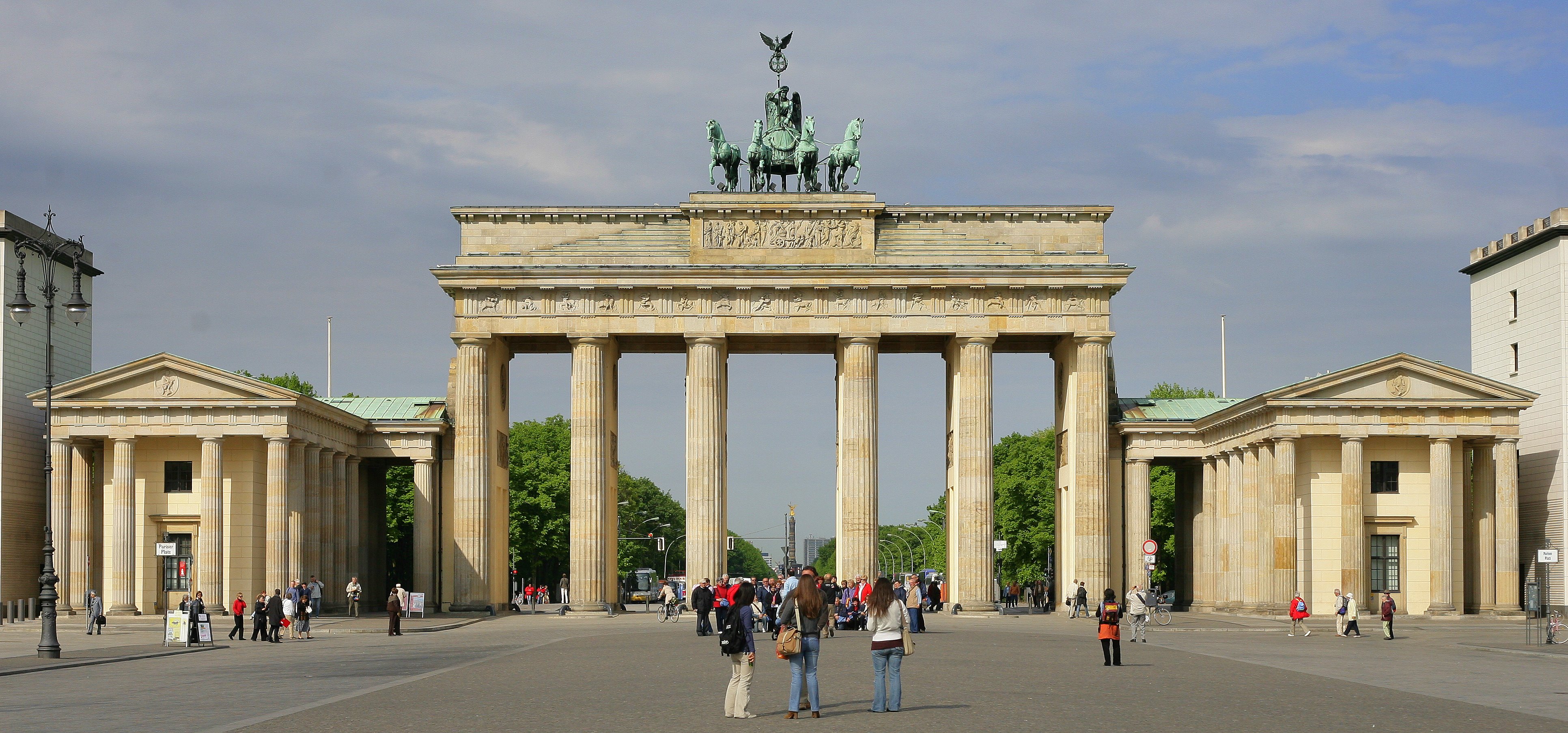
Brandenburg Gate
When Napoleon entered Berlin in October 1806 after crushing the Prussian army at Jena-Auerstedt, one of his first acts was to climb up to the top of the Brandenburg Gate, take down the bronze quadriga of horses and chariot, and ship it to Paris as a trophy. It was the first time anyone had stolen the sculpture, but it would not be the last time the gate itself was taken from someone. Built in 1788–1791 as a Friedenstor — a Peace Gate — Carl Gotthard Langhans's twelve fluted Doric columns have spent most of the past two and a half centuries acting as a backdrop for events that had very little to do with peace.
An Athenian Idea on the Spree
King Frederick William II had taken the throne in 1786 wanting Berlin to feel like a European capital — to have, as he put it, the cultural weight of Vienna or Paris or London. He summoned Carl Gotthard Langhans from Breslau and asked for a monument. What Langhans designed was unlike anything Prussia had built: twelve fluted Doric columns in five passageways, modelled on the Propylaea of the Acropolis in Athens. It was one of the first works of Greek Revival architecture in Germany, the first element of what Langhans called a new Athens on the Spree. Atop it, the sculptor Johann Gottfried Schadow placed a quadriga driven by the Greek goddess of peace, Eirene. The military victory the gate was meant to celebrate had been almost bloodless — Frederick William II had restored his brother-in-law to power in the Netherlands — and so the name Peace Gate seemed honest. The French Revolution had begun while construction was underway. Within four years of completion, the Dutch royals were in exile.
The Quadriga Comes Home
Napoleon's theft of the quadriga in 1806 made the sculpture, and the gate beneath it, into a Prussian wound. When Prussian forces took Paris in 1814, General Ernst von Pfuel oversaw the quadriga's return. Karl Friedrich Schinkel redesigned it. The goddess was now formally identified as Victoria, Roman goddess of victory rather than peace, and she carried an Iron Cross on her staff topped by a crowned Imperial eagle. Through the long nineteenth century the gate watched the Franco-Prussian War parades and the Kaiser's processions. In January 1919 government soldiers used the gate as a firing position during the Spartacist uprising, and again in March 1920 during the Kapp Putsch. The Nazis put it on their east-west axis through the planned world capital they called Germania. By 1945 it stood damaged but standing in the ruins of Pariser Platz, columns pocked with bullet holes, the original quadriga reduced to a single surviving horse's head now kept in the Märkisches Museum.
The Wall Right There
After Germany surrendered, the gate sat in the Soviet zone, just yards from the British zone that became the boundary between East and West Berlin. East and West actually cooperated on its restoration in the late 1950s — the holes were patched, a new quadriga cast from a 1942 plaster model. Then on 13 August 1961, the East German government began building the Berlin Wall, and the wall passed directly along the western face of the gate. For 28 years, no one walked through it. East Berliners could only see it from a distance. West Berlin's mayor Willy Brandt rushed back from a campaign tour the day construction began, joining crowds on the western side. In 1987, Ronald Reagan stood at the wall in front of the gate and addressed Mikhail Gorbachev directly: tear down this wall. Two years later, on 9 November 1989, the wall came down. On 22 December 1989, Helmut Kohl walked through the gate and shook hands with the East German prime minister Hans Modrow. Less than a year later Germany was reunified.
A Stage for Whatever Comes Next
The gate is closed to vehicles now, the cobblestones around it a pedestrian zone where over a million people can gather. Leonard Bernstein conducted Beethoven's Ninth here on Christmas Day 1989, six weeks after the Wall fell, with Freude — joy — replaced by Freiheit — freedom — in the choral finale. The German national football team celebrated the 2014 World Cup here. The Berlin Marathon finishes here. And after every distant atrocity the Berlin Senate decides to acknowledge — Paris in 2015, Brussels in 2016, Ukraine since February 2022 — the gate is bathed in coloured light, a bone-white monument turned briefly red, blue, yellow. In September 2023 climate activists sprayed the columns orange with fire extinguishers; fourteen were detained. The gate has lasted long enough to absorb almost any meaning anyone wants to project onto it. That, more than anything Langhans built, is what makes it a national symbol.
From the Air
The Brandenburg Gate stands at 52.516°N, 13.378°E, in the Mitte district at the eastern end of the Tiergarten and the western end of Unter den Linden. From the air it is identifiable by its position one block south of the Reichstag building and immediately east of the long green rectangle of the Tiergarten park. Berlin Brandenburg (EDDB) is 25 km southeast. From cruise altitude the gate itself is too small to pick out, but Pariser Platz appears as a distinct rectangular gap at the boundary between the Tiergarten and the dense urban grid of Mitte.