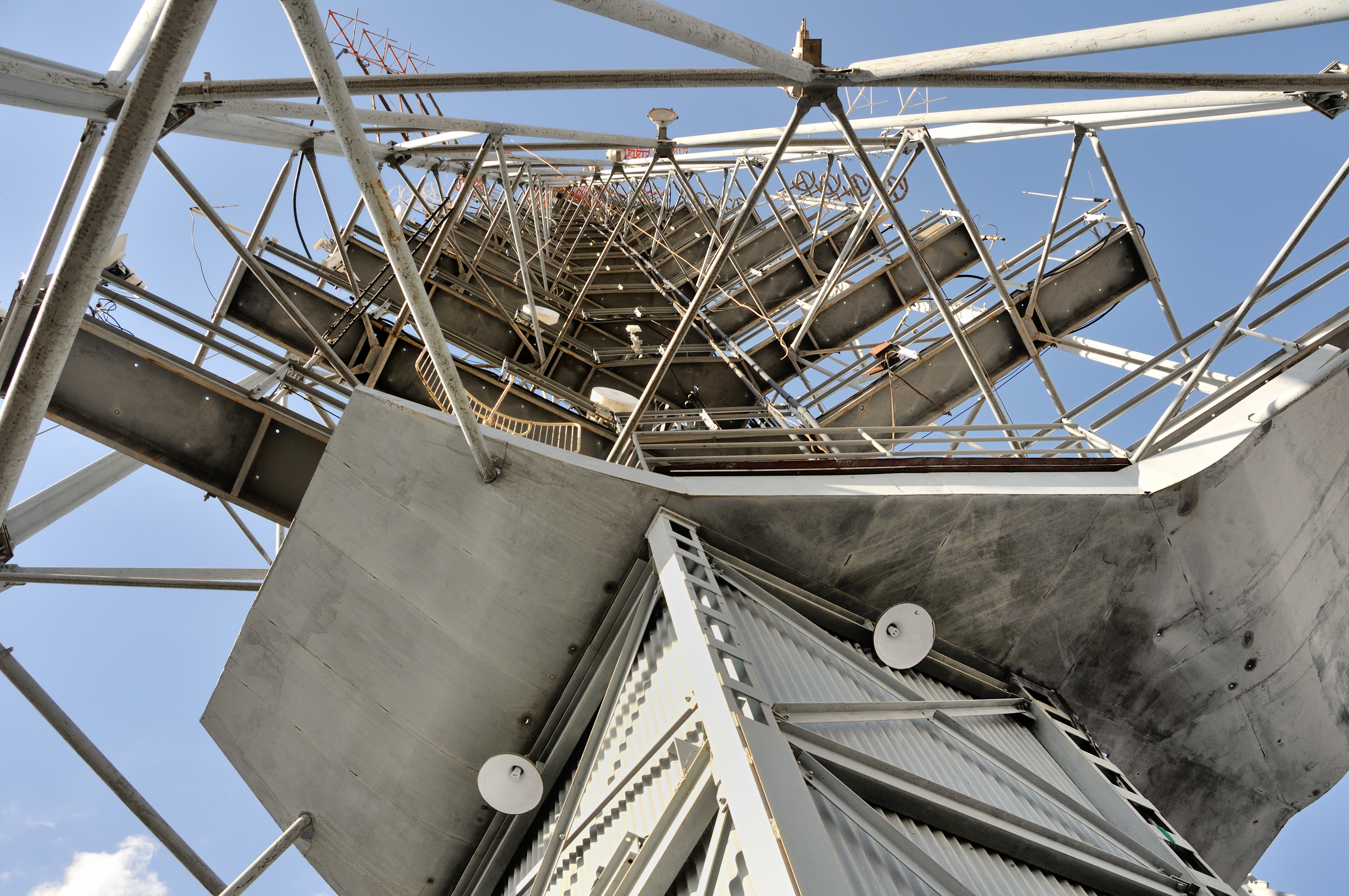
Brasília TV Tower
Twelve thousand people a week climb into an elevator that rises through a triangular glass-sheathed concrete volume supported by three pillars bent into a V. At 75 meters up, the doors open onto a belvedere where the entire geometry of Brasília unfolds like an architect's model come to scale. Lúcio Costa designed the Brasília TV Tower as a modernist lookout over the city he had planned - a way to see the airplane-shaped capital not from a plane, but from a single precise point at the center of its fuselage.
The Fourth Tallest
The tower was inaugurated in 1967 at 218 meters. Additions by the Bandeirantes television network raised it in stages to the current 224 meters, making it the fourth tallest structure in Brazil. It stands on the Monumental Axis, the central thoroughfare that runs the length of Costa's city plan, and serves as a recognizable landmark from the Juscelino Kubitschek Bridge and from nearly any vantage point in the Plano Piloto. The metallic tower itself - the part above the concrete base - rises 192 meters, built in three stacked sections of 122, 45, and 24 meters. Taken together, the pillars, the triangular volume, and the metal mast form a single vertical gesture against the wide Central Plateau sky.
A Museum of Gemstones
Inside the triangular volume that forms the tower's base, the Gem Museum occupies the second floor. Brazil is one of the world's great sources of colored gemstones - aquamarine, tourmaline, topaz, emerald - and the exhibition takes advantage of that abundance, displaying specimens in the shadow of the metal tower rising above. Few television towers double as museums. The belvedere above is open Tuesday through Sunday, 9am to 7pm, and was inaugurated in 1965, two years before the tower itself was completed. It holds 150 people, accessible by elevator, with a stairway for emergencies and service above that climbs to the transmission equipment.
The View from 75 Meters
From the belvedere, Costa's planned city reveals itself the way he intended it to be seen. Down the Monumental Axis stretches the Esplanade of the Ministries - twin rows of identical glass-and-concrete blocks leading toward Niemeyer's National Congress. The Northern and Southern Hotel Sectors flank the central zone. Farther out, Lake Paranoá curves around the pilot plan, with the Juscelino Kubitschek Bridge arching across its waters. The National Stadium Mané Garrincha and the Nelson Piquet International Autodrome mark the middle distance. On a clear Brasília day, the view extends to the horizon of the cerrado beyond, where the capital gives way to the open plateau.
Fountain, Fair, and Garden
The ground around the tower is its own attraction. The TV Tower Fountain opened in 2010 to celebrate Brasília's fiftieth anniversary, built at a cost of nine million reais. Eighty meters across, it contains two thousand water nozzles, the central jet reaching 50 meters into the air. On weekends, forty-minute shows synchronize colored water to music. Adjacent to the tower, a Sunday flea market and permanent craft fair fill the plaza with stands selling local crafts and souvenirs - some of the best in the city. Around it all, the Burle Marx Garden is under construction, a project from the legendary landscape architect planned with cerrado species: piqui, ipê, angico-preto, jequitibá vermelho, and other native trees of the Central Brazilian savanna.
A Landmark in a City of Landmarks
In a capital dominated by Niemeyer's curves - the Cathedral, the Congress, the Planalto - the TV Tower is one of Lúcio Costa's few built contributions to his own plan. Costa drew the city; Niemeyer built most of its buildings. The tower, visible from far across the Federal District, fills a role that makes the invisible visible: a fixed point where you can orient yourself inside Brasília's vast geometry. At night it becomes a beacon, its red warning lights marking the precise center of the airplane. In front of it stands Alexandre Wakhevitch's 15-meter bronze sculpture, popularly called Berimbau, a dark counterweight to the pale concrete above.
From the Air
Coordinates: -15.790°S, -47.893°W. The tower stands 224m above ground level at the center of Brasília's Monumental Axis. Easily visible from cruising and descent altitudes on approach to Brasília International Airport (SBBR), roughly 10km to the south-southeast. Look for the tall slender mast with the triangular glass base at the midpoint of the airplane-shaped city plan.