Breakers Station
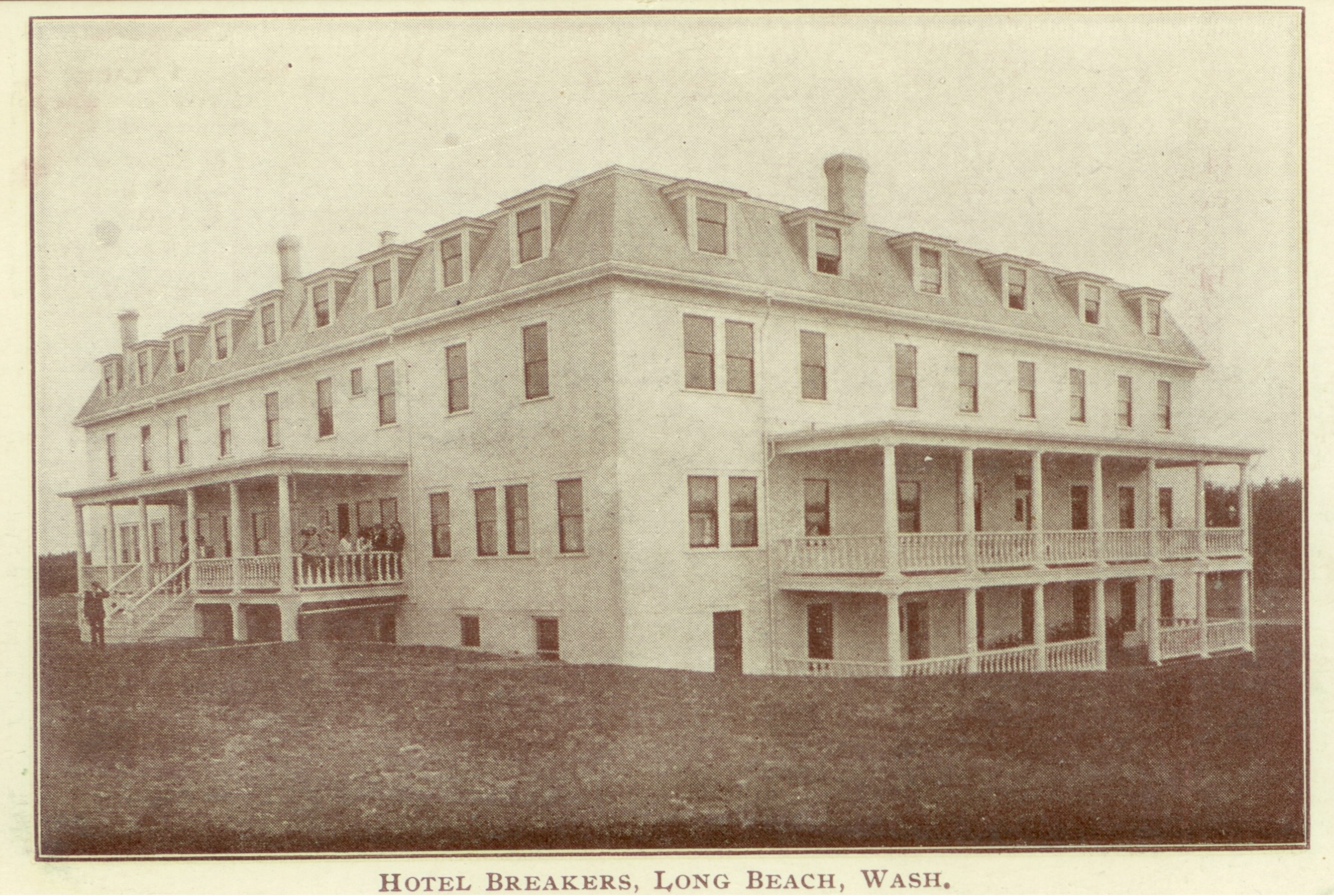
The promotional postcard promised the "best ladies' orchestra," a "large dancing pavilion," and a hotel that was "practically fire-proof." It was not. The first Breakers Hotel, built in 1901 by Joseph M. Arthur on a sand dune along Washington's Long Beach Peninsula, burned to the ground in 1904. Arthur rebuilt it. The second hotel -- the one on the postcard -- stood longer, but Breakers Station itself has vanished so completely that its name no longer appears on any map. What was once the social center of Pacific County's summer season is now absorbed into the city limits of Long Beach, remembered only by those who know where to look.
Tioga and the Iron Horse
Before it was Breakers Station, the stop was called Tioga -- an Iroquois word meaning "where it forks." The name came from the Tioga Hotel, the resort that anchored the surrounding subdivision in the 1890s. The Ilwaco Railway and Navigation Company ran a narrow-gauge line up the Long Beach Peninsula, and Tioga sat at the north boundary of the town of Long Beach, where the surrounding beach was lined with vacation cottages and canvas tents. Guests arrived by rail from Portland, transferring to a steamer at Astoria that crossed the Columbia River to Ilwaco, then catching the little train north along the coast. In 1917, Tioga still warranted a listing as a town five miles north of Long Beach. The railway itself was a peculiar, weather-beaten operation -- tracks laid through sand that shifted with the wind, schedules that bent to the tides -- but it opened the peninsula to a generation of Portland families looking for salt air and ocean waves.
The Social Center of Summer
J. M. Arthur saw something bigger than the Tioga Hotel could deliver. In 1901, he built the Breakers Hotel just north of the Tioga, behind a sand dune, with the rail line running between the hotel and the trees to the east. Guests could step off the train and walk directly to the beach. The hotel positioned itself as the peninsula's premier destination -- dancing, live music, ocean views. Then, three years later, fire took it. Arthur was not the kind of man to accept that verdict. He rebuilt on the same site, and the second Breakers Hotel became the one people remembered: a sprawling wooden structure facing the Pacific, advertised on postcards that encouraged travelers to "buy your ticket and check your baggage at any O.R. & N Co. Ticket Office direct to Breakers Station." The Oregon Railroad and Navigation Company connection meant you could book through from Portland without breaking your journey.
Practically Fire-Proof
The irony of the postcard's claim -- "practically fire-proof" -- would have been bitter to anyone who remembered the first hotel's fate. Wooden resort hotels on the Washington coast lived dangerous lives. Sea air rotted timber, wind fed flames, and the nearest fire brigade was miles down a sandy track. But for a few seasons, the Breakers was everything its advertising promised. The hotel sat just behind the dunes, close enough to hear the surf from its dancing pavilion. A ladies' orchestra played for guests who had come to escape Portland's rain for the peninsula's different kind of rain -- the salt-tinged, wind-driven variety that people somehow found refreshing rather than oppressive. The railroad station that bore the hotel's name was a simple affair: a platform, a name board, and the promise that this was somewhere worth stopping.
Sand Over the Tracks
The Ilwaco Railway ceased operations in 1930, a victim of the automobile and the roads that followed it up the peninsula. Without the train, Breakers Station lost its reason for existing as a named place. The Tioga Hotel was already gone. The second Breakers Hotel eventually disappeared too. Long Beach expanded its city limits northward, swallowing both Tioga and Breakers Station into its municipal boundaries. Today a fourth hotel occupies the location where Arthur's two Breakers Hotels stood, carrying on the hospitality tradition if not the name. The sand dunes remain, the Pacific still breaks against the shore, and the long flat beach that drew Portland's summer visitors in the 1890s draws visitors still -- though they arrive by car now, on highways built over the old rail bed, with no memory of the platform where the conductor once called out the stop.
From the Air
Breakers Station is located at 46.371N, 124.051W on the Long Beach Peninsula, a narrow sand spit on Washington's southwestern coast separating Willapa Bay from the Pacific Ocean. From the air, the peninsula is unmistakable -- a thin strip of land running north-south with ocean beach on the west and bay on the east. The site is approximately 2 miles north of Long Beach proper. Nearest airports: Astoria Regional Airport (KAST) approximately 14nm south across the Columbia River, Willapa Harbor Airport (S80) approximately 25nm north. Best viewed at 2,000-3,000 feet for the full peninsula context.