Brecon Cathedral
The churchyard is round, and in Wales, that detail carries meaning. A circular enclosure around a church usually indicates that the site predates the building, that Christians were worshipping here before the Normans arrived, before the stones of the current structure were quarried, perhaps before anyone thought to write down what happened in this valley. Brecon Cathedral sits on a site that may have held a Celtic church centuries before Bernard de Neufmarche, the Norman knight who conquered the kingdom of Brycheiniog in 1093, ordered a new church built and dedicated to St John the Evangelist.
From Priory to Cathedral
Bernard de Neufmarche gave the new church to a monk named Roger from Battle Abbey in Sussex, who founded a Benedictine priory on the site as a daughter house of Battle. The first prior was Walter, also from Battle, and the priory was endowed with lands, rights, and tithes from the surrounding countryside. When Bernard died, patronage passed to the Earls of Hereford, bringing greater wealth and prosperity. The church was rebuilt and extended in the Gothic style around 1215, during the reign of King John, giving it the soaring lines it retains today. In the Middle Ages, the church was known as the Church of Holy Rood, because it possessed a great golden rood, a crucifix that became an object of pilgrimage and veneration. Pilgrims travelled to Brecon to pray before it until Henry VIII's Dissolution of the Monasteries destroyed it in the sixteenth century.
The Smoke-Blackened Roof
Step inside and look up. The roof of the hall, built between 1237 and 1267, is still blackened with the smoke of medieval fires. It is one of those details that collapses the distance between centuries: the same wooden beams that caught the soot of thirteenth-century candles still span the space above your head. When the priory was dissolved in 1538, the prior was pensioned off and the church became the parish church of Brecon. The cloisters were left to decay and were eventually demolished. By the nineteenth century, only the nave was in use, and the building was in poor repair. Some restoration took place in 1836, but serious renovation did not begin until the 1860s, and the tower was not strengthened until 1914.
A Soldier's Grave, a New Beginning
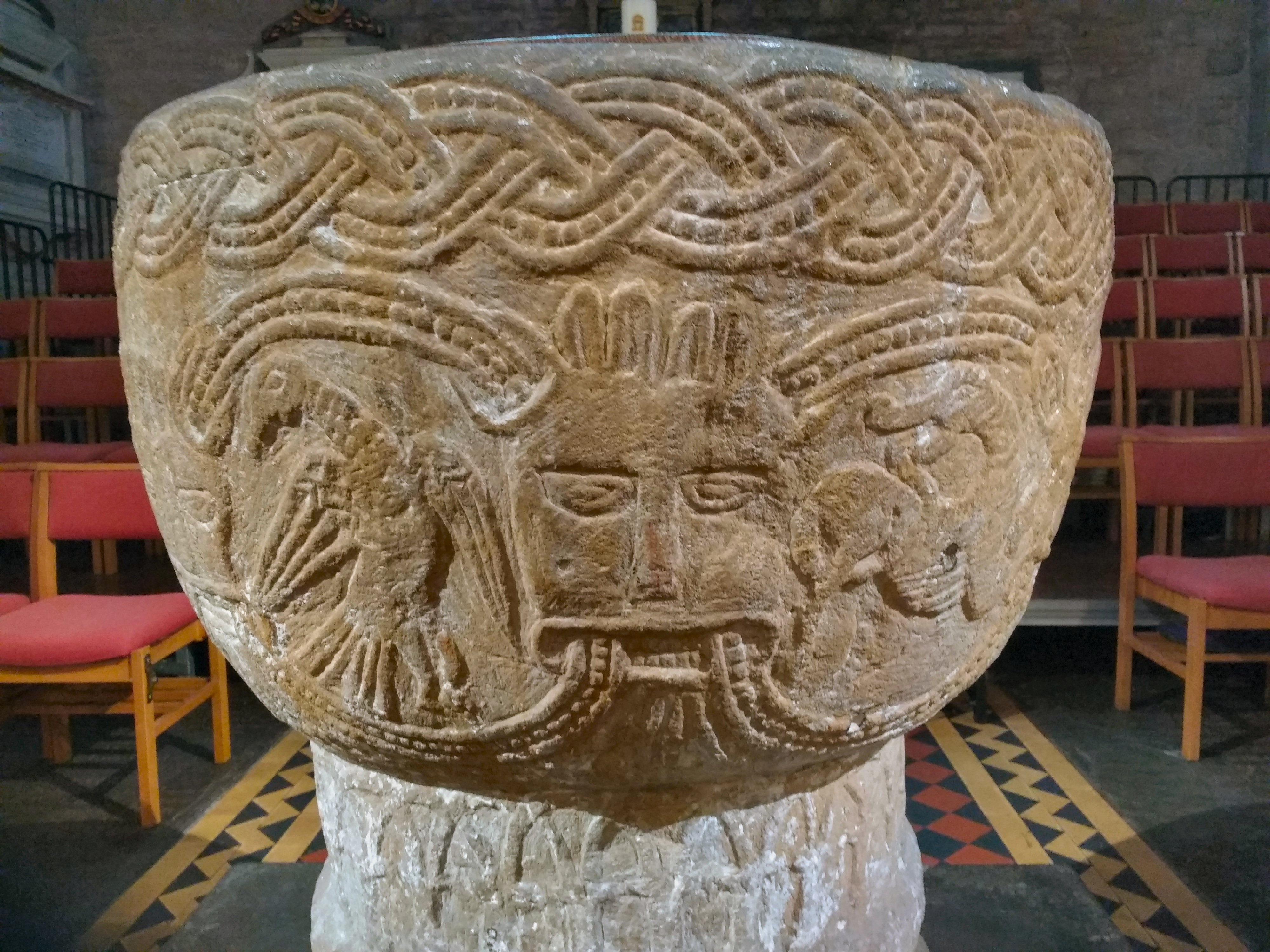
In the cathedral churchyard lies Charles Lumley, who was twenty when he earned the Victoria Cross during the Crimean War and thirty-four when he died in 1858. His grave is a quiet reminder that Brecon has always been a garrison town, close to the military heart of the Beacons. The church became a cathedral in a roundabout way: when the Church in Wales was disestablished in 1920, a new Diocese of Swansea and Brecon was created in 1923, and the old priory church was elevated to cathedral status. It was not built for the role, which gives it an intimacy that purpose-built cathedrals lack. The font, carved with a Green Man and a Tree of Life, links Christian iconography to older, wilder symbols.
The Hours
In recent years, the cathedral close has been thoughtfully converted into a living precinct: a diocesan centre, a heritage exhibition, a shop, and a restaurant called The Hours, named for the canonical hours of prayer that once structured monastic life. The cathedral has ten bells, rung in the full-circle English tradition, the tenor weighing sixteen hundredweight. On Sundays and feast days, their sound rolls down the valley and across the town of Brecon, as it has for centuries. The round churchyard, the smoke-blackened roof, the carved Green Man, the absent golden rood: Brecon Cathedral is a place where you can trace the layers of Welsh Christianity from Celtic origins through Norman conquest, medieval pilgrimage, dissolution, neglect, and careful revival, all within a single set of stone walls.
From the Air
Located at 51.95N, 3.39W in the market town of Brecon on the northern edge of the Brecon Beacons National Park. The cathedral's medieval tower is visible among the town's rooftops near the confluence of the Honddu and Usk rivers. Cardiff Airport (EGFF) lies approximately 35 miles to the south. The town of Brecon is a gateway to the national park.