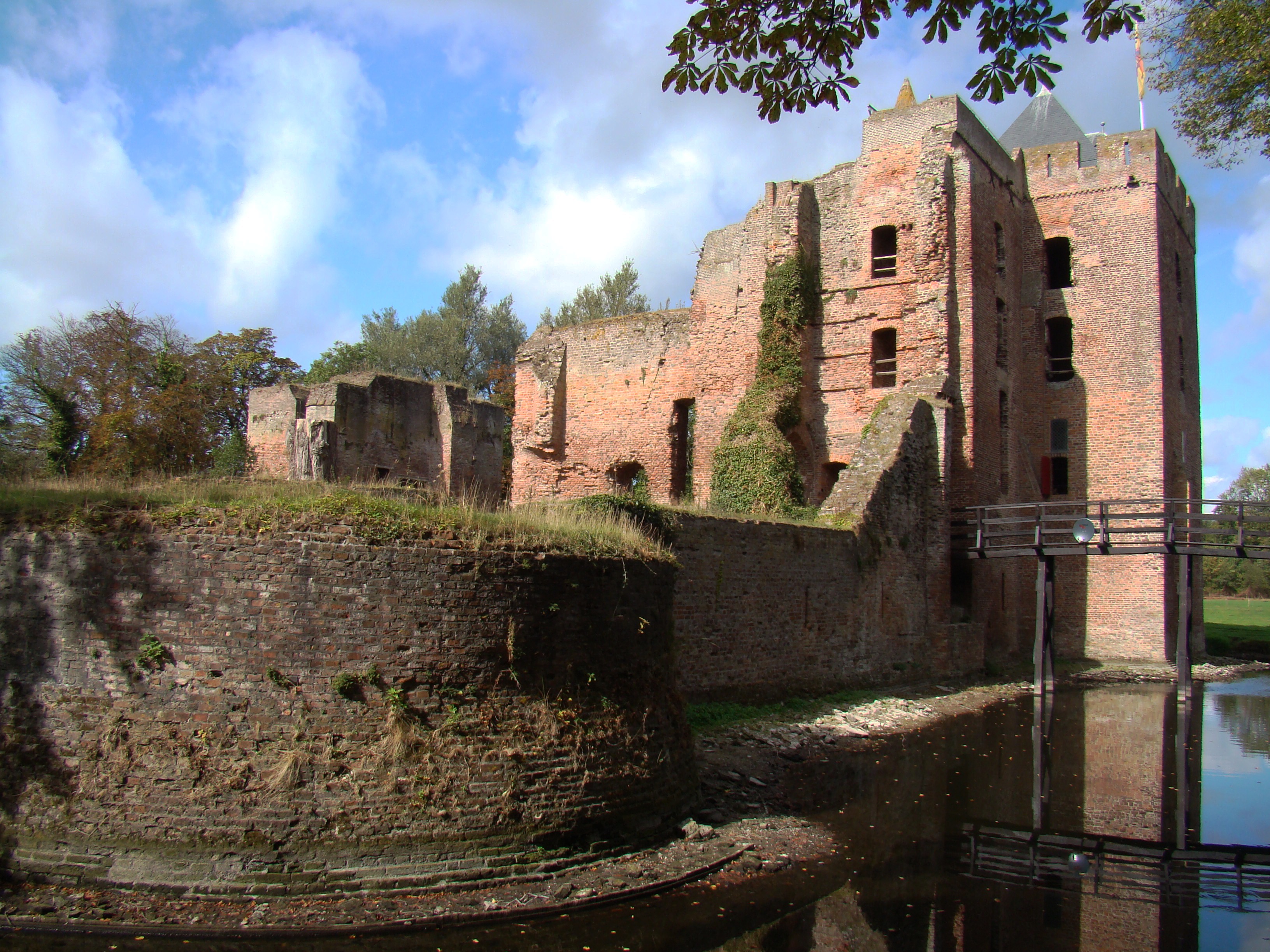
Brederode Castle
It became the first one. In the 1860s, when the Netherlands began the slow modern habit of saving its own past, the government picked a ruin north of Haarlem to restore first - a moated medieval wreck half-buried in encroaching dunes near Santpoort-Zuid. The Ruine van Brederode is widely credited as the first national monument the Dutch state ever bothered to preserve. The ruins it preserved had been failing for nearly three hundred years by then: besieged, demolished, rebuilt, plundered, partly demolished again, plundered again, burned by Spanish soldiers, and finally left to the dunes. The walls that survive today are about half a castle. The rest is grass, water, and a careful hush around what the Brederode family lost.
A Family From a Cleared Wood
The name is a map clue. Brederode comes from Brede Roede, broad wood - the patch of forest cleared in the early 13th century to make space for the first tower on this ground. William I van Brederode, born around 1215 and dead in 1285, founded the castle in the second half of that century. He descended from the lords of Teylingen, themselves cousins to the counts of Holland, and the high lordship of Brederode was given to his family as a feudal loan from those counts. By around 1300, William's son Dirk II van Brederode decided a single tower was too modest. He pulled it down and built a proper castle: square keep, surrounding walls, moat fed by groundwater, the standard kit of medieval status display. For the next century the Brederodes were a force in Holland.
The Hooks and the Cods
Then came the Hook and Cod wars, a dynastic feud that tore Holland apart through the late 14th and 15th centuries. The Brederodes were Hooks. In 1351, Gijsbrecht van Nijenrode of the Cod faction laid siege to Brederode Castle. The garrison surrendered by treaty on 23 October 1351. By the terms, the unnamed lord of Brederode made peace with Count William, accepted a yearly allowance of 350 pounds while his lands were sequestered, and watched his castellan and garrison walk out with half their possessions. The treaty looked moderate. The aftermath was not: the besiegers damaged the castle so badly that it was deliberately demolished. After the Brederode reconciliation with the counts of Holland in 1354, the family rebuilt. The current floor plan dates from that rebuild. They never lived in it again - they moved their seat to Batestein - but it stayed a useful Hook base, and the wars stayed useful at burning it. In 1426, during the Hook siege of Haarlem, the Cods returned and destroyed the southern half. The family was forbidden to repair it.
Lancelot's Head
The castle's worst hour came during the Eighty Years' War. After the Geuzen rebels lost the Battle of Haarlemmermeer in 1573 and Haarlem fell to the Spanish, the victorious army moved up the dunes to Brederode. The current lord was Lancelot van Brederode - vice admiral of the Geuzen, a Protestant, and exactly the sort of nobleman the Duke of Alba's army was hunting. They beheaded him. They plundered the castle and set it on fire. The walls that survived stood as a charred shell, no longer defensible, and the dunes began their slow climb over the lower courses of stonework. In 1568 the castle had already fallen formally to the States of Holland; in 1679 the last Brederode lord, Wolfert, died and the title died with him. From that point the ruins were the property of the Dutch state, which mostly meant they belonged to nobody and to the sand.
The First Saving
Two centuries of weather later, the 19th century arrived with new ideas about heritage. Across Europe, governments were beginning to notice that medieval ruins might be worth keeping. The Dutch government picked Brederode to demonstrate the principle. The ruins were stabilized, partly rebuilt, and made accessible to visitors - the first restoration project of the Rijksmonument tradition. Walk the site today and the layering is visible: original 13th-century courses at the base, 14th-century rebuilds above them, 19th-century restoration sealing the edges, modern walkways letting visitors stand where the keep once rose. The Hook and Cod wars are a footnote in tourist brochures. The dunes, which once threatened to swallow the place, now keep a respectful distance. Lancelot van Brederode has a memorial plaque. The first monument the Netherlands ever decided to save is still being saved.
From the Air
Brederode sits at 52.426 N, 4.622 E near Santpoort-Zuid, in the dunes north of Haarlem and west of the IJ. From the air, look for the ruin's distinctive moat-circle and surrounding parkland between the dune ridges and the village of Santpoort. The North Sea coast is 3 km west; Haarlem city is 5 km southeast. Nearest airport: Amsterdam Schiphol (EHAM), 17 km southeast. Best viewed at 1,500-3,500 feet.