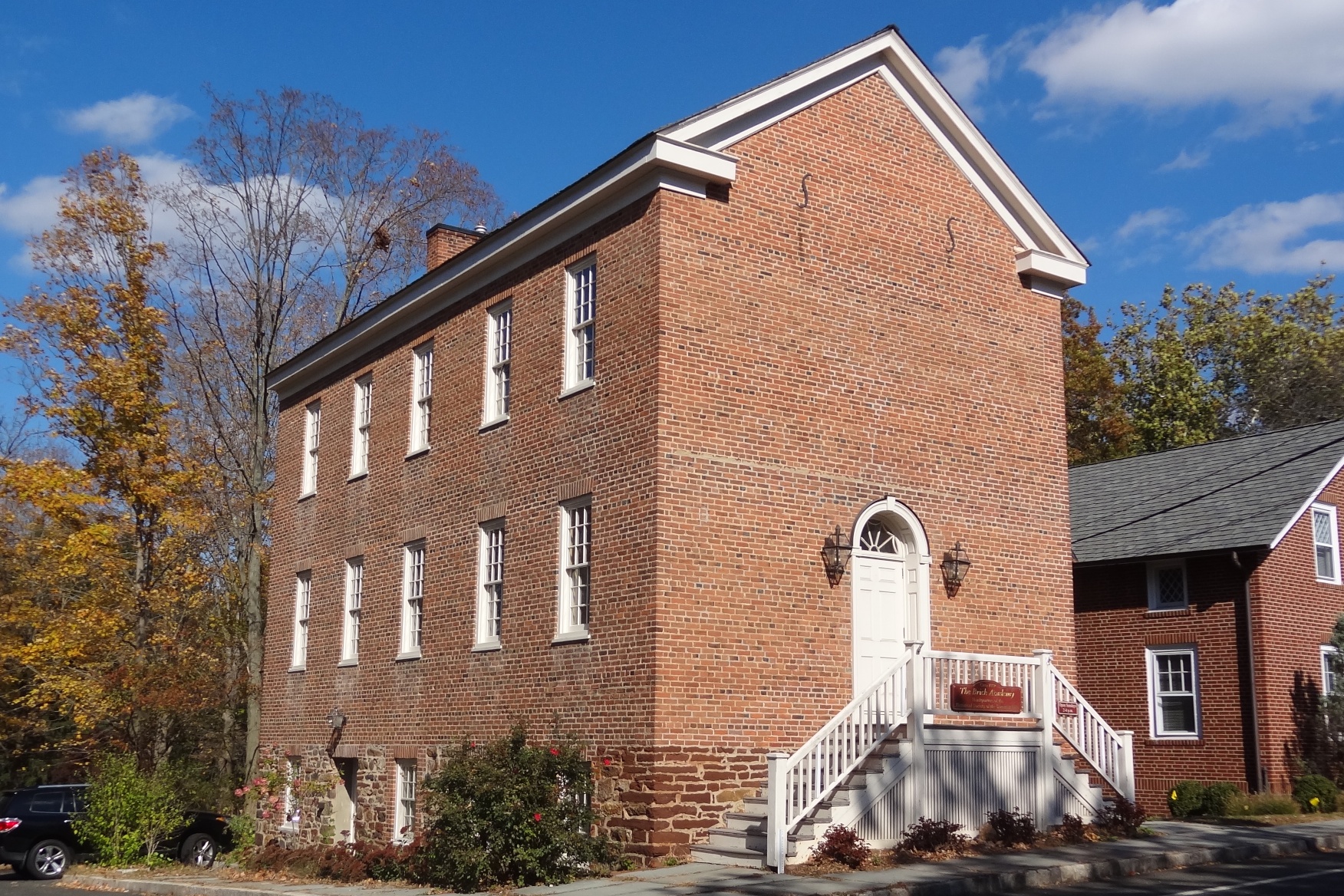
Brick Academy
Three of its students ran for Vice President of the United States. One became Governor of New Jersey and Secretary of the Navy. Another served as Minister to France during the Civil War. All of them passed through the doors of a modest brick building in Basking Ridge, a village in the Somerset Hills where the Reverend Robert Finley ran a preparatory school that punched so far above its weight it seems almost fictional. The Brick Academy, as it came to be known, was built in 1809, but the school it housed had been shaping American leaders for at least a decade before its walls went up.
The Reverend's Pipeline to Princeton
Robert Finley arrived in Basking Ridge as the local Presbyterian pastor and promptly established a classical school for boys. The Basking Ridge Classical School, as it was formally known, started with fewer than 12 students and grew to an average of 25, sometimes reaching 40. The boys came from prominent families across the region, drawn by Finley's reputation and by the school's track record of sending graduates to the College of New Jersey -- which would not rebrand itself as Princeton University until 1896. This was a high-end preparatory school operating in a rural village, and its alumni list reads like an early American power directory. Samuel Lewis Southard went on to serve as U.S. Senator, Secretary of the Navy, and the 10th Governor of New Jersey. Theodore Frelinghuysen became a Senator and the Whig candidate for Vice President in 1844. William Lewis Dayton served as Senator and ran as the first Republican Vice Presidential candidate in 1856.
Brick and Mortar, Name and Legend
The brick building itself went up in 1809, a Federal-style structure built to house Finley's growing school. But the nickname has caused persistent confusion. Samuel Southard, for instance, is often cited as having attended the Brick Academy -- except he graduated from Princeton in 1804, a full five years before the brick building existed. He attended the school; he never set foot in the building that carries its famous nickname. Finley departed for Georgia in 1817 to become president of the University of Georgia, dying about a month after his arrival. The school continued without him. By 1828, the Basking Ridge Brick Academy Company was formally incorporated, and the building kept serving students -- first as a private institution, then as a public school beginning in 1853.
From Schoolhouse to Municipal Building
The Brick Academy's second century brought a string of reinventions. In 1904, the building was sold to the Ancient Order of United Workmen and the Junior Order of United American Mechanics, fraternal organizations that used it as a meeting hall. Bernards Township began renting the space for municipal offices in 1924 and purchased it outright in 1948. For decades, local government operated from the same rooms where Southard and Frelinghuysen had parsed Latin and Greek. When the township government moved to a new building in 1975, the old schoolhouse could have faced demolition. Instead, it was leased to The Historical Society of the Somerset Hills in 1976 -- the same year it was listed on the National Register of Historic Places.
A Classroom That Outlasted Its Students
Today the Brick Academy serves as the historical society's headquarters, housing a museum, a recreated one-room schoolhouse, and a research room for local history. The building was recognized on the National Register on July 21, 1976 for its significance in education, philosophy, and religion -- a fitting trio for a school founded by a Presbyterian minister who believed that classical learning was inseparable from moral development. A restoration effort culminated in 2008 with the dedication and reopening of the building's top floor. Walk through the Brick Academy now and you are walking through layers of American ambition: a village pastor's conviction that a small school could produce great men, the students who proved him right, and the community that refused to let the building disappear.
From the Air
Located at 40.707N, 74.550W in Basking Ridge, Bernards Township, Somerset County, New Jersey. The building sits in the historic village center near the famous Basking Ridge oak tree. From the air, look for the compact village center amid the wooded Somerset Hills. Nearby airports include Somerset Airport (KSMQ) approximately 4 nm west and Morristown Municipal Airport (KMMU) about 8 nm north. Recommended viewing altitude 1,500-2,000 ft AGL.