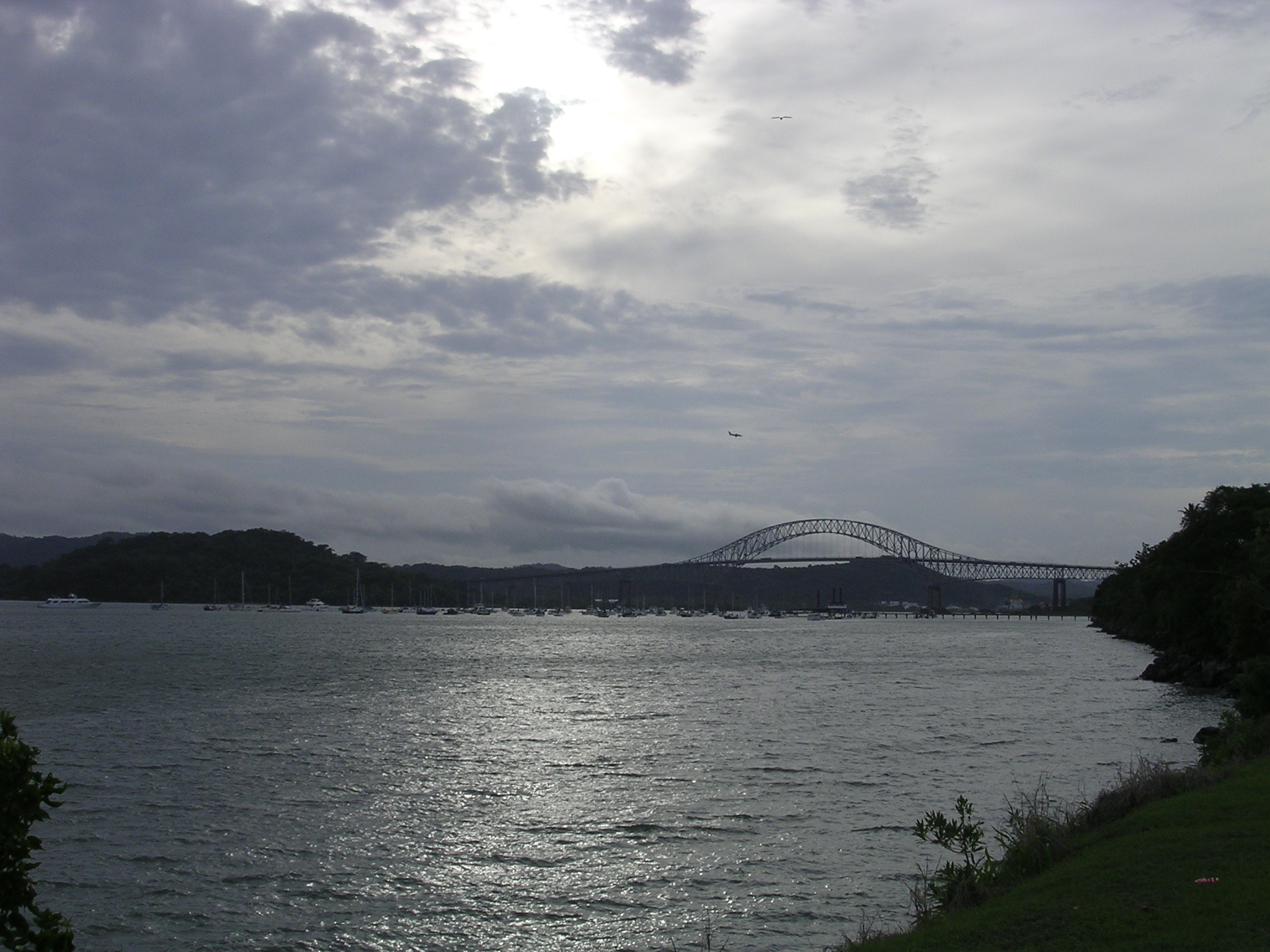
Bridge of the Americas
Ten days before the ribbon-cutting, Panama's National Assembly passed a resolution. The bridge over the Panama Canal, it declared, shall bear the name "Bridge of the Americas." Panamanian officials shall reject any document using any other name. Copies of this resolution shall be forwarded to all legislative bodies of the world. The date was October 2, 1962. The United States, which had paid $20 million to build the bridge and controlled the Canal Zone through which it passed, had a different name in mind: the Thatcher Ferry Bridge. The inauguration on October 12 became a collision of these two visions -- complete with pro-Panamanian protesters who disrupted the ceremony and tore the memorial plaques from the bridge itself.
Forty Years of Ferries
Before the bridge existed, crossing the Panama Canal by road meant waiting for a ferry. The original Thatcher Ferry -- named for Maurice H. Thatcher, a former Canal Commission member who had pushed for its creation -- carried vehicles across the canal at roughly the point where the bridge now stands. By 1940, additional barges had been added to handle growing military traffic. In June 1942, a road and rail swing bridge opened at the Miraflores Locks, but it could only operate when no ships were passing through, which at the busiest waterway in the Western Hemisphere meant frequent closures. Another ferry, the Presidente Porras, joined the service in November 1942. The idea of a permanent bridge had been proposed as a priority as early as 1923. Subsequent Panamanian administrations pressed the issue with Washington for decades, until the 1955 Remon-Eisenhower Treaty finally committed the United States to building one.
Steel, Concrete, and Ceremony
The contract went to John F. Beasly & Company, who built the bridge from steel and reinforced concrete. A groundbreaking ceremony on December 23, 1958, drew U.S. Ambassador Julian Harrington and Panamanian President Ernesto de la Guardia Navarro. Construction began in earnest on October 12, 1959, and took nearly two and a half years. The result was a cantilever bridge with a tied-arch suspended span, crossing the Pacific approach to the canal at Balboa. At its inauguration on October 12, 1962, Maurice H. Thatcher himself -- the man after whom the ferry and now the bridge were named -- cut the ribbon. Nationwide radio and television carried the event live. But the crowd overwhelmed the security arrangements, and Panamanian demonstrators seized the moment to make their point about the bridge's name. The "Thatcher Ferry Bridge March" played on. The protests did not stop.
A Bridge by Any Other Name
The naming dispute was never just about a bridge. It was about sovereignty over a strip of territory that bisected a nation. The United States officially designated the structure the Thatcher Ferry Bridge, and that name appeared on postage stamps issued by the Canal Zone postal service. One sheet of those stamps became famous among collectors for a printing error: the bridge itself was missing from the image. Panama refused to acknowledge the American name. Its National Assembly resolution was unambiguous and, in its insistence on forwarding copies to "all legislative bodies of the world," theatrical in a way that underscored the seriousness of the grievance. The bridge remained officially the Thatcher Ferry Bridge until 1979, when Panamanian control of the Canal Zone began under the terms of the Torrijos-Carter Treaties. Only then did the Bridge of the Americas become its legal name -- seventeen years after Panama had declared it so.
Bottleneck and Beyond
Whatever its name, the bridge transformed transit across the canal. When it opened, approximately 9,500 vehicles crossed daily. By 2004, that number had swelled to 35,000, and the bridge had become a chokepoint on the Pan-American Highway. The Centennial Bridge, completed in 2004, was built specifically to relieve this congestion. In May 2010, the bulk cargo ship Atlantic Hero lost engine power and struck one of the bridge's protective bases, partially blocking canal shipping traffic -- though the bridge itself escaped damage and no one was hurt. Later that year, a mudslide collapsed the Centennial Bridge's access road, and commercial traffic was rerouted back to the original span. The Bridge of the Americas endures as both infrastructure and symbol: the first permanent crossing of the canal that divided Panama in two, and the structure whose very name became a battleground for national identity.
From the Air
Located at 8.943N, 79.565W, the Bridge of the Americas spans the Pacific entrance to the Panama Canal at Balboa. The cantilever bridge with its distinctive tied-arch center span is clearly visible from altitude, crossing the canal just north of the Amador Causeway. Ship traffic passing beneath provides additional visual context. The Centennial Bridge is visible approximately 15 km north along the canal. Nearest airport is Marcos A. Gelabert International (MPMG/PAC) at Albrook, less than 2 km east. Tocumen International (MPTO) is 20 km east. Best viewed from 2,000-4,000 feet on approach from the Pacific side, where the bridge frames the canal entrance with the skyline of Panama City beyond.