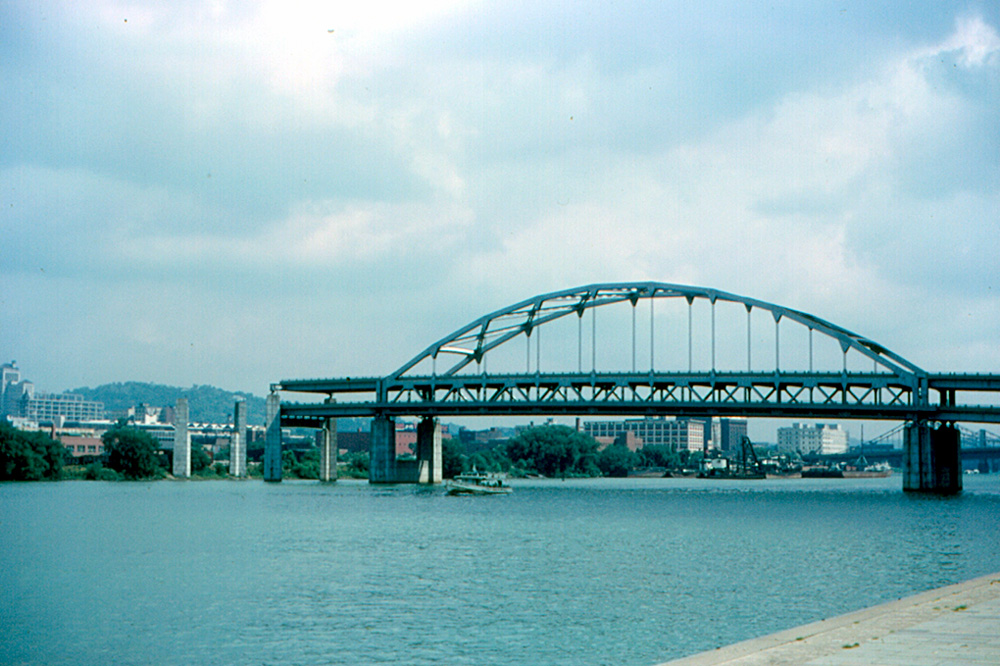
Bridge to Nowhere
Drive along the Rue Emile Pathe in Forest, in the southern fringe of Brussels, and you arrive at a stretch of curving asphalt that simply stops. It was meant to be the southern arc of the R0 motorway ring, the inner orbital that was supposed to wrap all the way around the Belgian capital. Local residents refused to let it cross their neighbourhood, and the slip of road already poured was abandoned where it lay. Today people park their cars on it. The phrase "bridge to nowhere" usually arrives with a sneer, attached to some politician's pet project; in practice, it describes a category of half-finished human ambition that turns up almost everywhere - a wedge of concrete pointing at the horizon, with nothing on the other side.
How a Bridge Ends in the Air
A bridge becomes a bridge to nowhere in one of a handful of ways, and each carries its own particular failure. Sometimes the money simply runs out, as with the Bridge to Nowhere over the San Gabriel River in California, built in 1936 to carry a road that the great floods of 1938 swept away before the engineers could finish it. Sometimes the bridge survives a disaster but the road it served does not, as happened to Honduras's Choluteca Bridge in 1998, when Hurricane Mitch left the span intact but carved the river an entirely new channel - the bridge now stood over dry ground. Sometimes the politics changes mid-pour. And sometimes the bridge is finished perfectly, exactly to plan, and then the people it was built for never come.
Belgium's Quiet Examples
Belgium has at least two. The R0 stub at Rue Emile Pathe in Forest is the more famous, an artefact of Brussels's long quarrel with the motorway age. In Perwez, a small town in Walloon Brabant about thirty kilometres south-east of Brussels, a bridge originally meant for a bypass sits alone in the middle of a field, a smooth concrete arc rising from one stretch of grass and descending into another. There is no road on either side, only the suggestion of one. Cows graze beneath it. Local children ride bicycles along its surface. It is the kind of structure that, if you came upon it without warning, would make you wonder briefly whether you had wandered into an art installation or a dream.
Ghosts of the Autobahn
Germany has so many such bridges that there is a word for them: Soda-Brucken, a pun on so da, "just there." Most were poured in the 1970s as part of the great post-war autobahn expansion, and most stopped abruptly when the 1973 oil crisis and a rising environmental movement combined to kill highway projects mid-construction. A Soda-Brucke near Merklinde, in the Ruhr, was completed in 1978 and never connected to anything. The Schanzlebrucke in Konstanz, on the Swiss border, waited from 1975 to 2007 - thirty-two years - before traffic finally crossed it. Some are still waiting. Drivers passing on the road beneath look up and see a perfect concrete span with grass growing along its parapets, going from one piece of forest to another.
Politics in Concrete
The phrase entered the English language with full force in 2005, when the United States Congress earmarked $223 million for a bridge to connect Ketchikan, Alaska - population about 8,000 - to Gravina Island, where 50 people and an airport waited on the other side. Ferries already made the crossing in seven minutes. The Gravina Island Bridge became, almost overnight, the most famous unbuilt infrastructure project in American history, a stand-in for everything voters disliked about federal spending. It was never built. Its real legacy was rhetorical: ever since, the phrase has been a political weapon, hurled at any project that strikes its opponents as wasteful, regardless of whether anyone proposes a bridge at all.
What These Bridges Mean
Stand on the deck of one and the experience is strangely peaceful. The wind blows. Birds nest in the expansion joints. There is no traffic to dodge. A bridge built for cars but used only by walkers becomes, accidentally, the most generous kind of public space - a viewing platform, a meeting place, a stage. The Big Four Bridge across the Ohio River at Louisville, an abandoned railroad span whose approach ramps were torn down in 1969, sat unused for forty-four years until the city rebuilt the ramps for pedestrians in 2013. Now half a million people a year walk across it. New Zealand's Bridge to Nowhere, deep in Whanganui National Park, was meant to serve a soldier-settler scheme that failed; today it is the destination of a popular hike. The bridges outlast the reasons they were built, and sometimes, given enough time, they find new ones.
From the Air
The Forest, Brussels stub is centred at 50.80 N, 4.31 E, immediately south of the Brussels-Capital Region in the commune of Forest. The Perwez bridge sits roughly 30 km south-east, in open Walloon farmland. Brussels Airport (EBBR) is 12 km north-east of Forest; Charleroi/Brussels South (EBCI) is about 35 km south. Recommended viewing altitude for the urban stub is 1,500 ft AGL; the rural Perwez span is easier to spot at 1,000 ft over flat fields. Both are visual curiosities best caught in side light, when shadows trace the abandoned alignments.