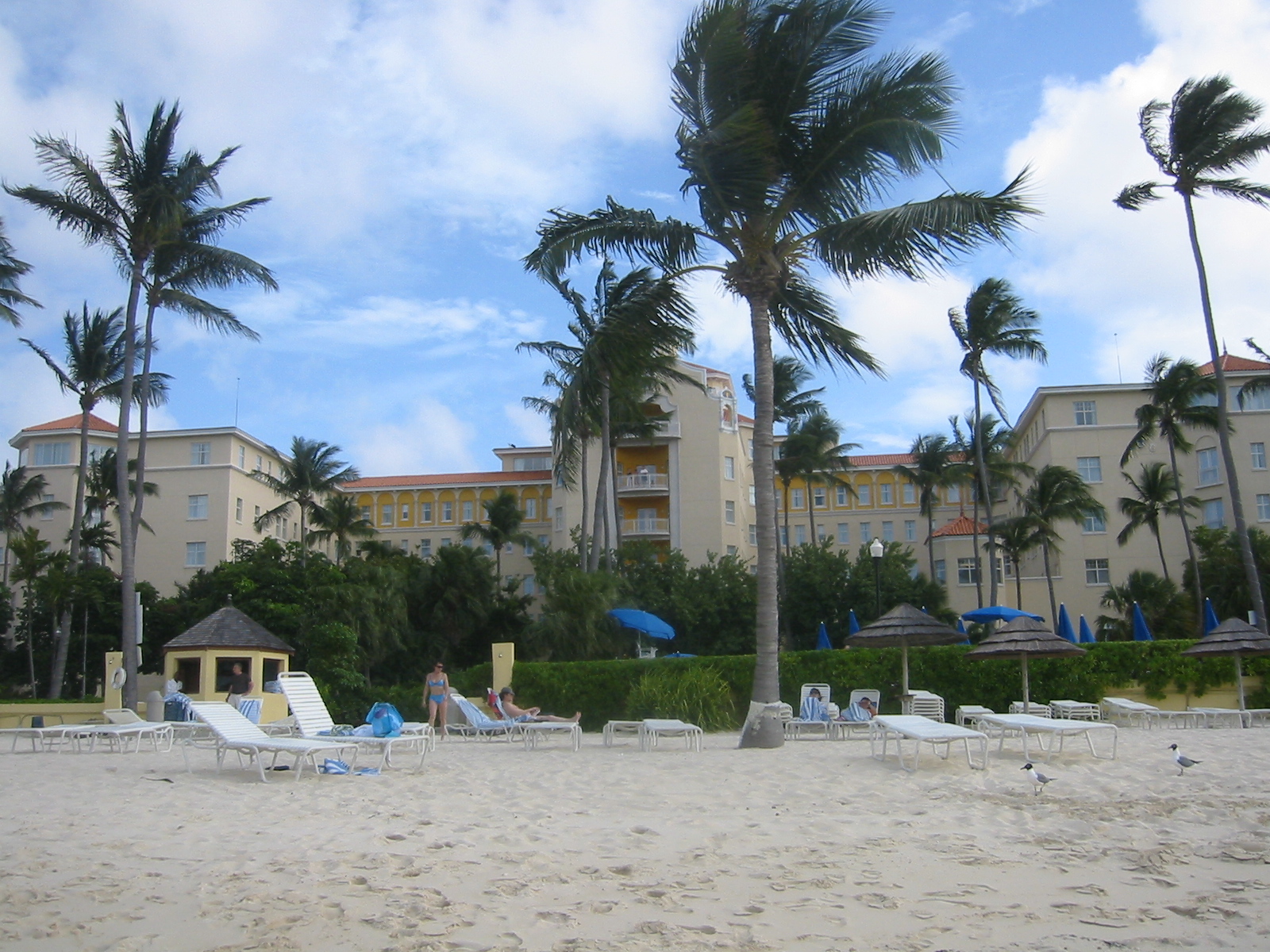
British Colonial Hotel
Sir Harry Oakes bought the hotel on a whim. The story, repeated so often in Nassau that it has acquired the weight of scripture, holds that Oakes -- a Canadian mining magnate who had struck one of the richest gold deposits in North American history -- checked into the Colonial Hotel in 1932, received terrible service, and decided to buy the entire property rather than simply complain. He renamed it the British Colonial Hotel and proceeded to make it the social center of Nassau. Eleven years later, Oakes was found bludgeoned to death in his bed at his nearby estate, his body partially burned, feathers scattered across the scene. The case was never solved. It was called the "murder of the century," and it forever linked the hotel's name with wealth, power, and unsettling mystery.
Pirates, Forts, and the Ground Beneath
The land under the British Colonial Hotel carries more history than most entire neighborhoods. The first settlement here dates to 1666, when Nassau was still called Charles Town -- a rough, improvised place of taverns and brothels frequented by pirates. Spanish forces attacked repeatedly, driving residents to flee to the American colonies. The town was rebuilt with a fort and renamed Nassau, only to be destroyed again in 1703 by combined French and Spanish forces. Piracy finally declined after British Governor Woodes Rogers arrived in 1718 and imposed order. The Old Fort of Nassau stood on this site for decades, guarding the western entrance to Nassau Harbour, until it was demolished in 1873. When Henry Flagler -- the railroad baron who had already built the Breakers Hotel in South Florida -- purchased the land in 1900, he was building on ground that had been contested for nearly 250 years.
Rising, Burning, Rising Again
Flagler's original Colonial Hotel opened in 1901, an enormous structure designed to draw wealthy Americans southward. But the building's first incarnation did not last. The Bahamian government backed the Munson Line shipping company, which purchased the land and erected a brand-new seven-story hotel in just six months. The New Colonial celebrated its grand opening on January 7, 1924, during an era when Prohibition in the United States was sending Americans to the Bahamas in search of legal liquor. The hotel initially operated only three months per winter season, catering to the wealthy who arrived by steamship. After Oakes took ownership in 1932, the hotel became a fixture of Nassau's social elite, frequented by the Duke of Windsor himself. But Oakes's murder in 1943 cast a permanent shadow, and the hotel changed hands repeatedly in the decades that followed.
A Parade of Names
Few hotels have worn as many brands as the British Colonial. Florida-based Gill Hotels acquired it in 1960. Two years later, Sheraton made it their fourth-ever franchise property, rechristening it the Sheraton British Colonial. That arrangement lasted until 1988, when Best Western took over and the hotel became the British Colonial Beach Resort. Through the 1990s, the aging building slowly emptied -- rooms shut down wing by wing until guests occupied only a small fraction of the complex. In 1997, RHK Capital purchased the property and undertook a $90 million renovation that gutted the interiors while preserving the facade of towers, galleries, and molded reliefs. The hotel reopened in October 1999 under Hilton management. A further $15 million renovation followed in 2009. Then, in 2014, China State Construction Engineering Corporation purchased it, and a $250 million complex called The Pointe rose on the former parking lot, eventually branded as Margaritaville Beach Resort Nassau.
Bond on the Pier
The British Colonial occupies Nassau's only private beach, and in 1983 that beachfront earned a place in cinema history. The James Bond film Never Say Never Again, starring Sean Connery, used the hotel as a filming location. In one memorable sequence, the villain Fatima Blush -- played by Barbara Carrera -- waterskis up to the resort's pier and steps directly into Bond's arms at the hotel's old gazebo bar. The pier had been built specifically for the movie, but the hotel kept it after filming wrapped, a permanent souvenir of its brush with 007. The connection is fitting: Nassau has long cultivated an air of glamour and intrigue, and the British Colonial has stood at the center of that mythology since the 1920s.
The Grand Dame Endures
The hotel closed temporarily in early 2020 during the COVID-19 pandemic, reopened in December of that year, then shut again in February 2022 as business and convention travel -- its primary clientele -- remained depressed. It ceased its association with the Hilton brand at that point. Extensive renovations followed during the closure. Guidebooks have long called it "the Grand Dame of all Nassau hotels" and "the most distinctive and pleasant of the island's large hotels," and the building's bones justify the praise: its position on the harbor, its coral-stone facade, its layered history visible in every corridor. Standing on its private beach, you look out over the same water that pirates once sailed, past the same harbor entrance that the Old Fort once guarded. The hotel has been burned, demolished, rebuilt, renamed, sold, renovated, shuttered, and reopened. It endures the way Nassau itself endures -- by reinventing itself without quite forgetting what came before.
From the Air
Located at 25.08N, 77.35W in downtown Nassau, New Providence Island, Bahamas. The hotel sits on the waterfront at the western edge of Nassau Harbour, identifiable by its coral-colored facade and private beach. Lynden Pindling International Airport (MYNN/NAS) is approximately 10 miles west. From the air, the hotel is visible along the Nassau cruise port waterfront, adjacent to the modern Margaritaville/Pointe development. Best viewed at 2,000-4,000 feet on approach to or departure from Nassau. The harbor, cruise ship terminals, and Paradise Island bridge provide orientation landmarks.