British Malaya
Francis Light made a promise he had no authority to keep. In the 1780s, the British East India Company captain assured the Sultan of Kedah that Britain would defend his state from Siamese aggression -- if the sultan handed over the island of Penang. The Company had authorized no such guarantee. When Light took possession of Penang on 1 May 1786 and raised the Union Flag, he was bluffing. The sultan, realizing he had been deceived, tried to take the island back by force. He failed. That broken promise became the first thread in a web of treaties, manipulations, and strategic alliances that would bind the entire Malay Peninsula to the British Crown for the next 170 years.
The Art of the Unequal Treaty
Britain's grip on Malaya tightened through a pattern repeated across the peninsula: find a succession dispute, back one claimant, extract concessions. In Perak, when Sultan Ali died in 1871, the British supported Raja Abdullah over his rival Raja Ismail -- and the resulting Pangkor Treaty of 1874 installed the first British Resident in a Malay state. In Johor, Stamford Raffles exploited a similar dynastic split in 1819 to found Singapore, recognizing a passed-over elder prince as sultan in exchange for a trading post at the tip of the peninsula. The pattern worked because Malay succession customs created genuine ambiguity. A prince had to be present at a sultan's deathbed to inherit -- a requirement that left room for competing claims and foreign manipulation. The British were not the first to exploit these openings; the Siamese and Dutch had done so before them. But the British proved the most systematic.
Tin, Rubber, and the Engine of Empire
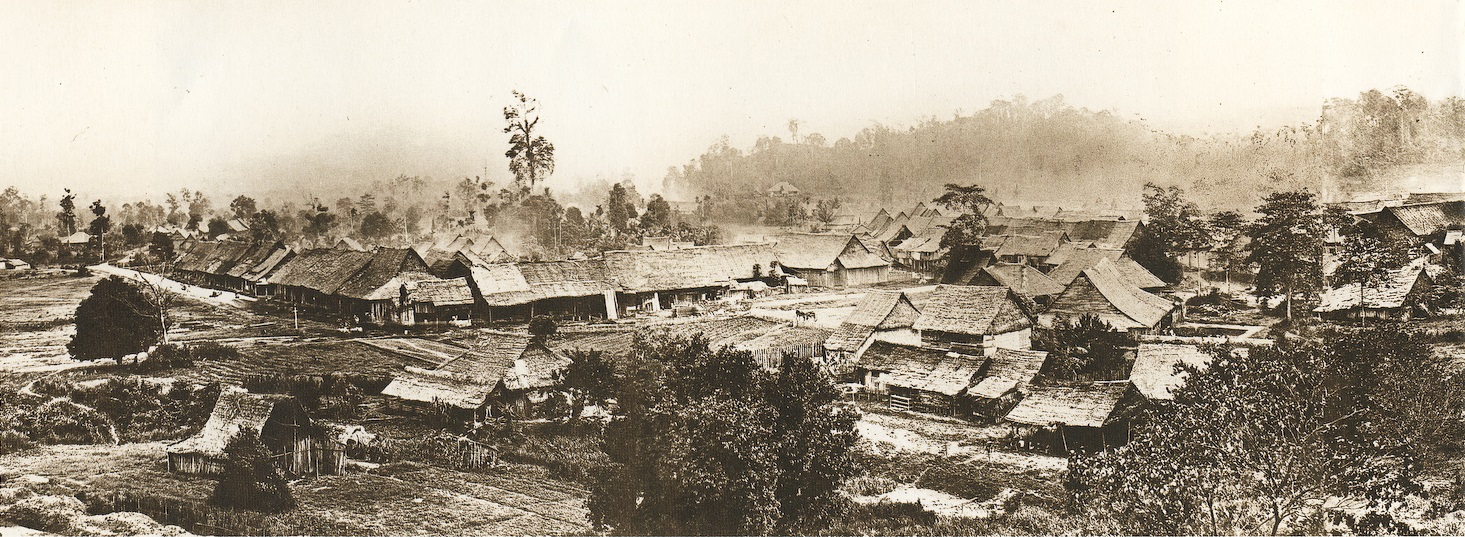
What drew Britain deeper into Malay affairs was not ideology but commodity. Perak held the richest alluvial tin deposits in the world, and by the 1840s, Chinese laborers imported from Penang had transformed the state's economy. Secret societies like Ghee Hin and Hai San competed violently for control of the mines, creating the instability that gave Britain its pretext to intervene. Selangor's tin fields around Hulu Klang and Lukut followed the same trajectory -- rapid growth, Chinese immigration, factional violence, British arbitration. When rubber cultivation arrived in the late nineteenth century, Malaya became doubly indispensable to the empire. By the early twentieth century, the territory was the world's largest producer of both tin and rubber, a commercial engine that funded roads, railways, and the colonial bureaucracy itself. Kuala Lumpur, built from a muddy confluence of rivers by Chinese kapitan Yap Ah Loy, became the capital of the Federated Malay States.
Federated and Unfederated
By 1910, British Malaya was not one entity but seven overlapping jurisdictions. The Straits Settlements -- Penang, Malacca, and Singapore -- were a crown colony under direct London control. The Federated Malay States grouped Perak, Selangor, Negeri Sembilan, and Pahang under a Resident-General in Kuala Lumpur, their sultans retaining ceremonial authority over Islam and Malay custom but little else. The Unfederated Malay States -- Kedah, Perlis, Kelantan, Terengganu, and Johor -- maintained more autonomy, accepting British advisors rather than full residents. This patchwork reflected a deliberate strategy: centralize enough to protect trade, but leave enough local authority to keep the sultans cooperative. The Anglo-Siamese Treaty of 1909 added the northern states to the British sphere, with Siam ceding Kedah, Perlis, Kelantan, and Terengganu in exchange for British restraint elsewhere. The Malay rulers were not consulted. They accepted the arrangement because they had little choice.
Occupation and the Road to Independence
Japan shattered the colonial order in weeks. The invasion of Malaya in December 1941, coordinated with the attack on Pearl Harbor, swept down the peninsula with a speed that stunned British commanders. By February 1942, Singapore had fallen -- the worst military disaster in British imperial history. Japan governed Malaya as a single colony from Singapore, rewarding its ally Siam with the four northern Malay states. When Japan surrendered in August 1945, Britain returned to a peninsula that had changed fundamentally. The myth of European invincibility was broken. Within a year, the British proposed the Malayan Union, consolidating all peninsular territories under one administration with liberal citizenship rules. Malay opposition was fierce -- the union threatened both the sultans' authority and Malay political primacy. The backlash gave birth to UMNO and forced the British to replace the union with the Federation of Malaya in 1948, a structure that preserved the sultans' role and Malay special rights. Independence came on 31 August 1957. Six years later, the federation expanded into Malaysia.
Borders Drawn, Borders Endured
The most lasting consequence of British Malaya is cartographic. The Anglo-Dutch Treaty of 1824 drew a line through the Malay world that became the modern Indonesia-Malaysia border. The Anglo-Siamese Treaty of 1909 fixed the Malaysia-Thailand boundary. Decisions made in London, Bangkok, and The Hague by men who had never seen the communities they were dividing became permanent facts of geography. The constitutional monarchy that governs Malaysia today -- with its rotating kingship among nine sultans -- descends directly from the compromise the British struck between centralized administration and local royal authority. The rubber estates and tin mines that built the colonial economy attracted Chinese and Indian workers whose descendants form the multiethnic society Malaysia is today. What began with Francis Light's unauthorized promise on a tropical island in 1786 became a nation of 33 million people, its modern borders, ethnic composition, and political structure all shaped by that century and a half of British entanglement.
From the Air
Centered at approximately 3.22°N, 101.10°E near Kuala Lumpur, British Malaya encompassed the entire Malay Peninsula. Key airports include Kuala Lumpur International (WMKK), Penang International (WMKP), and Singapore Changi (WSSS). Flying at 10,000 feet along the peninsula's west coast reveals the tin-mining landscape of Perak and Selangor, the plantation belt stretching from Johor to Kedah, and the Strait of Malacca that made this region one of the world's great maritime crossroads.