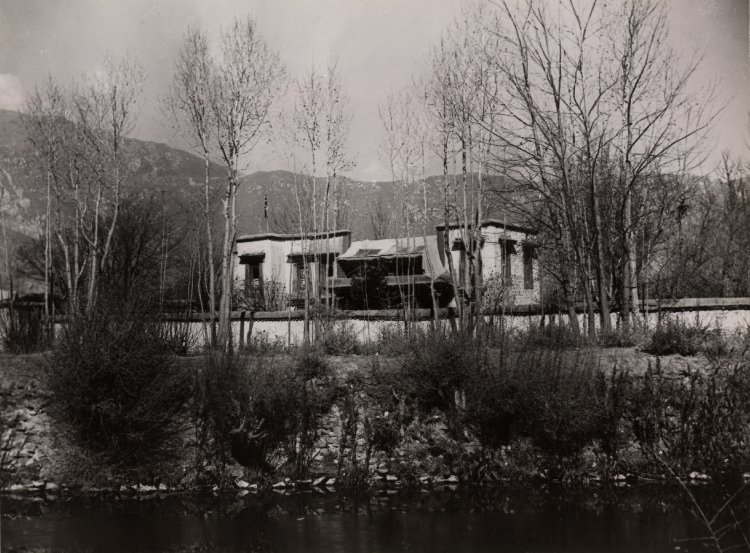
British Mission in Lhasa
On New Year's Day, 1937, the British mission in Lhasa hosted a banquet for the Tibetan Regent, Reting Rinpoche, and the four ministers of the Kashag. As a gift, the Tibetans presented passports for the 1938 British Mount Everest expedition. It was a small diplomatic exchange in a small diplomatic outpost -- a two-story, flat-roofed Tibetan-style building called Dekyi Lingka, with a courtyard, a stable, servants' quarters, and a radio that connected it to London. For fourteen years, this modest compound was Britain's window into the most isolated capital in Asia.
Countering China at the Roof of the World
The mission's origin was reactive. In 1934, the Nationalist Government of China had sent Huang Musong to Lhasa with a delegation to honor the deceased 13th Dalai Lama. Huang left behind two officers and a radio -- a seemingly minor gesture that alarmed British India. If China was establishing a permanent communication link with Lhasa, Britain needed one too. In August 1936, Basil Gould, the Political Officer in Sikkim, led a mission into the Tibetan capital. His delegation included Spencer Chapman as private secretary, Brigadier General Philip Neame, two Royal Corps of Signals telegraphists, a military doctor, and Hugh Richardson, then assigned to the Gyantse trade delegation. When Gould departed in February 1937, he left Richardson behind with a Tibetan assistant named Norbu Tenzin and the radio station. Richardson became the officer in charge. He would remain, in various capacities, for the next thirteen years.
Richardson's Lhasa
Hugh Richardson was not a typical colonial official. He stayed in Lhasa longer than any other Westerner of his era, served under both the British and Indian governments, and became one of the foremost scholars of Tibetan history. His duties ranged from the diplomatic to the unexpected. On September 7, 1936, he and Gould watched Brigadier Neame inspect a military drill conducted by Tibetan troops at Drapchi Prison. In April 1946, Richardson provided the Tibetan government with intelligence about the Tibetan Improvement Party, a group plotting to overthrow the government, and supplied evidence identifying Banda Raga as the ringleader. The Tibetan government acted on his information; at its request, India extradited two conspirators to China.
The School That Lasted Six Months
In 1943, Richardson and the Assistant Governor of Sikkim proposed to the Kashag that Tibetan teenagers should learn English -- a skill that would enable Tibet to engage independently in political, military, and industrial matters. The Kashag agreed. By January 1944, a headmaster had been recruited, and Richardson helped design the school campus in Lhasa's Lubu district. The Kashag allocated 25,000 Tibetan silver coins and 700 grams of highland barley for construction. The opening ceremony took place on July 31, 1944, in a temporary building at Chongdrelinka Villa. Tsepon Shakabpa represented the Kashag. But the monasteries opposed the school from the start, seeing English education as a threat to their influence. By January 1945, the Foreign Affairs Bureau informed the British mission that the school had been closed. The entire experiment had lasted roughly six months.
From British to Indian to Irrelevant
After Indian independence in August 1947, the Lhasa mission was restructured as the Indian Mission, and its British staff were replaced by Indians. The exception was Richardson himself: no Indian official could replace his institutional knowledge or his relationships with the Tibetan elite. He stayed until August 1950, just before the People's Liberation Army entered Tibet. Sumul Sinha from the Indian Ministry of External Affairs took over and served until September 1952, when the mission's fate was sealed by a conversation between Zhou Enlai and Indian diplomats. The Chinese premier suggested normalizing the mission by downgrading it to a consulate, subordinate to India's embassy in Beijing. India agreed. On September 16, 1952, the announcement made it official: India recognized Tibet as part of China.
What a Building Can Witness
Dekyi Lingka, the mission's compound, evolved over the years. In 1939, Gould persuaded the British Indian government to make it a permanent establishment. A Western-style hospital was designed by the British and funded by Tibet around 1940. A living room was added in 1942; a hospital and school were formally approved in 1943. Starting with Charles Alfred Bell, the first British official to reside in Lhasa, the building had served as Britain's foothold in a city that few Westerners ever saw. The mission witnessed the last years of an independent Tibet -- the banquets with regents, the Everest permits, the school that could have been, the intelligence reports, and finally the arrival of an army that rendered the whole enterprise moot. What had been a diplomatic post became a historical footnote in a matter of months.
From the Air
Dekyi Lingka, the British Mission compound, was located in Lhasa at approximately 29.65°N, 91.10°E at an elevation of roughly 3,650 m (11,975 ft). The nearest airport is Lhasa Gonggar Airport (ZULS), about 60 km to the southwest. Lhasa is visible from altitude as the primary urban area in the broad Lhasa River valley, flanked by the Potala Palace on the north side. The mission building was in the central area of the city. Gyantse, where Richardson was originally posted, lies about 250 km to the southwest.