The British Museum: Eight Million Objects and One Enormous Question
Eight million objects. Two million years of human history. One building in Bloomsbury. The British Museum holds the largest permanent collection of any museum on Earth, and it charges nothing to see it. When it opened in 1759 in Montagu House, it became the world's first public national museum. By 2023, it was the most visited attraction in the United Kingdom, drawing 5.8 million people through its doors. But the museum's story is inseparable from the story of the empire that filled it. Some of its most celebrated acquisitions -- the Rosetta Stone, the Elgin Marbles, the Benin Bronzes -- are subjects of long-running repatriation disputes that show no sign of resolution. The British Museum is simultaneously one of humanity's greatest intellectual achievements and one of its most contentious institutions.
A Cabinet of Curiosities, Writ Large
The museum began in 1753 with three private collections, chief among them the 71,000 objects accumulated by the physician Sir Hans Sloane. Parliament purchased Sloane's collection after his death for 20,000 pounds -- well below its market value -- and combined it with the Harleian manuscripts and the Cotton library to create a national institution. The early museum was a cramped affair in a converted mansion, and visitors needed tickets obtained in advance. Gradually, the collection outgrew every container. The natural history specimens left for South Kensington in 1881, becoming the Natural History Museum. The library department was separated into the British Library in 1973, though it remained in the museum's Round Reading Room until 1997. What remained was the human story: art, archaeology, and ethnography from every inhabited continent.
The Contested Treasures
The Rosetta Stone, taken by British forces from the French in Egypt in 1801, unlocked the decipherment of hieroglyphs and remains the museum's most visited object. The Elgin Marbles -- sculptures removed from the Parthenon in Athens by Lord Elgin between 1801 and 1812 -- have been the subject of Greek repatriation demands since the 1980s. The museum's position, rooted in an Act of Parliament that prohibits the disposal of collection items, has been that the sculptures are legally held and best preserved in London, where they can be seen in a global context alongside works from other civilizations. Greece argues they were taken without meaningful consent from an occupied nation. Similar claims attach to the Benin Bronzes, looted by British soldiers during a punitive expedition in 1897, and to numerous other objects acquired during the height of colonial power. These disputes are not academic abstractions. They touch on fundamental questions about who owns the past.
Under the Great Court's Roof
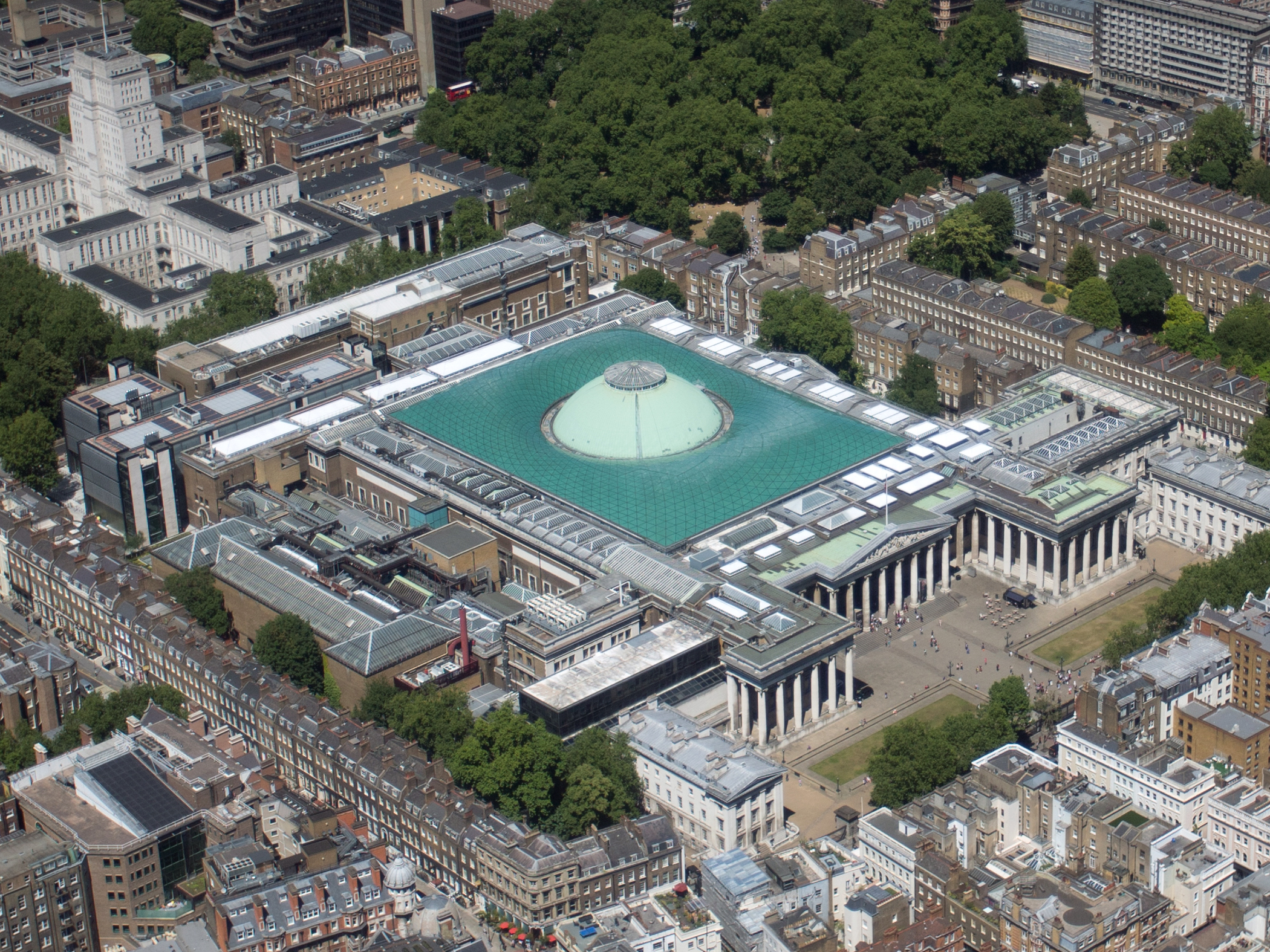
The museum's physical transformation has been as dramatic as its ethical one. The original Montagu House was replaced by Robert Smirke's Greek Revival building in the 1850s, its colonnaded facade becoming one of London's most recognizable architectural landmarks. In 2000, the Queen Elizabeth II Great Court opened: a vast two-acre indoor square designed by Norman Foster, roofed by a lattice of 3,312 glass panels, no two the same shape. At its center sits the restored Round Reading Room where Karl Marx researched Das Kapital and Virginia Woolf found her material. The Great Court transformed the museum's circulation, turning a cluttered backyard into Europe's largest covered public square. Free admission, established in 2001 after a brief experiment with charges, ensures that the collection remains accessible to anyone who walks through the gates.
A Museum That Cannot Stand Still
In 2023, the museum disclosed that approximately 2,000 items had been stolen or damaged by a staff member over a period of years -- a security breach that shook public confidence and led to the resignation of the director. The scandal raised uncomfortable questions about the museum's stewardship argument: if it could not protect its own collection from internal theft, how could it claim to be the safest repository for contested objects? The museum has since undertaken a comprehensive review of its storage and cataloguing practices. Meanwhile, the repatriation debate continues to evolve. Nigeria and Greece maintain their claims. Other nations have joined them. The British Museum remains a place of extraordinary power -- where a visitor can walk from Assyrian palace reliefs to Polynesian navigation charts in a single afternoon -- but it is no longer a place that can avoid the question of how all those objects arrived in Bloomsbury.
From the Air
The British Museum is located in Bloomsbury, central London (51.52N, 0.13W), identifiable from the air by its large Greek Revival colonnaded facade and the distinctive glass-roofed Great Court. It sits approximately 1km north of the Thames, between Tottenham Court Road and Russell Square. Nearest airports are London City (EGLC) 13km east and London Heathrow (EGLL) 25km west. The museum's footprint is one of the largest building complexes in central London.