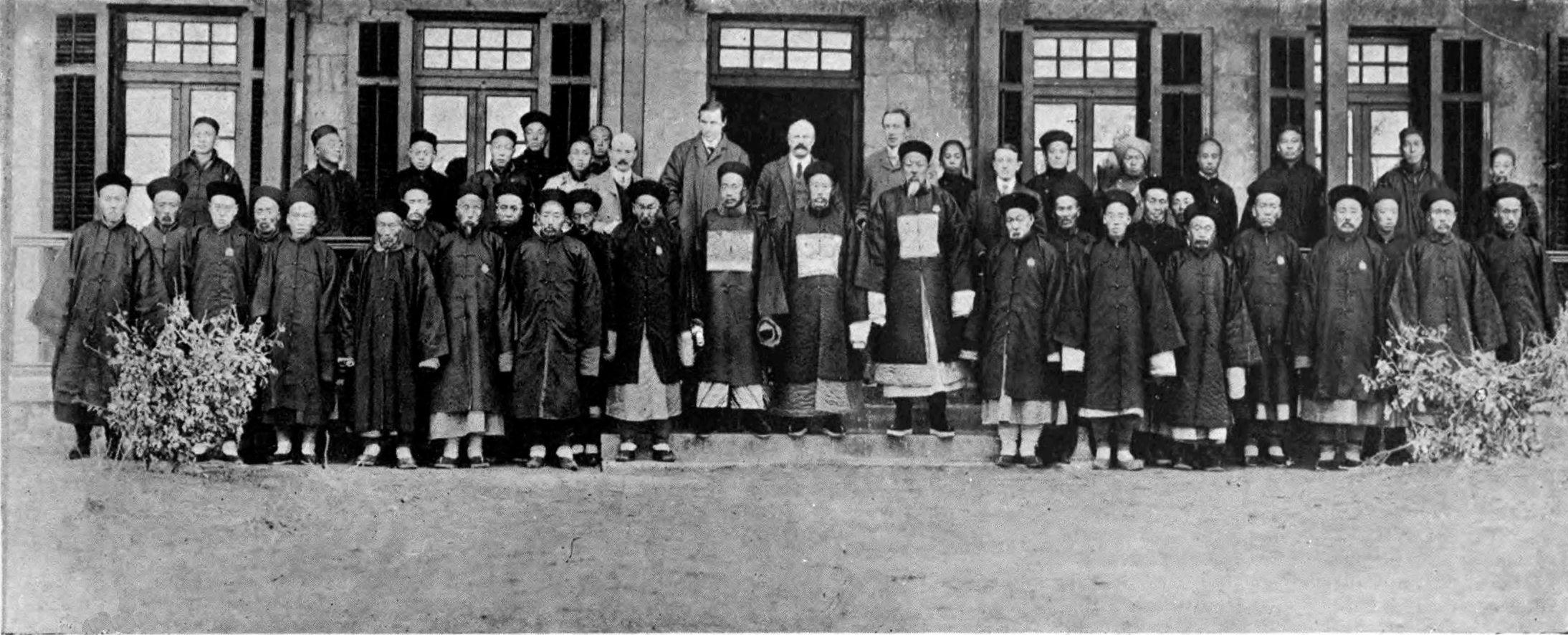
British Weihaiwei
British sailors called it "Way High." Officially, it was Weihaiwei -- a 288-square-mile leased territory on the northeastern coast of China that the United Kingdom held from 1898 to 1930. Unlike Hong Kong, which became one of the world's great cities under British administration, Weihaiwei remained a backwater: a summer anchorage for the Royal Navy, a health resort for British expatriates, and a geopolitical chess piece that served its purpose and was quietly returned. Its final commissioner was Reginald Fleming Johnston, the sinologist who had tutored China's last emperor, Pu Yi.
An Ultimatum in 48 Hours
The British acquisition of Weihaiwei was naked great-power maneuvering. On March 28, 1898 -- the day after Russia signed a convention granting itself a 25-year lease on Port Arthur to the north -- Sir Claude MacDonald, the British minister in Beijing, informed the Zongli Yamen that Britain demanded Weihaiwei on comparable terms. When China refused, MacDonald suggested that Britain might relent if China could persuade Russia to leave Port Arthur. Two days later, he issued a 48-hour ultimatum. On April 2, China capitulated. The lease was explicitly tied to Russia's presence at Port Arthur: Britain would hold Weihaiwei for as long as the Russians stayed. The British fleet raised the Union Jack on May 24, 1898.
A Colony That Never Quite Was
Weihaiwei occupied an awkward legal and administrative space. Normal British colonies operated under the British Settlements Act of 1887, but because Weihaiwei was a leased territory subject to return at any time, it was governed instead under the Foreign Jurisdiction Act of 1890 -- the same law that granted extraterritorial powers over British subjects in China. This distinction was not academic. It meant Weihaiwei was never developed like Hong Kong. Germany held the sphere of influence over Shandong Province, and Britain agreed through Arthur Balfour not to build a railway from Weihaiwei into the provincial hinterland. Local Chinese administration continued for most civil matters, and the port remained a free port until 1923. The British built residences, hospitals, churches, sports grounds, and a naval cemetery, but the grand colonial infrastructure that characterized Hong Kong never materialized.
The Commissioner and the Dragon Flag
The Commissioners of Weihaiwei initially flew a Union Jack adorned with a Chinese imperial dragon from the Qing dynasty flag. When Sir James Stewart Lockhart arrived as the first civilian commissioner in 1902, he wrote to the Colonial Office requesting that the dragon be replaced with Mandarin ducks, arguing that it was inappropriate to put a Chinese national symbol on a British flag. Lockhart served until 1921, overseeing the renaming of the administrative seat from Matou to Port Edward and developing the territory as a holiday resort. The Weihaiwei Regiment, formed in 1898 under Lieutenant-Colonel Hamilton Bower, served in the Boxer Rebellion before being disbanded in 1906. During World War I, the British recruited men from Weihaiwei into the Chinese Labour Corps to support the war effort on the Western Front.
Policemen for Hong Kong
In 1922, when a seamen's strike paralyzed Hong Kong, the colonial government turned to an unexpected source of law enforcement: Weihaiwei. Two European police officers traveled to the territory in September to recruit about 50 men as Royal Hong Kong Police constables. After six months of training on Shandong soil, the recruits shipped south to maintain order in a city they had never seen. Known as the D Contingent, their service numbers were prefixed with the letter D to distinguish them from European, Indian, and Cantonese officers. By 1927, they had been replaced by Indian recruits. The episode illustrates how Britain's scattered colonial possessions operated as an interconnected system, drawing resources from one outpost to manage crises in another.
A Quiet Return
Weihaiwei was returned to Chinese rule on October 1, 1930. On the transitional day, Commissioner Johnston flew the flag of the Republic of China alongside the Union Jack -- a gesture of orderly handover that contrasted with the coercive ultimatum that had begun British tenure 32 years earlier. China designated Weihaiwei a Special Administrative Region and assumed the commissioner's role. But one piece remained in British hands: the Chinese government leased Liugong Island to the Royal Navy for another ten years. That arrangement ended when Japan landed forces on the island on October 1, 1940. In 1909, Hong Kong's governor had proposed trading Weihaiwei for perpetual control of the New Territories, but the deal was never made. Hong Kong returned to China in 1997; Weihaiwei, its obscure sibling, had gone home 67 years earlier.
From the Air
British Weihaiwei occupied the area around modern Weihai at approximately 37.50N, 122.10E, at the northeastern tip of the Shandong Peninsula. Weihai Dashuibo Airport (ZSWH) serves the area. Liugong Island is visible in the harbor. The former leased territory extended 72 miles along the coastline to a depth of 10 miles inland, roughly corresponding to modern Weihai's Huancui District.