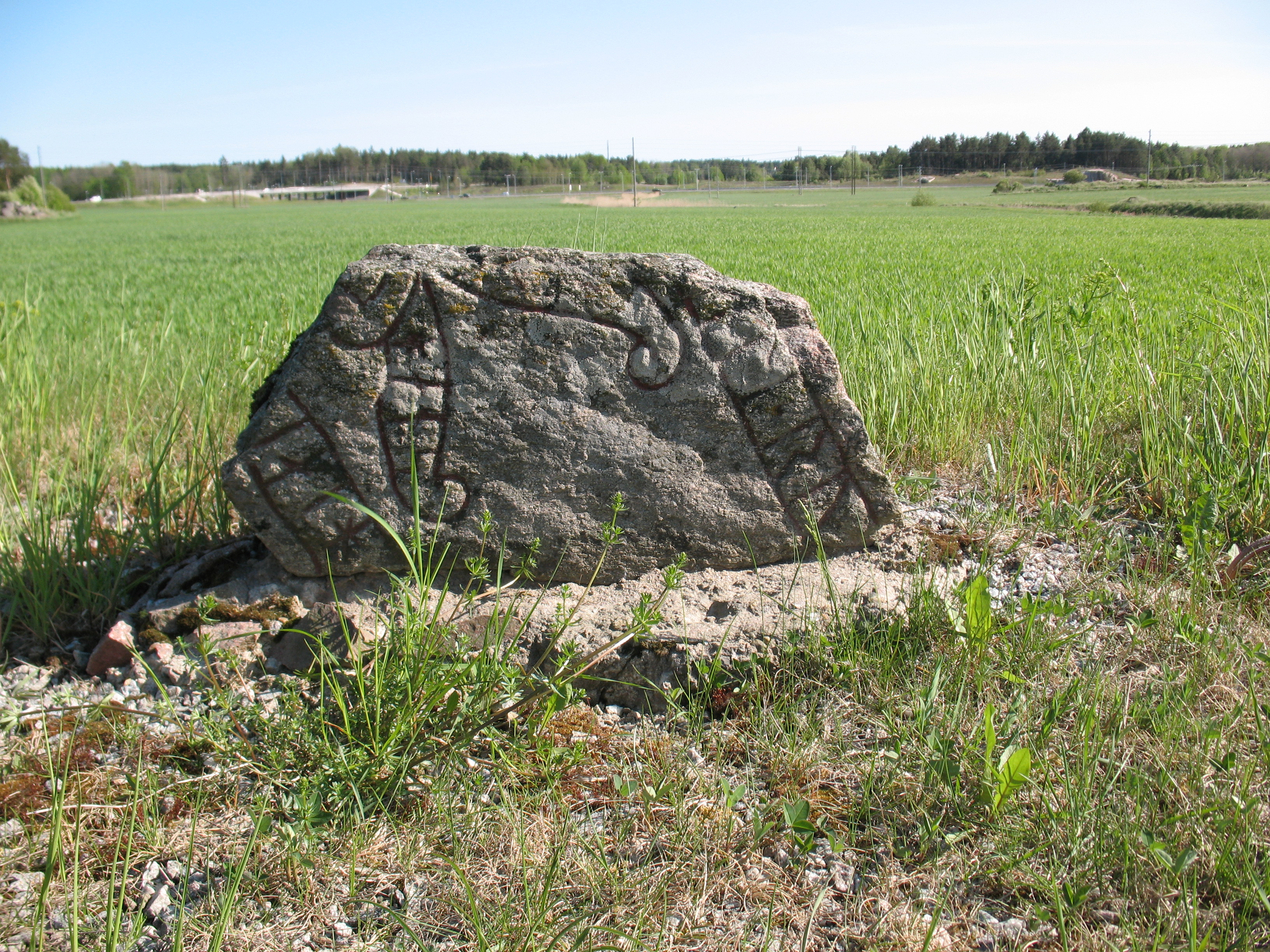
Broby bro Runestones
The name Estrid echoes across a thousand years of Swedish history. At Broby bro in Uppland, six granite slabs rise from the earth like pages from a family chronicle written in runes. These stones tell no tale of battles or conquests, but something more intimate: the story of a mother who outlived her husband and son, raising monuments that would preserve their memory long after the Viking Age faded into legend. Estrid would become the matriarch of one of medieval Sweden's most powerful clans, and these weathered stones at Broby bro form the opening chapter of that dynasty's story.
A Pilgrim's Journey East
Osten was no ordinary Viking. While his contemporaries sailed west to raid and trade, he turned his longship toward Jerusalem. The runestone U 136, raised by his widow Estrid, records his fate in stark Old Norse: he sought Jerusalem and died in the Greek realm. That single carved line captures an epic journey of thousands of miles, from the birch forests of Uppland through the rivers of Rus, past Constantinople, and into the Holy Land. Osten joined the thousands of Scandinavian pilgrims and warriors who traveled the Varangian trade routes during the 11th century, seeking either salvation or fortune in Byzantium. He found neither return voyage, leaving Estrid to memorialize him in stone.
The Weight of Grief
Before Osten departed for Jerusalem, tragedy had already struck the family. Runestone U 137, the oldest of the Broby bro monuments, was raised while Osten still lived. It commemorates their son Gag, who died young, his name forever uncertain to scholars who read the weathered runes as either Kag or Gag. When Estrid later commissioned stones for her husband, she omitted Gag from the list of their sons. Only three names appear: Ingefast, Osten, and Sven. The absence speaks volumes about Viking memorial conventions. Gag died too young to have accomplished anything worthy of mention alongside his brothers, who built both a bridge and a burial mound for their father.
Grandmother of an Empire
Estrid's story does not end at Broby bro. Her name appears on runestones scattered across Taby and surrounding parishes, tracing the expansion of her descendants' power. She was born in Snottsta, married Osten of Taby, and after his death in the Byzantine Empire, married again in Harg near her birthplace. Her grandson Jarlabanke would become the local strongman who boasted of owning all of Taby, his runestones among the most numerous in Sweden. The approximately 20 Jarlabanke Runestones form a web of family connections, political claims, and pious dedications that scholars still work to untangle. At the center of this web stands Estrid, the bridge between the age of eastern pilgrimages and the emergence of powerful Swedish landholding families.
Stone Sentinels
Three of the Broby bro runestones still stand by the roadside where travelers have passed for a millennium. The others, U 135, U 136, and U 137, have been moved a short distance to protect them from the pollution and vibrations of modern traffic. All three relocated stones date from the period 1020 to 1050, carved in the Pr2 style that marks the mature phase of Swedish runestone production. The serpentine bands that frame their inscriptions coil with the sophisticated interlace patterns that Scandinavian artists perfected during this era. Each letter was carefully picked into the granite, designed to be read by passersby who would speak the names aloud and keep the dead alive in memory.
Reading the Past
The Old Norse inscriptions preserve not just names but the rhythm of an ancient language. U 135 declares that Ingefast, Osten, and Sven had these stones raised for their father Osten, and they made this bridge and this mound. The practical and spiritual intertwined in Viking commemorations. Building a bridge earned merit for the souls of both the living and the dead, while the runestone ensured that travelers crossing would speak blessings for the departed. U 136 carries Estrid's voice directly: she had these stones raised for her husband Osten, who sought Jerusalem and died in Greece. A thousand years later, her words still travel across time to anyone who stops to read them.
From the Air
Located at 59.48N, 18.03E in Uppland, Sweden, approximately 20 kilometers northeast of Stockholm. The site sits along an ancient road near Taby Municipality. From the air, look for the cluster of runestones near the modern roadway. Nearest major airport is Stockholm Arlanda (ESSA) approximately 15 km to the north. Best viewed at low altitude (1000-2000 feet) in clear weather when the granite stones contrast with surrounding vegetation.