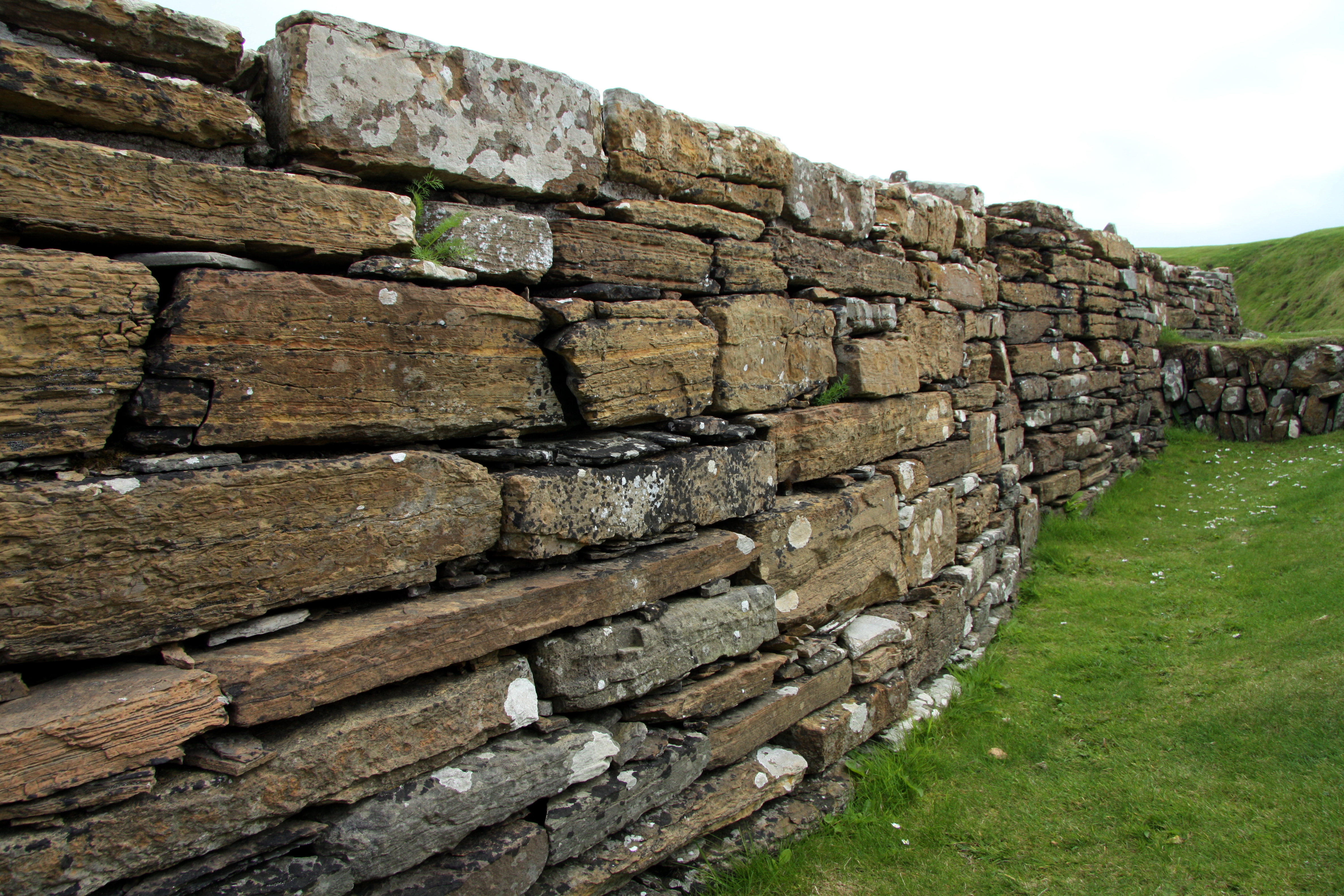
Broch of Gurness
In 1929, Robert Rendall -- an Orkney poet and naturalist better known for his shells than his archaeology -- was sketching on the northeast coast of Mainland Orkney when the leg of his stool broke through the grass into a void. What lay beneath was not a rabbit hole but the remains of an Iron Age village that had been hidden for centuries. The Broch of Gurness, overlooking Eynhallow Sound about fifteen miles northwest of Kirkwall, turned out to be one of Orkney's most substantial prehistoric settlements.
The Tower and Its Village
Settlement at Gurness began sometime between 500 and 200 BC. At its heart stood the broch itself -- a circular stone tower with walls up to 4.1 metres thick and remains still standing 3.6 metres high. The roof was probably conical or gently curved. Brochs are unique to Scotland, and their purpose has been debated for decades: defensive stronghold, status symbol, or community centrepiece. At Gurness, the answer seems to be all three. The tower was likely home to the principal family or clan of the area, but it also served as a last resort for the surrounding village in case of attack. Around it clustered the houses of a community substantial enough to require organisation -- a settlement with a hierarchy and a plan.
Concentric Defences
The village was not defenceless. Concentric ditches surrounded the settlement, creating rings of protection that any attacker would have had to cross before reaching the broch itself. The defensive layout suggests a community that took the possibility of conflict seriously, even if the coastline location also offered natural protection on one side. The buildings between the ditches and the tower include small stone houses whose foundations and internal divisions are still clearly visible -- rooms for sleeping, cooking, and storage that give a remarkably detailed picture of daily life more than two millennia ago. At some point after 100 AD, the broch was abandoned and the ditches filled in. The reasons are unknown.
Stone Against the Sound
Gurness overlooks Eynhallow Sound, the channel separating Mainland Orkney from the island of Rousay. The setting is windswept and exposed, the kind of landscape where building in stone was not an aesthetic choice but a practical necessity -- there are no trees in Orkney to speak of. The stone construction that makes brochs possible is also what makes them survive: walls built without mortar, using carefully selected and shaped flagstone, have lasted where timber would have rotted within decades. The broch sits on the coast as it has for over two thousand years, its stones weathered but intact, its proportions still legible against the Orkney sky. Now in the care of Historic Environment Scotland, it remains one of the most accessible and impressive Iron Age sites in the Northern Isles.
From the Air
Located at 59.12N, 3.08W on the northeast coast of Mainland Orkney, overlooking Eynhallow Sound. The circular broch and surrounding settlement are visible from low altitude as a distinct circular feature on the coastal headland. Nearest airport: Kirkwall (EGPA), approximately 15 miles southeast.