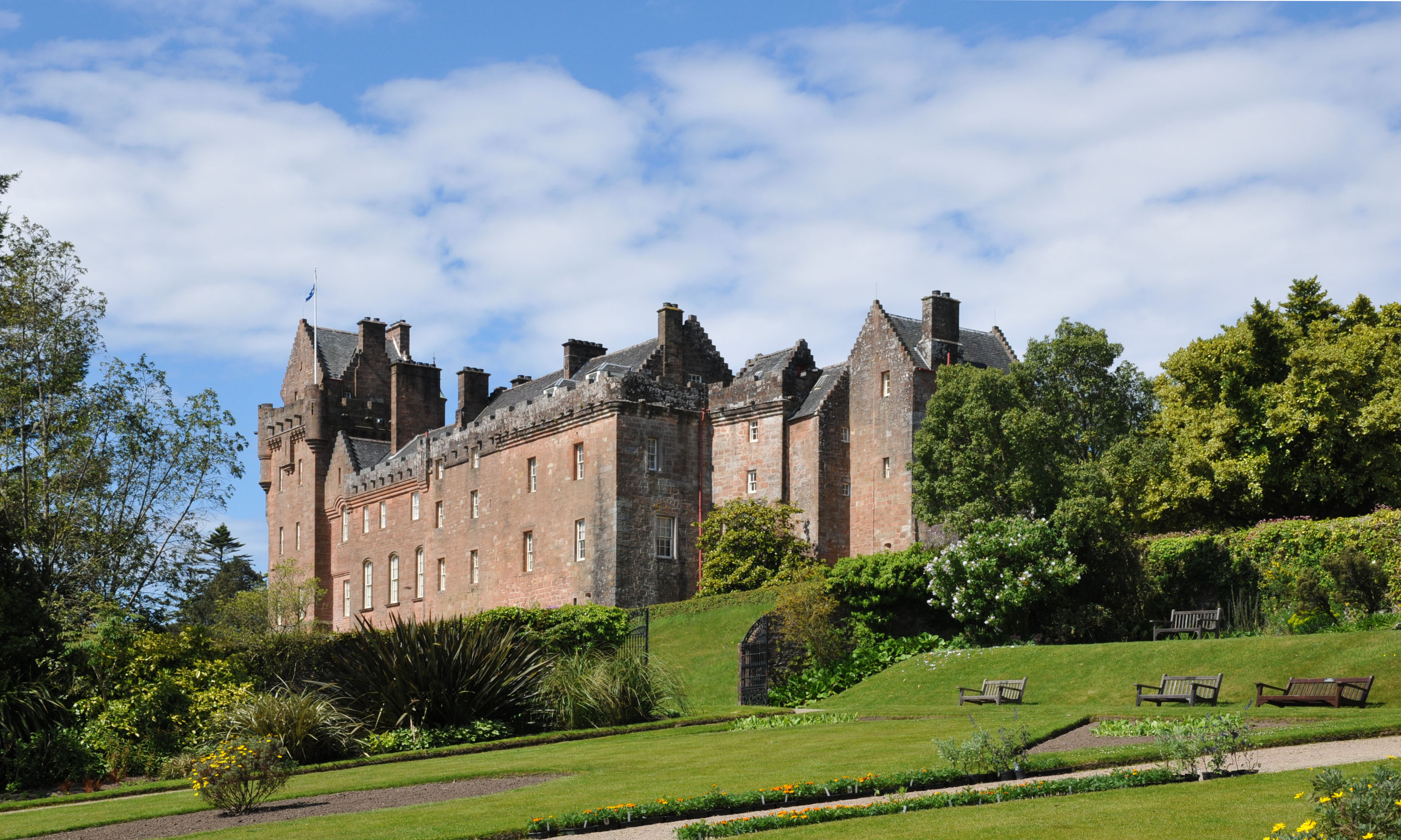
Brodick Castle
Robert the Bruce was hiding. It was the winter of 1306, and the newly crowned King of Scots had been defeated at the Battle of Methven, driven from the mainland, and was sheltering somewhere on the Isle of Arran. Legend says it was here -- on this island in the Firth of Clyde -- that he watched a spider repeatedly try and fail and try again to spin its web, and drew from its persistence the resolve to fight on. Whether or not the story is true, what happened next is documented: James Douglas, acting on Bruce's orders, attacked the English forces supplying Brodick Castle, and in January 1307, with Sir Robert Boyd of Kilmarnock, dislodged the English garrison. Brodick was one of the first castles to fall in Bruce's campaign to reclaim Scotland.
Broad Bay, Deep History
A fortress has stood at Brodick since at least the fifth century, when Gaelic invaders from Antrim expanded their kingdom of Dal Riata across the Irish Sea. The name Brodick comes from the Norse Breidvik -- Broad Bay -- reflecting centuries of Scandinavian control. By the mid-13th century, Arran was part of the Kingdom of Mann and the Isles, and in 1263 the Norwegian King Hakon Hakonarson anchored his invasion fleet in Lamlash Bay, just south of Brodick, before the inconclusive Battle of Largs. The ensuing Treaty of Perth in 1266 ceded the western isles to Scotland, and Brodick's strategic position on the Firth of Clyde ensured it would remain a prize worth fighting over for centuries to come.
The Hamilton Centuries
After 1470, James III granted Brodick to his brother-in-law James Hamilton, and the castle became the seat of the Earls of Arran and later the Dukes of Hamilton -- one of Scotland's most powerful noble families. The 2nd Earl served as Regent of Scotland during the infancy of Mary, Queen of Scots, and was rewarded with a French dukedom for arranging her marriage to the Dauphin. He enlarged and fortified Brodick accordingly. The castle changed hands repeatedly during the Wars of the Three Kingdoms: seized by the Campbells, recovered by the Hamiltons, lost again, and finally occupied by Cromwell's Roundheads in 1650, who added an artillery battery to defend the Firth.
Napoleon's Step-Granddaughter and a Victorian Expansion
In 1843, the 11th Duke of Hamilton married Princess Marie of Baden, whose grandmother was Stephanie de Beauharnais, the adopted daughter of Napoleon Bonaparte. A year later, the Duke commissioned architect James Gillespie Graham to almost triple the size of the castle, transforming it from a fortified tower house into the baronial mansion that stands today. The 12th Duke, having no male heirs, entailed the castle upon his daughter Lady Mary Louise Douglas-Hamilton, who married the 6th Duke of Montrose in 1906. After more than five hundred years, the Hamilton name left Brodick -- though the castle's stories remained.
Bletchley Park to the National Trust
The castle was given to the National Trust for Scotland in 1958 by Lady Jean Fforde, in lieu of death duties following her mother's death. Lady Jean, who had worked at Bletchley Park during the Second World War breaking enemy codes, described losing the castle and its contents as 'like losing my whole life.' Today the castle is open to visitors in summer, with Brodick Country Park accessible year-round. The walled garden, built in 1710, contains bee boles -- niches for straw beehives -- that predate the castle's Victorian expansion. An illustration of Brodick has appeared on Royal Bank of Scotland twenty-pound notes since 1972. Within these walls, you can trace the history of Scotland itself: from Gaelic kings and Norse invaders through the Wars of Independence, the Reformation, the Civil Wars, and the slow transformation of a fighting fortress into a family home, and finally into a place where that history is shared with the quarter of a million people who visit Arran each year.
From the Air
Brodick Castle is at 55.59N, 5.15W on the east coast of the Isle of Arran in the Firth of Clyde, just north of the port town of Brodick. The castle sits on elevated ground overlooking Brodick Bay with Goatfell (874m), Arran's highest peak, rising behind it. The island is accessible by ferry from Ardrossan. Nearest airports: Glasgow Prestwick (EGPK, 25nm east across the Firth) and Glasgow (EGPF, 40nm northeast). Brodick Bay and the dramatic mountain profile of northern Arran are unmistakable from altitude.