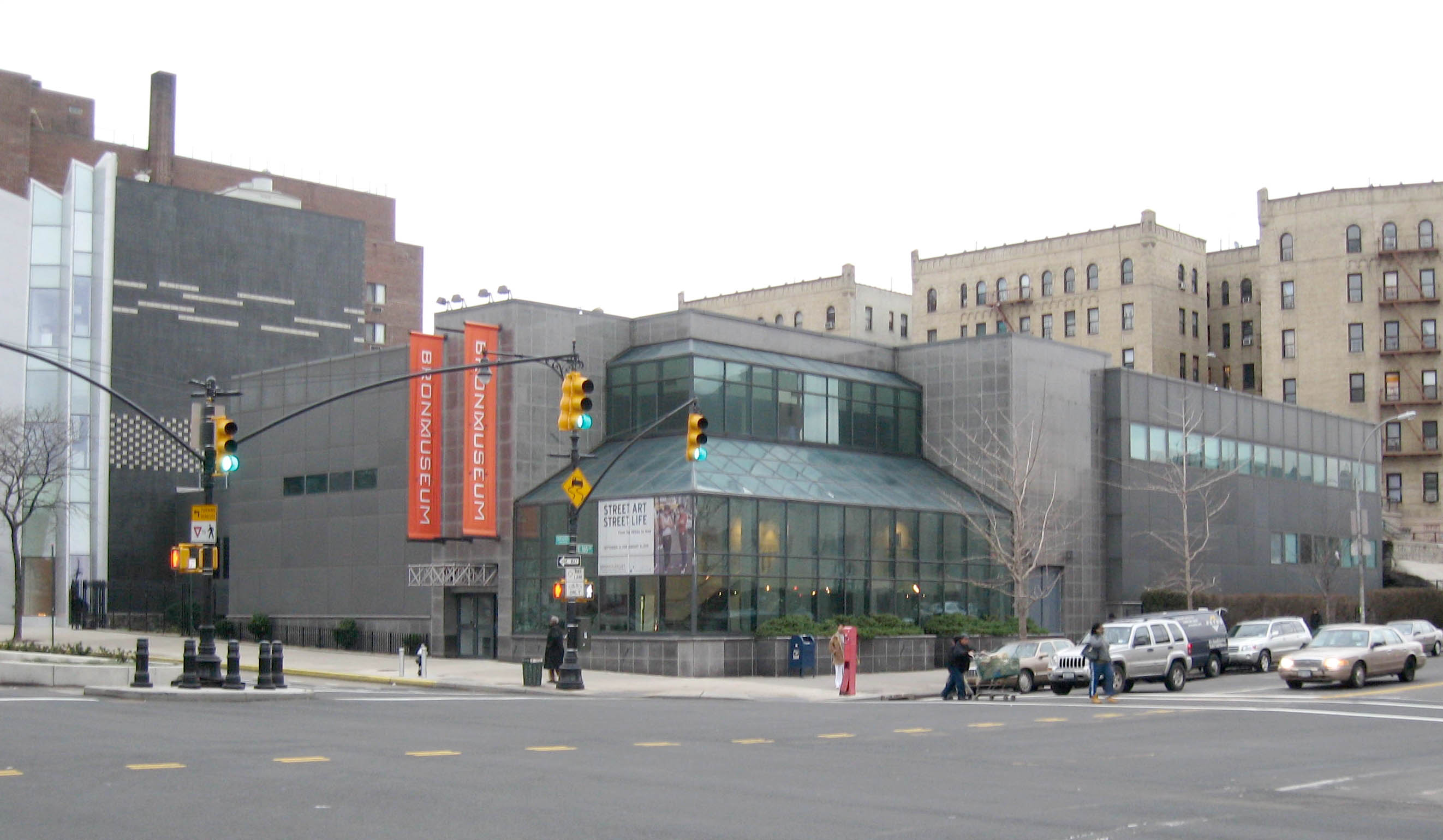
Bronx Museum of the Arts
The first exhibition consisted of 28 paintings borrowed from the Metropolitan Museum of Art. It was May 11, 1971, a borough-wide celebration called Bronx Day, and a small museum was opening at the corner of 165th Street and the Grand Concourse with the ambitious goal of stirring interest in the arts across an entire borough. The South Bronx in 1971 was deep in the crisis that would define it for a generation -- buildings burning, population fleeing, city services collapsing. Irma Fleck, a member of the Bronx Council on the Arts, believed a museum could push back against that decline. More than five decades later, the Bronx Museum of the Arts is still there, still pushing.
Art Where the Fires Were
The museum's founding was an act of deliberate defiance against the narrative that the South Bronx was beyond saving. Fleck and the Bronx Council on the Arts, founded in 1961, partnered with the Metropolitan Museum of Art to create an outpost that would bring world-class work to a neighborhood that had no reason to expect it. The early years were modest -- borrowed paintings, temporary spaces. In the early 1980s, the museum moved into a converted building on the Grand Concourse, fitted out with concrete, steel, and glass at a cost of $2 million. An expansion and renovation in 1988 cost $5.8 million and added exhibition space. The building's exterior features black and white concrete blocks arranged in geometric patterns that echo the brick facades of Bronx rowhouses and commercial buildings, a design choice that roots the museum in the visual language of its neighborhood.
From Borrowed Paintings to the Venice Biennale
The museum's ambitions grew steadily beyond its humble origins. In 1987, it mounted a career retrospective of Romare Bearden, the African American artist whose collages and paintings captured Black urban life with extraordinary depth. That same year, it presented an early exhibition of computer-generated art, positioning itself at the edge of a new medium. In 2006, the show "Tropicalia: A Revolution in Brazilian Culture" brought Latin American avant-garde history to the Concourse. The museum's biggest coup came in 2013, when it won a competition to represent the United States at the Venice Biennale, commissioning "Triple Point," an installation by artist Sarah Sze. For a museum that had started with loaner paintings in a borough most New Yorkers avoided, Venice was confirmation that the Bronx had something to say to the world.
Free to All
On March 29, 2012, the museum dropped its admission fee entirely, making every day free for all visitors. Previously, only Fridays had been free. The decision reflected the institution's core mission: art should be accessible to the communities it serves. In 2008, a 3,000-square-foot education center had been added to serve local schoolchildren and their families. The museum annually hosts "The Artist in the Marketplace" program, where emerging artists are selected by a panel of professionals for networking and mentorship, culminating in an exhibition. In 2013, the museum completed a campaign to raise $1 million specifically for acquiring works by contemporary artists with strong connections to the Bronx. Once funded almost entirely by government grants, the museum now relies mainly on corporations, foundations, and private donors to sustain its $3.5 million operating budget.
Building for the Next Fifty Years
The museum has never stopped evolving physically. In 2016, it announced a $25 million renovation and expansion plan along with a $10 million endowment, with architect Monica Ponce de Leon overseeing the design and $7 million coming from the office of Mayor Bill de Blasio. The plan shifted hands to Marvel Architects by 2022, and construction finally began in July 2024 at a projected cost of $33 million. The museum sits slightly northeast of Yankee Stadium on the Grand Concourse, part of the Grand Concourse Historic District, an Art Deco boulevard that was once called the Champs-Elysees of the Bronx. Leadership has seen its own transitions: founding director Irma Fleck gave way to Holly Block, who led from 2006 until her death in 2017, followed by Deborah Cullen and then Klaudio Rodriguez, who became executive director in 2020 after coming from the Frost Art Museum at Florida International University. Through every change, the museum's purpose has remained constant -- making art matter in a place where people need it most.
From the Air
Located at 40.831N, 73.920W at the corner of 165th Street and the Grand Concourse in the Concourse neighborhood of the South Bronx. Yankee Stadium is approximately 0.5nm to the southwest. The Grand Concourse is a wide boulevard running north-south through the Bronx, visible from altitude. Nearest airports: LaGuardia (KLGA) 4nm east, Teterboro (KTEB) 9nm west. Best viewed at 2,000-3,000 ft AGL.