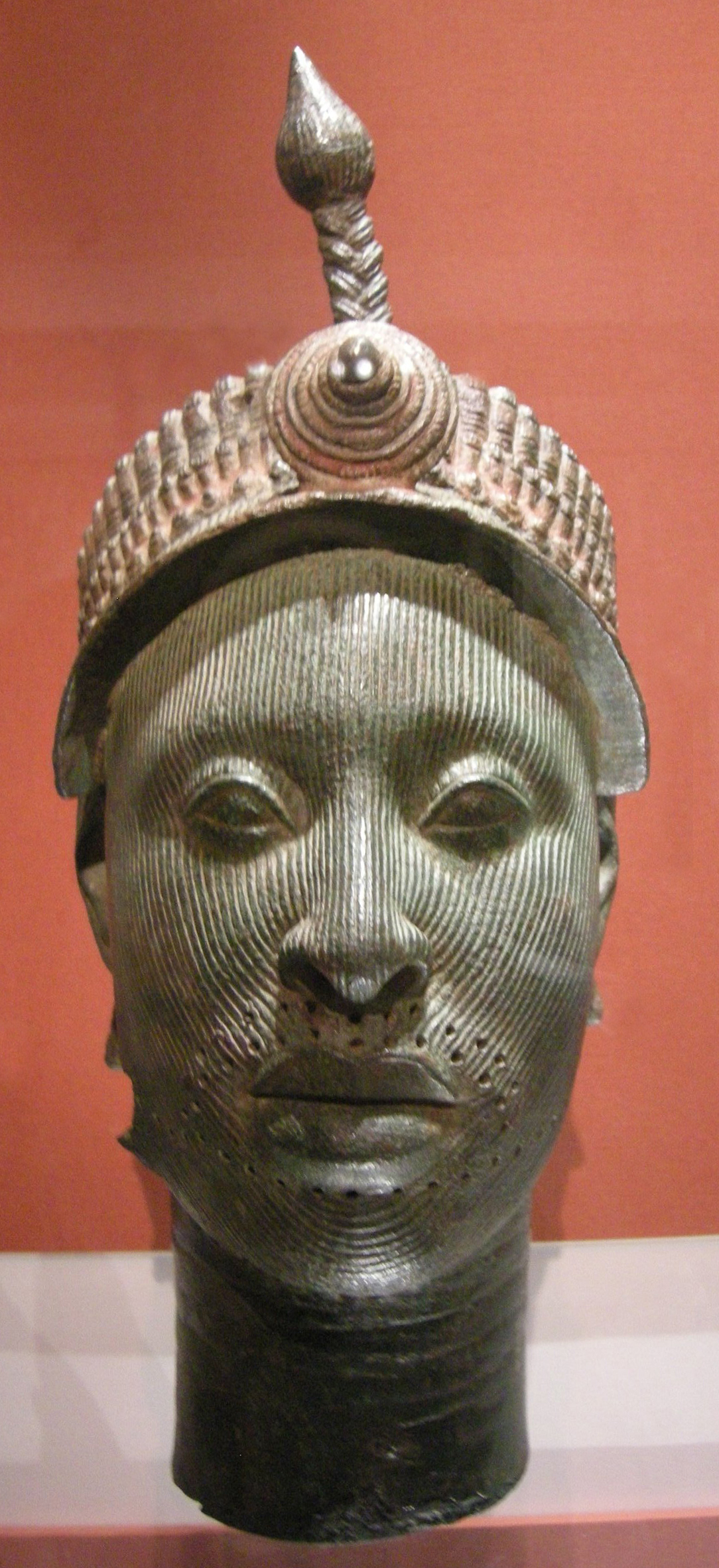
Bronze Head from Ife
When workers digging foundations for a new house at the Wunmonije Compound in Ife struck metal in 1938, they unearthed something that would upend an entire continent's art history. Among seventeen brass and copper heads buried in the soil of this Yoruba holy city lay a portrait so naturalistic, so technically accomplished, that European scholars refused to believe Africans had made it. The German ethnologist Leo Frobenius, who had encountered similar pieces years earlier, proposed they must be the work of a lost colony of ancient Greeks -- and suggested Ife itself might be the origin of the Atlantis legend. He was wrong on every count. The Bronze Head from Ife, as it came to be known, is the product of an indigenous West African artistic tradition that reached extraordinary heights of realism centuries before the European Renaissance.
A Face Across Seven Centuries
The head stands 35 centimeters tall, roughly three-quarters life-size, cast in copper alloy using the lost-wax technique. Fine parallel striations cover the face -- delicate incised lines that scholars believe represent either scarification patterns or the texture of a beaded veil, though the smooth, unmarked lips suggest a deliberate artistic choice rather than a simple rendering of skin. The crown is a marvel of observation: layered tubes of beads, tassels, and a rosette-topped crest with a plume now slightly bent to one side. Traces of red and black paint cling to the crown's surface, hinting at the original polychrome effect. The sculpture is believed to depict an Ooni, the traditional ruler of Ife, and was likely commissioned under the patronage of King Obalufon Alayemore, whose famous life-size copper face mask shares unmistakable stylistic kinship with this work. Among the Yoruba today, Obalufon is venerated as the patron deity of brass casters.
The Holy City Where Humans Were Made
Ife holds a singular place in Yoruba cosmology. This is where the deities created humanity -- where the world began. That spiritual centrality translated into temporal power. During the 14th and 15th centuries, when the Bronze Head was likely cast, Ife thrived as a prosperous city-state, its wealth built on trade networks extending along the River Niger throughout West Africa. The sculptural tradition that produced this head did not emerge from nowhere. Centuries of terracotta work preceded the shift to metal, and Ife's bronze casters operated within a broader constellation of West African artistic cultures: the Nok of central Nigeria, the Igbo-Ukwu in the southeast, the Bura of Niger, the Koma of Ghana, and the Jenne-Jeno of Mali. Each developed distinctive approaches to figurative art across a timespan stretching from the 3rd century to the 15th century CE. The Ife tradition stands out for its startling naturalism -- faces that look like portraits of specific individuals, not generalized types.
Atlantis, Racism, and Art History
The story of how Europeans received these sculptures is a story about prejudice. When Frobenius first encountered Ife bronzes, Western scholars simply could not accept that sub-Saharan Africa had produced art of this refinement. Rather than revise their assumptions, they invented explanations: a lost Greek colony, the remnants of Atlantis. Frobenius's Atlantis theory, widely circulated in the popular press, reflected the deep investment European academia had in denying African civilizational achievement. The art itself made the denials untenable. As more pieces surfaced and dating techniques improved, the evidence became overwhelming: these were the work of Yoruba artists operating within a sophisticated, centuries-old tradition. The recognition came slowly, but it came. Today the Ife sculptural tradition is acknowledged as one of the great achievements of medieval world art.
A Head in London, a Legacy in Question
The particular head that ended up in the British Museum traveled a circuitous route. H. Maclear Bate, editor of the Daily Times of Nigeria, acquired it from the 1938 excavation and likely sold it to the National Art Collections Fund, which passed it to the British Museum in 1939. Two other heads from the same discovery were sent to America. The hemorrhaging of Nigerian cultural patrimony spurred the colonial government to enact export controls on antiquities that same year -- too late for these pieces. The head became a symbol of Nigerian identity abroad: it served as the emblem for the 1973 All-Africa Games in Lagos and featured prominently in the British Museum's 2010 exhibition "Kingdom of Ife," mounted in partnership with Nigeria's National Commission for Museums and Monuments to mark 50 years of Nigerian independence. In 2011, the BBC and British Museum selected it as one of their "History of the World in 100 Objects." The question of where it belongs -- in London or Ife -- remains unresolved.
From the Air
Located at 7.47N, 4.56E in the ancient Yoruba city of Ile-Ife, Osun State, southwestern Nigeria. The Wunmonije Compound excavation site sits within the city center. Nearest airport is Akure Airport (DNAK), approximately 40 km to the east. At low altitude, the dense urban fabric of Ife is visible, though the specific archaeological sites require ground-level identification. The surrounding terrain is relatively flat tropical lowland.