The Brooke Hart Kidnapping and San Jose Lynching
On the evening of November 9, 1933, Brooke Hart pulled his graduation-present Studebaker out of a downtown San Jose parking lot to pick up his father for a Chamber of Commerce dinner. He never arrived. What followed over the next eighteen days would grip California in a saga of ransom calls, desperate searches, and finally, a mob of 15,000 citizens storming the Santa Clara County Jail while a Los Angeles radio station broadcast the lynching live to listeners across the state.
The Heir to Hart's Department Store
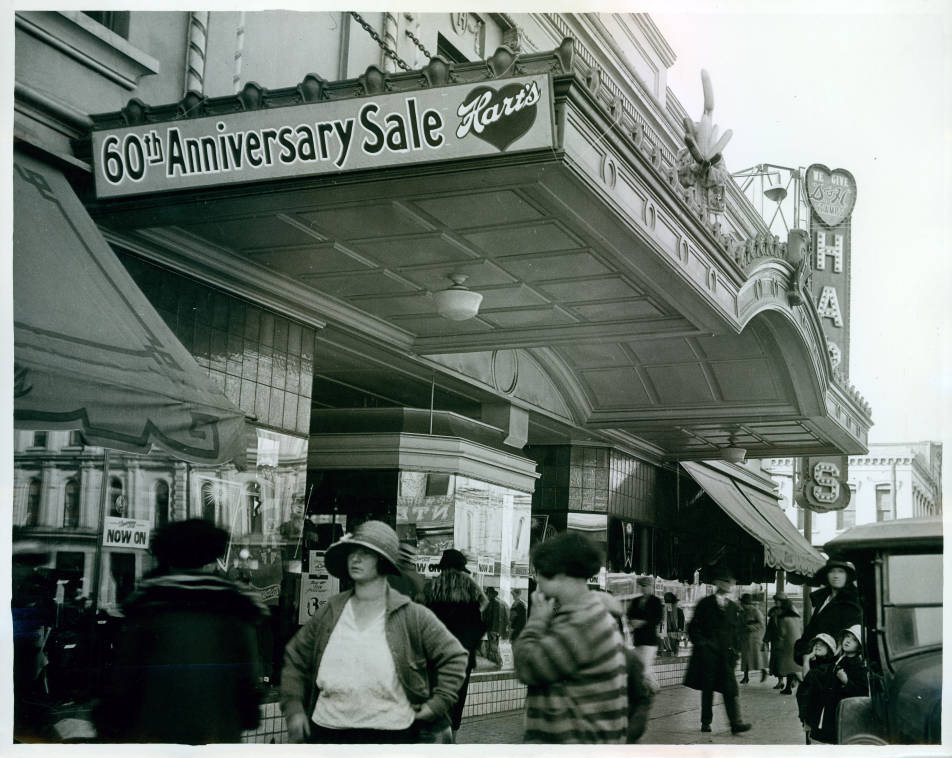
At 22, Brooke Hart was being groomed to inherit an institution. His grandfather Leopold, an Alsatian immigrant, had purchased a mercantile shop called the Cash Corner in 1866. Under Brooke's father, A.J. Hart, the L. Hart & Son department store grew into a San Jose landmark, as central to the city's identity as Macy's was to New York. The Hart family wielded such influence that local legend claimed the artist who repainted the Cathedral Basilica of St. Joseph in the 1920s modeled its cherubs on the Hart children. Brooke had worked in the store since youth, graduated from Santa Clara University, and accepted a position as junior vice president. He was punctual, responsible, and well-liked.
Eighteen Days of Ransom Calls
The kidnappers demanded $40,000, equivalent to nearly a million dollars today. They called repeatedly, insisting A.J. Hart drive to deliver the ransom. There was a problem: A.J. had never learned to drive. A sign went up in the store window explaining this. The family chartered an airplane to search the hills near Milpitas, where Brooke's abandoned Studebaker had been found with its lights still on. Letters arrived with instructions to install a radio in the car, unaware it already had one. Phone taps traced calls to a San Francisco hotel, then to a downtown San Jose garage, but each time the caller vanished before police arrived.
Arrest at the Payphone
On November 16, another call came demanding the ransom. Police traced it to a parking garage at Market near San Antonio, just blocks from the station. Police Chief J.N. Black and Sheriff William Emig arrived to find Thomas Harold Thurmond hanging up the payphone. Under interrogation, Thurmond and his accomplice John Holmes confessed. They had intercepted Brooke near Milpitas, struck him twice on the head with a concrete block, bound his arms with baling wire, tied concrete blocks to his feet, and thrown him from a bridge into San Francisco Bay. Two men scavenging for wood had heard screams for help that night at 7:25 p.m., coming from near the Dumbarton crossing.
A Governor's Endorsement
Sheriff Emig moved the suspects to San Francisco for safekeeping as lynch threats mounted. When Brooke's badly decomposed body washed ashore on November 26, the crowds outside the Santa Clara County Jail swelled. The next night, November 26, a mob estimated at 15,000 people stormed the jail, battered down doors with a pipe, and dragged Thurmond and Holmes to St. James Park across the street. They were hanged from mulberry trees. Governor James Rolph Jr. refused to send the National Guard and publicly endorsed the lynchings, declaring he would pardon anyone convicted for participating. A Los Angeles radio station broadcast the event live.
The Aftermath in St. James Park
No one was ever prosecuted for the lynching. Royce Brier of the San Francisco Chronicle won a Pulitzer Prize for his coverage of the event. The Hart family buried Brooke at Oak Hill Memorial Park and retreated from public life. St. James Park, where the hangings occurred, still sits across from where the old county jail once stood in downtown San Jose. The case became a touchstone in debates about vigilante justice, with Holmes's parents maintaining their son's innocence to the end. Governor Rolph's endorsement of the mob action drew national condemnation, though it did little to diminish his popularity in California.
From the Air
The events centered on San Jose, California, at approximately 37.47N, 121.99W. St. James Park, site of the lynching, lies in downtown San Jose near the intersection of North First and St. James Streets. The Dumbarton Bridge area where Hart's body was thrown into the bay is visible to the north, crossing the southern end of San Francisco Bay. Nearest airports: Reid-Hillview (KRHV, 4nm SE), San Jose International (KSJC, 3nm NW), Palo Alto (KPAO, 12nm NW). Best viewed at 2,000-3,000 feet AGL for context of the route between downtown San Jose and the bay.