Brookgreen Gardens
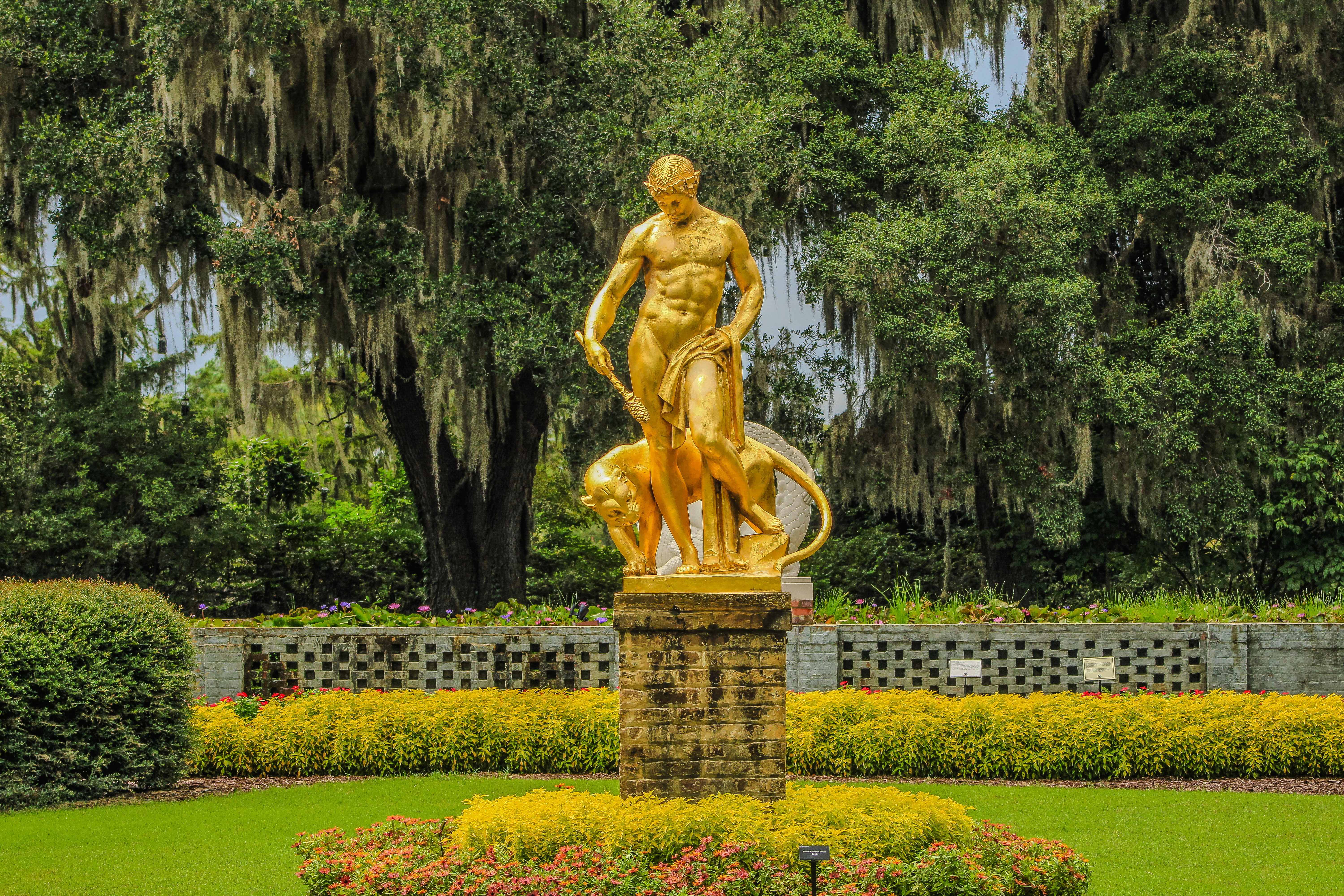
A bronze Diana draws her bow beneath live oaks draped in Spanish moss, frozen mid-hunt in a garden that was once a rice plantation worked by more than a thousand enslaved people. Brookgreen Gardens occupies a strip of Waccamaw Neck in Georgetown County, South Carolina, wedged between the Waccamaw River and the Atlantic Ocean. Opened in 1932, it was America's first public sculpture garden -- and it remains the largest collection of figurative sculpture by American artists displayed outdoors anywhere in the world, with roughly 1,445 works set among themed gardens, fountains, and Lowcountry landscape. The place is simultaneously a celebration of American art and an encounter with the layered, often painful history of the Carolina coast.
Plantations Beneath the Garden Paths
Before the sculptures arrived, four rice plantations occupied this land: The Oaks, Brookgreen, Springfield, and Laurel Hill. The gardens take their name from the Brookgreen Plantation, owned by Joshua John Ward, whose estate held more than 1,000 enslaved African Americans and was, by 1860, the largest slaveholding operation in the United States. Only scattered relics survive from that era. The Alston cemetery on The Oaks plantation grounds holds the grave of Governor Joseph Alston and a memorial to his wife, Theodosia Burr Alston -- daughter of Vice President Aaron Burr -- who was lost at sea and whose ghost, legend has it, still haunts the Grand Strand. The rice mill at Laurel Hill is all that remains of that plantation. During the Civil War, Confederate soldiers raised earthworks here to block Union Navy vessels from entering the tidal rivers.
A Sculptor's Vision Takes Root
Archer and Anna Hyatt Huntington first visited the area in 1929. Archer, the stepson of railroad magnate Collis Potter Huntington, was a scholar of Hispanic culture and a philanthropist. Anna was already among the most prominent sculptors in America -- her Joan of Arc stands in New York City's Riverside Park. They purchased the four plantations, intending to build a winter home on the coast. But Anna saw something larger in the property. What began as a personal retreat became a public showcase for American figurative sculpture, with Anna's own works forming the core of the collection alongside pieces by artists ranging from Augustus Saint-Gaudens and Gutzon Borglum to Janet Scudder and Donald De Lue. Archer's wealth and Anna's artistic ambition transformed abandoned rice fields into one of the great cultural landscapes of the American South.
Where Sculpture Meets the Lowcountry
Walking the garden paths, you move between carefully composed outdoor galleries -- bronzes in fountain settings, marble figures framed by magnolias, works by more than thirty sculptors linked by winding walkways and garden vistas. The property was listed on the National Register of Historic Places in 1978. Beyond the sculpture gardens, the Lowcountry Trail follows a boardwalk across the hillside overlooking Mainfield, a restored rice field. For enslaved workers on the Brookgreen Plantation, this hillside separated the world of daily labor from the slave village beyond the crest. Archaeological excavations have uncovered the foundations of an overseer's residence, a kitchen, a smokehouse, and a dependency. Stainless steel figures by Babette Bloch now stand along the trail, representing the plantation owner, the overseer, and two enslaved individuals -- a quiet, powerful counterpoint to the classical bronzes in the garden.
Living Landscape
Brookgreen is more than a sculpture park. The Lowcountry Zoo houses native wildlife, and trekker tours thread the back roads of the former plantations where ongoing archaeological work continues to uncover building foundations and artifacts. Over 2,000 species of life have been identified on the property, from longleaf pines to the alligator named Cowboy who became a minor celebrity at the zoo. The Atlantic coast side of the property was leased to South Carolina in 1960 to form Huntington Beach State Park. Each winter, the Nights of a Thousand Candles transforms the gardens into a luminous spectacle, with more than 2,700 candles and thousands of lights set among the trees and sculptures -- an event that has earned recognition among the nation's best botanical garden holiday displays.
From the Air
Brookgreen Gardens sits at 33.52N, 79.10W on Waccamaw Neck in Georgetown County, South Carolina. From the air, the property appears as a large green expanse between US-17 and the Waccamaw River, with Huntington Beach State Park and the Atlantic coastline directly to the east. The sculpture gardens occupy the central portion, while restored wetlands and former rice fields are visible to the west. Nearest airports: Myrtle Beach International (KMYR) approximately 18nm northeast, Georgetown County Airport (KGGE) about 14nm south. Best viewed at 2,000-4,000 feet AGL. The live oak canopy and garden clearings are distinctive from altitude.