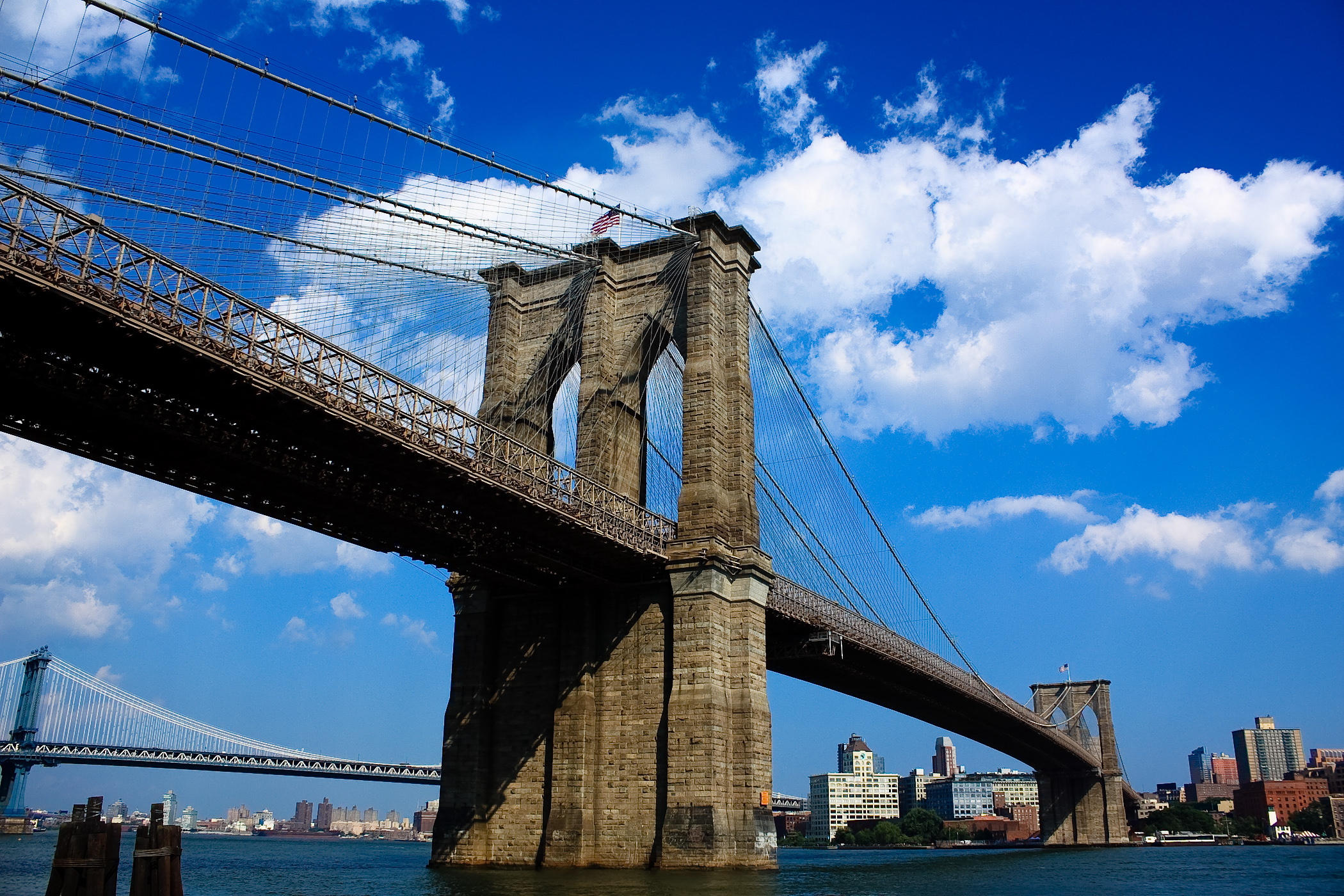
The Brooklyn Bridge: The Wonder That Killed Its Builder
The Brooklyn Bridge took 14 years to build, killed its chief engineer, paralyzed his son, and claimed the lives of at least 27 workers. When it opened on May 24, 1883, it was the longest suspension bridge in the world and the first to use steel cables - an engineering marvel that connected Manhattan and Brooklyn across the East River. The men who built it worked underwater in pressurized caissons, emerging with 'caisson disease' (the bends) that crippled many. The bridge that cost so much blood and treasure became an American icon. 140 years later, it still carries over 100,000 vehicles daily.
The Vision
John Roebling was America's foremost bridge builder when he proposed spanning the East River in 1867. The river was too wide, too deep, and too busy for a conventional bridge. Roebling designed something revolutionary: a suspension bridge with towers taller than any structure in New York, cables of steel wire (not iron), and a span of 1,595 feet.
Skeptics said it couldn't be done. Roebling never got to prove them wrong. While surveying the site in 1869, a ferry crushed his foot against the dock. He developed tetanus and died three weeks later. His son Washington took over.
The Caissons
The bridge towers had to rest on bedrock beneath the riverbed. Workers descended into massive wooden boxes (caissons), pumped full of compressed air to keep water out, and dug through mud and rock by candlelight. The conditions were hellish: cramped, dark, dangerous.
As the caissons descended deeper, workers began suffering 'caisson disease' - the bends, caused by nitrogen bubbles forming in the blood during decompression. No one understood the cause. Men emerged paralyzed, bleeding from the ears, sometimes dead. Washington Roebling himself was crippled by the bends in 1872.
The Supervision
Washington Roebling never returned to the construction site. From his bedroom overlooking the river, he watched through a telescope and directed work through his wife Emily. She carried messages, learned engineering, and became the de facto chief engineer - an unprecedented role for a woman.
Emily Roebling mastered materials science, cable mathematics, and construction management. She dealt with contractors, politicians, and skeptical board members. When the bridge opened, she was the first to cross it. Her contribution was finally recognized - a plaque on the bridge honors her today.
The Opening
The Brooklyn Bridge opened on May 24, 1883. President Chester Arthur walked across. Emily Roebling rode a carriage carrying a live rooster as a symbol of victory. An estimated 150,000 people crossed on opening day. The impossible bridge was reality.
But tragedy followed quickly. On May 30, 1883, a woman stumbled on the stairs, someone shouted 'The bridge is falling!' and panic ensued. Twelve people were crushed to death in the stampede. The bridge was solid - the terror was unfounded. Human fear, not engineering failure, claimed those lives.
The Icon
The Brooklyn Bridge was the longest suspension bridge in the world for 20 years. It proved that steel cables could span vast distances, enabling future bridges like the Golden Gate. Its Gothic towers became New York icons, symbols of a city reaching toward the future.
Today, the bridge carries six lanes of traffic, pedestrians, and cyclists. Engineers have reinforced and repaired it, but the original steel cables still bear the load. The bridge that killed its builders has outlived everyone who doubted it. The Roeblings' monument stands, connecting two boroughs across the river that nearly claimed it.
From the Air
The Brooklyn Bridge (40.71N, 73.99W) spans the East River between Manhattan and Brooklyn. LaGuardia Airport (KLGA) is 12km northeast. The bridge's Gothic towers and suspension cables are distinctive from the air. The bridge is one of several East River crossings, identifiable by its stone towers. Weather is temperate continental with four seasons.